



 Chat with AI
Exam 16: The Evolution of Biodiversity

Exam 1: The Nature of Science and the Characteristics of Life80 Questions
Exam 2: The Chemistry of Life93 Questions
Exam 3: Cell Structure and Internal Compartments89 Questions
Exam 4: Cell Membranes, Transport, and Communication89 Questions
Exam 5: Energy, Metabolism, and Enzymes85 Questions
Exam 6: Photosynthesis and Cellular Respiration89 Questions
Exam 7: Cell Division84 Questions
Exam 8: Cancer and Human Health86 Questions
Exam 9: Patterns of Inheritance86 Questions
Exam 10: Chromosomes and Human Genetics77 Questions
Exam 11: DNA and Genes83 Questions
Exam 12: From Gene to Protein88 Questions
Exam 13: DNA Technology96 Questions
Exam 14: How Evolution Works72 Questions
Exam 15: The Origin of Species76 Questions
Exam 16: The Evolution of Biodiversity102 Questions
Exam 17: Biological Diversity, Bacteria, and Archaea80 Questions
Exam 18: Protista, Plantae, and Fungi83 Questions
Exam 19: Animalia80 Questions
Exam 20: The Biosphere88 Questions
Exam 21: Growth of Populations70 Questions
Exam 22: Animal Behavior82 Questions
Exam 23: Ecological Communities105 Questions
Exam 24: Ecosystems74 Questions
Exam 25: Global Change73 Questions
Exam 26: Internal Organization and Homeostasis75 Questions
Exam 27: Nutrition and Digestion81 Questions
Exam 28: Circulation and Gas Exchange77 Questions
Exam 29: Animal Hormones79 Questions
Exam 30: Nervous and Sensory Systems76 Questions
Exam 31: Skeletons,Muscles,and Movement77 Questions
Exam 32: The Immune System80 Questions
Exam 33: Reproduction and Development86 Questions
Exam 34: Plant Structure, Nutrition, and Transport80 Questions
Exam 35: Plant Growth and Reproduction81 Questions
Select questions type


Members of all of Earth's different species (past and present)have been (or will be)converted into some type of fossil after their death.
(True/False)
4.9/5  (85)
(85) Which of the following groups of animals evolved the most recently?
(Multiple Choice)
4.9/5 (72)
(72) Which of the following was NOT necessary for plants to develop in order to adapt to life on land?
(Multiple Choice)
4.8/5 (83)
(83) After the extinction of the dinosaurs,the stage was set for the eventual evolution of humans by the adaptive radiation of ____________________.
(Short Answer)
4.9/5 (81)
(81) A particular homeotic gene,if it is present in an organism's genome,will be active in every cell in that organism's body.
(True/False)
4.7/5 (86)
(86) The lowest level of classification in the Linnaean hierarchy is the species.
(True/False)
4.8/5 (75)
(75) A gene that controls a battery of other genes that are responsible for the development of structures such as a limb during embryological development is called a(n)_____________.
(Multiple Choice)
4.7/5 (78)
(78) Which of the following is NOT an effect of mass extinctions on the diversity of life?
(Multiple Choice)
4.8/5 (65)
(65) The following organism is the evolutionary ancestor of the modern whale.
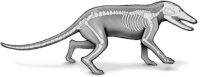
(True/False)
4.9/5 (63)
(63) A mutation in a homeotic gene would NOT be likely to cause which of the following developmental changes in an organism?
(Multiple Choice)
4.9/5 (78)
(78) During the time of Pangaea,an ancestor of modern crocodiles inhabited the region marked by the star in this map (left in the following figure).
 Where would you expect to find fossils of this animal today (the map on the right)?
 (Multiple Choice)
4.8/5 (79)
(79) The earliest forms of life evolved and lived in ____________________.
(Short Answer)
4.7/5 (72)
(72) Mass extinctions remove dominant groups of organisms and thus provide new ecological and evolutionary opportunities for groups of organisms that were previously of little importance.These organisms can then fill the now existing niches through the process of ___________.
(Multiple Choice)
4.8/5 (82)
(82) The homeotic gene that controls eye development in mice and humans can trigger the development of eyes in an eyeless ciliate.
(True/False)
4.8/5 (88)
(88) The human and chimpanzee genomes are approximately 98% similar;thus,the 2% of genes that are different accounts for all of the differences between the two organisms.
(True/False)
4.8/5 (81)
(81) 
Filters
- Essay(0)
- Multiple Choice(0)
- Short Answer(0)
- True False(0)
- Matching(0)