



 Chat with AI
Exam 4: Cell Membranes, Transport, and Communication

Exam 1: The Nature of Science and the Characteristics of Life80 Questions
Exam 2: The Chemistry of Life93 Questions
Exam 3: Cell Structure and Internal Compartments89 Questions
Exam 4: Cell Membranes, Transport, and Communication89 Questions
Exam 5: Energy, Metabolism, and Enzymes85 Questions
Exam 6: Photosynthesis and Cellular Respiration89 Questions
Exam 7: Cell Division84 Questions
Exam 8: Cancer and Human Health86 Questions
Exam 9: Patterns of Inheritance86 Questions
Exam 10: Chromosomes and Human Genetics77 Questions
Exam 11: DNA and Genes83 Questions
Exam 12: From Gene to Protein88 Questions
Exam 13: DNA Technology96 Questions
Exam 14: How Evolution Works72 Questions
Exam 15: The Origin of Species76 Questions
Exam 16: The Evolution of Biodiversity102 Questions
Exam 17: Biological Diversity, Bacteria, and Archaea80 Questions
Exam 18: Protista, Plantae, and Fungi83 Questions
Exam 19: Animalia80 Questions
Exam 20: The Biosphere88 Questions
Exam 21: Growth of Populations70 Questions
Exam 22: Animal Behavior82 Questions
Exam 23: Ecological Communities105 Questions
Exam 24: Ecosystems74 Questions
Exam 25: Global Change73 Questions
Exam 26: Internal Organization and Homeostasis75 Questions
Exam 27: Nutrition and Digestion81 Questions
Exam 28: Circulation and Gas Exchange77 Questions
Exam 29: Animal Hormones79 Questions
Exam 30: Nervous and Sensory Systems76 Questions
Exam 31: Skeletons,Muscles,and Movement77 Questions
Exam 32: The Immune System80 Questions
Exam 33: Reproduction and Development86 Questions
Exam 34: Plant Structure, Nutrition, and Transport80 Questions
Exam 35: Plant Growth and Reproduction81 Questions
Select questions type


Epithelial tissue in animals provides a barrier against the invasion of bacteria into the body.Which of the following is most likely to be responsible for creating a tight enough barrier between cells to prevent the passage of bacteria between them?
(Multiple Choice)
5.0/5  (73)
(73) In the following flowchart summarizing membrane transport,both active and facilitated transports terminate at separate carrier proteins.Which statement explains why the lines do not converge at the same carrier protein?
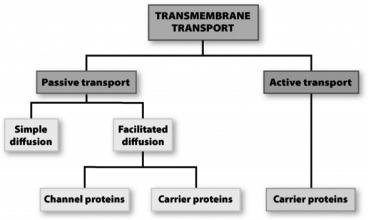
(Multiple Choice)
4.9/5 (93)
(93) You place some Elodea,an aquarium plant,in a hypotonic solution.What happens?
(Multiple Choice)
5.0/5 (83)
(83) The concentration of solutes is higher within the mitochondria than it is in the cytosol.Therefore,the cytosol is ________ to the inside of the mitochondrion.
(Short Answer)
4.8/5 (83)
(83) A cell that is gaining water from its surroundings is in a(n)________ solution.
(Multiple Choice)
4.9/5 (78)
(78) Which type of molecule will diffuse through the plasma membrane most quickly?
(Multiple Choice)
4.9/5 (72)
(72) Several types of lipoproteins exist;the best balance for cardiovascular health is achieved with ________ amount of LDL and ________ amount of HDL.
(Short Answer)
4.8/5 (66)
(66) A positive correlation has been shown between HDL and dementia;unfortunately,lowering HDL without medication is difficult,and serious side effects have been reported.
(True/False)
4.8/5 (87)
(87) The various connections between cells,including cell junctions and signaling molecules,allow the cells in a multicellular organism to "talk" to each other,a principle known as cell-to-cell ________.
(Short Answer)
4.7/5 (83)
(83) A red blood cell is placed in a solution and it begins to shrink.Which of the following describes the solution?
(Multiple Choice)
4.8/5 (85)
(85) Water moves across a membrane from a hypotonic solution to a ________ solution.
(Short Answer)
4.9/5 (79)
(79) Which statement best describes the equilibrium condition shown in the following illustration?
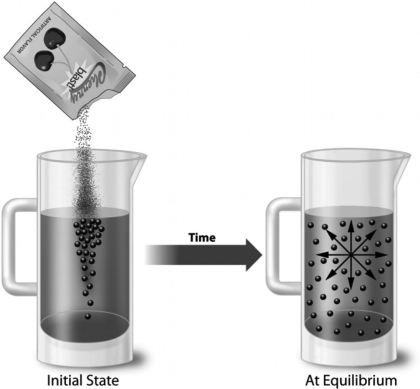
(Multiple Choice)
4.9/5 (77)
(77) The fragrance of bread baking in a kitchen spreads to other rooms by
(Multiple Choice)
4.9/5 (78)
(78) You observe a cell in a solution that swells until it bursts.What you have seen is an instance of osmosis in a(n)________ solution.
(Multiple Choice)
4.8/5 (91)
(91) Ingested protein is always degraded to amino acids before absorption in the mature human small intestine,but nursing infants can absorb intact antibodies (large protein molecules)from breast milk.How might this difference in intestinal function be explained?
(Multiple Choice)
4.8/5 (89)
(89) Animal cells are attached to neighboring cells by all of the following,EXCEPT
(Multiple Choice)
4.9/5 (79)
(79) 
Filters
- Essay(0)
- Multiple Choice(0)
- Short Answer(0)
- True False(0)
- Matching(0)