



 Chat with AI
Exam 4: Cell Membranes, Transport, and Communication

Exam 1: The Nature of Science and the Characteristics of Life80 Questions
Exam 2: The Chemistry of Life93 Questions
Exam 3: Cell Structure and Internal Compartments89 Questions
Exam 4: Cell Membranes, Transport, and Communication89 Questions
Exam 5: Energy, Metabolism, and Enzymes85 Questions
Exam 6: Photosynthesis and Cellular Respiration89 Questions
Exam 7: Cell Division84 Questions
Exam 8: Cancer and Human Health86 Questions
Exam 9: Patterns of Inheritance86 Questions
Exam 10: Chromosomes and Human Genetics77 Questions
Exam 11: DNA and Genes83 Questions
Exam 12: From Gene to Protein88 Questions
Exam 13: DNA Technology96 Questions
Exam 14: How Evolution Works72 Questions
Exam 15: The Origin of Species76 Questions
Exam 16: The Evolution of Biodiversity102 Questions
Exam 17: Biological Diversity, Bacteria, and Archaea80 Questions
Exam 18: Protista, Plantae, and Fungi83 Questions
Exam 19: Animalia80 Questions
Exam 20: The Biosphere88 Questions
Exam 21: Growth of Populations70 Questions
Exam 22: Animal Behavior82 Questions
Exam 23: Ecological Communities105 Questions
Exam 24: Ecosystems74 Questions
Exam 25: Global Change73 Questions
Exam 26: Internal Organization and Homeostasis75 Questions
Exam 27: Nutrition and Digestion81 Questions
Exam 28: Circulation and Gas Exchange77 Questions
Exam 29: Animal Hormones79 Questions
Exam 30: Nervous and Sensory Systems76 Questions
Exam 31: Skeletons,Muscles,and Movement77 Questions
Exam 32: The Immune System80 Questions
Exam 33: Reproduction and Development86 Questions
Exam 34: Plant Structure, Nutrition, and Transport80 Questions
Exam 35: Plant Growth and Reproduction81 Questions
Select questions type


Tight junctions prevent the movement of the extracellular matrix between cells.
(True/False)
4.8/5  (63)
(63) Elevated cholesterol and LDL (the particles that transport cholesterol)have been strongly associated with vascular disease;what process(es)lead to the elevated levels?
(Multiple Choice)
4.9/5 (77)
(77) When the solute concentration outside a cell is equal to the solute concentration inside the cell,the cell is in a(n)________ solution.
(Short Answer)
4.8/5 (82)
(82) The concentration of glucose inside a cell is higher than the concentration outside that cell,yet glucose continues to enter the cell.This is an example of
(Multiple Choice)
4.9/5 (86)
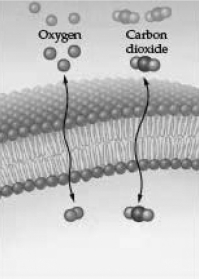
(86) What best explains the double-headed arrows associated with carbon dioxide and molecular oxygen shown in the following illustration?
(Multiple Choice)
4.9/5 (69)
(69) Which of the following would directly supply energy to an active carrier protein?
(Multiple Choice)
4.8/5 (82)
(82) Which of the following signaling molecules would NOT be found in animals?
(Multiple Choice)
4.7/5 (82)
(82) Osmoregulation refers to balancing water concentrations in organisms and cells.
(True/False)
4.8/5 (90)
(90) Imagine a cell needing an essential specific amino acid (one the cell cannot synthesize).What process could acquire the amino acid most quickly?
(Multiple Choice)
4.9/5 (79)
(79) Soon after a certain molecule enters a cell,the cell begins producing a new type of protein.The molecule was probably a
(Multiple Choice)
4.8/5 (97)
(97) The human hormone insulin is produced only by a single organ,the pancreas,yet insulin is used to move glucose from the bloodstream into cells all over the body.What aspect of hormones makes it possible for insulin to work throughout the body?
(Multiple Choice)
4.8/5 (97)
(97) Even though the concentration of water in a cell remains constant in an isotonic solution,the random movement of water molecules during ________ requires that water be constantly moving in both directions across the plasma membrane.
(Short Answer)
4.7/5 (76)
(76) A concentration ________ is said to exist when a molecule is more abundant in one area than it is in another.
(Short Answer)
4.7/5 (78)
(78) Imagine two solutions separated by a selectively permeable membrane that is impermeable to glucose.On one side of the membrane,solution A contains 10 percent glucose and on the other side,solution B contains 25 percent glucose.Which of the following is true?
(Multiple Choice)
4.9/5 (79)
(79) After entering its target cell,a hydrophobic hormone binds to its intracellular receptor and then interacts with the cell's DNA,resulting in the production of a specific ________.
(Short Answer)
4.9/5 (88)
(88) The principle of cell ________ is that different cells in the same organism may have different functions.
(Short Answer)
4.7/5 (91)
(91) A given signaling molecule can bind to several different kinds of cell surface receptors.
(True/False)
4.8/5 (96)
(96) 
Filters
- Essay(0)
- Multiple Choice(0)
- Short Answer(0)
- True False(0)
- Matching(0)