



 Chat with AI
Exam 27: Medically Significant Fungi

Exam 1: Bacterial Cell Structure, Physiology, Metabolism, and Genetics48 Questions
Exam 2: Host-Parasite Interaction44 Questions
Exam 3: The Laboratory Role in Infection Control29 Questions
Exam 4: Control of Microorganisms60 Questions
Exam 5: Performance Improvement in the Microbiology Laboratory39 Questions
Exam 6: Specimen Collection and Processing57 Questions
Exam 7: Microscopic Examination of Materials From Infected Sites34 Questions
Exam 8: Use of Colony Morphology for the Presumptive Identification of Microorganisms37 Questions
Exam 9: Biochemical Identification of Gram-Negative Bacteria52 Questions
Exam 10: Immunodiagnosis of Infectious Diseases56 Questions
Exam 11: Applications of Molecular Diagnostics50 Questions
Exam 12: Antimicrobial Agent Mechanisms of Action and Resistance44 Questions
Exam 13: Antimicrobial Susceptibility Testing83 Questions
Exam 14: Staphylococci34 Questions
Exam 15: Streptococcus, Enterococcus, and Other Catalase-Negative, Gram-Positive Cocci37 Questions
Exam 16: Aerobic Gram-Positive Bacilli45 Questions
Exam 17: Neisseria Species and Moraxella Catarrhalis31 Questions
Exam 18: Haemophilus and Other Fastidious Gram-Negative Bacilli29 Questions
Exam 19: Enterobacteriaceae30 Questions
Exam 20: Vibrio, Aeromonas, Plesiomonas, and Campylobacter Species27 Questions
Exam 21: Nonfermenting and Miscellaneous Gram-Negative Bacilli28 Questions
Exam 22: Anaerobes of Clinical Importance34 Questions
Exam 23: The Spirochetes26 Questions
Exam 24: Chlamydia, Rickettsia and Similar Organisms24 Questions
Exam 25: Mycoplasma and Ureaplasma20 Questions
Exam 26: Mycobacterium Tuberculosis and Nontuberculous Mycobacteria34 Questions
Exam 27: Medically Significant Fungi26 Questions
Exam 28: Diagnostic Parasitology20 Questions
Exam 29: Clinical Virology40 Questions
Exam 30: Agents of Bioterror and Forensic Microbiology33 Questions
Exam 31: Biofilms: Architects of Disease27 Questions
Exam 32: Upper and Lower Respiratory Tract Infections33 Questions
Exam 33: Skin and Soft Tissue Infections30 Questions
Exam 34: Gastrointestinal Infections and Food Poisoning33 Questions
Exam 35: Infections of the Central Nervous System26 Questions
Exam 36: Bacteremia and Sepsis33 Questions
Exam 37: Urinary Tract Infections31 Questions
Exam 38: Genital Infections and Sexually Transmitted Diseases25 Questions
Exam 39: Infections in Special Populations20 Questions
Exam 40: Zoonotic Diseases22 Questions
Exam 41: Ocular Infections25 Questions
Select questions type


What organism is found in the San Joaquin Valley region of California?

Free
(Multiple Choice)
4.7/5  (77)
(77) Correct Answer: Verified
C
This organism was isolated from a sinus aspirate of a patient with chronic sinusitis and respiratory allergies.Identify the organism shown below. 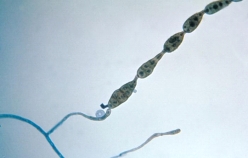
Free
(Multiple Choice)
4.8/5 (96)
(96) Correct Answer:Verified
VerifiedB
A patient with very pale patches on his arms and legs is examined at his physician's office.His physician orders a fungal culture.The fungus shows a spaghetti-and-meatball appearance on the direct smear.What organism is it?
Free
(Multiple Choice)
4.8/5 (77)
(77) Correct Answer:Verified
VerifiedB
A young man notices a darkened area of skin on the palm of his hand.It seems to be increasing in size over the past 2 weeks.His health care provider collects a skin scraping for microscopic examination, which shows septate hyphal elements and budding cells.This organism is most likely: 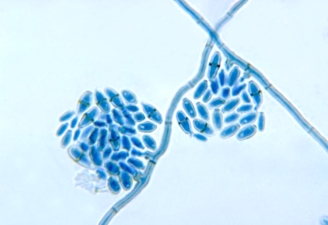
(Multiple Choice)
4.8/5 (77)
(77) A patient with thickened and discolored nails was diagnosed with onychomycosis.A scraping of the nail was sent for culture.Microscopic analysis of the mold colony growth revealed the following morphology.The most likely identity of this organism is: 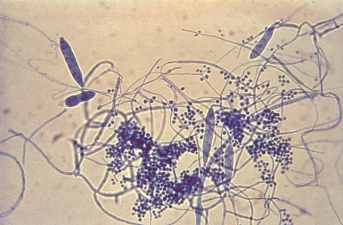
(Multiple Choice)
4.9/5 (87)
(87) Chromoblastomycosis is caused by all the following organisms except:
(Multiple Choice)
5.0/5 (92)
(92) What organism is one of the primary opportunistic infections in AIDS patients?
(Multiple Choice)
4.8/5 (83)
(83) A recreational cave explorer develops a productive cough and fever.A sputum culture is sent to the laboratory for bacterial, fungal, and mycobacterial cultures.A white mold colony develops on Sabouraud's agar after 5 days at 22° C.Identify the organism shown below. 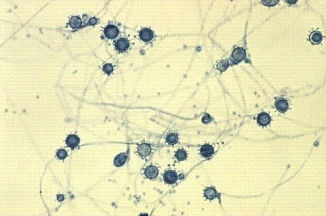
(Multiple Choice)
4.7/5 (71)
(71) A bone marrow transplant patient develops an abrupt fever with respiratory distress.Despite treatment with antifungal medications, the patient dies on the fifth day.The following organism was isolated from both sputum and blood cultures.Identify the organism shown below. 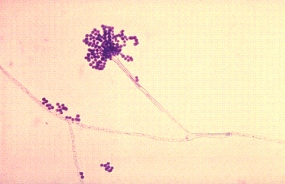
(Multiple Choice)
4.8/5 (93)
(93) A graduate student returning from a month-long fieldwork experience in South America develops a dark nodular lesion on his left hand.Microscopic examination of the nodule reveals dark, coinlike inclusions.The following organism grows in culture.This organism is most likely: 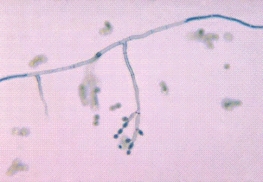
(Multiple Choice)
4.8/5 (89)
(89) The following organism was isolated from an immunocompetent patient with chronic sinusitis.This organism is most likely: 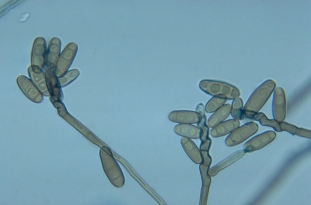
(Multiple Choice)
4.7/5 (63)
(63) A patient returning from a trip to tropical Africa comes to his physician noting scaly patches of skin along the waistband, which are lighter in color than his normal skin.A skin scraping reveals budding yeast and short septate hyphal elements, with some branching present.This organism, shown below, is most likely: 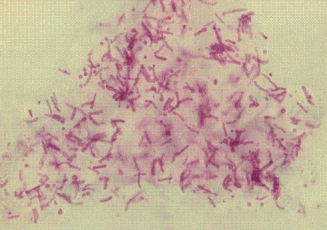
(Multiple Choice)
4.7/5 (85)
(85) All of the following are examples of dimorphic fungi except:
(Multiple Choice)
4.8/5 (78)
(78) The following organism was isolated from the sputum culture of a cancer chemotherapy patient.This organism is most likely: 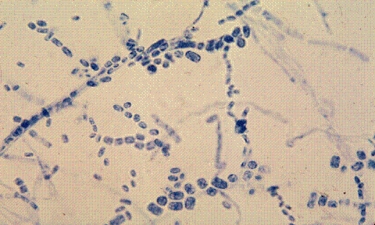
(Multiple Choice)
4.9/5 (66)
(66) All of the following organisms cause cutaneous mycoses except:
(Multiple Choice)
4.8/5 (63)
(63) For potassium hydroxide (KOH) to work properly, what is done to speed up the dissolution of the keratin and skin layers?
(Multiple Choice)
4.9/5 (85)
(85) A young boy develops itchy, dry scaly lesions on his leg with a raised, red, outer edge.A culture of the lesion reveals the following organism in a lactophenol cotton blue stain.This organism is most likely: 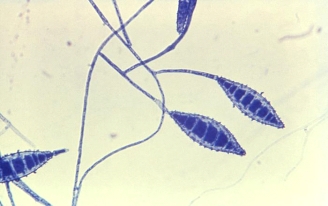
(Multiple Choice)
4.9/5 (74)
(74) A student working for the summer at a plant nursery has a nodular lesion on his forearm that develops a draining tract.The following organism is isolated from the culture at 22C.Identify the organism shown below. 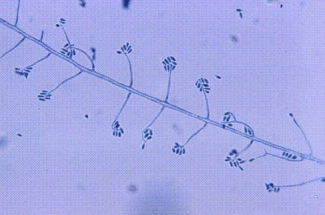
(Multiple Choice)
4.8/5 (97)
(97) A Seattle woman with HIV complains of headaches and also displays some memory loss.Because of her history, the physician collects cerebrospinal fluid (CSF) and sends it to the laboratory for analysis.The following image is seen using India ink stain.What is the most likely identification of this organism? 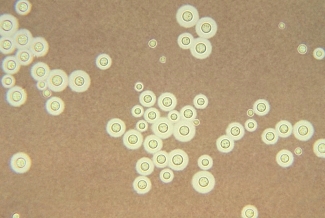
(Multiple Choice)
4.8/5 (73)
(73) 
Filters
- Essay(0)
- Multiple Choice(0)
- Short Answer(0)
- True False(0)
- Matching(0)