



 Chat with AI
Exam 26: Microbial Diseases

Exam 1: Microbial Life: Origin and Discovery69 Questions
Exam 2: Observing the Microbial Cell69 Questions
Exam 3: Cell Structure and Function72 Questions
Exam 4: Bacterial Culture, Growth, and Development70 Questions
Exam 5: Environmental Influences and Control of Microbial Growth70 Questions
Exam 6: Viruses70 Questions
Exam 7: Genomes and Chromosomes70 Questions
Exam 8: Transcription, Translation, and Bioinformatics76 Questions
Exam 9: Gene Transfer, Mutations, and Genome Evolution72 Questions
Exam 10: Molecular Regulation73 Questions
Exam 11: Viral Molecular Biology70 Questions
Exam 12: Biotechniques and Synthetic Biology72 Questions
Exam 13: Energetics and Catabolism77 Questions
Exam 14: Electron Flow in Organotrophy, Lithotrophy, and Phototrophy70 Questions
Exam 15: Biosynthesis70 Questions
Exam 16: Food and Industrial Microbiology73 Questions
Exam 17: Origins and Evolution70 Questions
Exam 18: Bacterial Diversity71 Questions
Exam 19: Archaeal Diversity70 Questions
Exam 20: Eukaryotic Diversity70 Questions
Exam 21: Microbial Ecology70 Questions
Exam 22: Microbes in Global Elemental Cycles70 Questions
Exam 23: Human Microbiota and Innate Immunity70 Questions
Exam 24: The Adaptive Immune Response70 Questions
Exam 25: Microbial Pathogenesis70 Questions
Exam 26: Microbial Diseases69 Questions
Exam 27: Antimicrobial Therapy72 Questions
Exam 28: Clinical Microbiology and Epidemiology75 Questions
Select questions type


Using the figure below, which organism is an incidental host for Lyme disease? 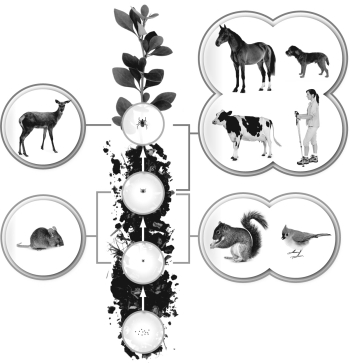
(Multiple Choice)
4.9/5  (87)
(87) How does Clostridium botulinum, an obligate anaerobe, secrete its potent toxins in food?
(Essay)
4.7/5 (82)
(82) During secondary syphilis, the spirochetes spread to the nervous and cardiovascular system. Consequently
(Multiple Choice)
4.9/5 (84)
(84) What makes uropathogenic Escherichia coli different from the other E. coli?
(Essay)
5.0/5 (76)
(76) What type of disease is an infection that normally affects animals but can be transmitted to humans?
(Multiple Choice)
4.9/5 (85)
(85) Regarding the neurotoxigenic disease caused by Clostridium tetani, which of the following is NOT correct?
(Multiple Choice)
4.9/5 (75)
(75) The major challenge with treating flesh-eating disease caused by Streptococcus pyogenes is that
(Multiple Choice)
4.8/5 (80)
(80) Which of the following pathogens is an intracellular agent?
(Multiple Choice)
4.8/5 (86)
(86) Diarrhea associated with the intake of nonabsorbable substrates is categorized as
(Multiple Choice)
4.7/5 (78)
(78) 
Filters
- Essay(0)
- Multiple Choice(0)
- Short Answer(0)
- True False(0)
- Matching(0)