



 Chat with AI
Exam 25: Microbial Pathogenesis

Exam 1: Microbial Life: Origin and Discovery69 Questions
Exam 2: Observing the Microbial Cell69 Questions
Exam 3: Cell Structure and Function72 Questions
Exam 4: Bacterial Culture, Growth, and Development70 Questions
Exam 5: Environmental Influences and Control of Microbial Growth70 Questions
Exam 6: Viruses70 Questions
Exam 7: Genomes and Chromosomes70 Questions
Exam 8: Transcription, Translation, and Bioinformatics76 Questions
Exam 9: Gene Transfer, Mutations, and Genome Evolution72 Questions
Exam 10: Molecular Regulation73 Questions
Exam 11: Viral Molecular Biology70 Questions
Exam 12: Biotechniques and Synthetic Biology72 Questions
Exam 13: Energetics and Catabolism77 Questions
Exam 14: Electron Flow in Organotrophy, Lithotrophy, and Phototrophy70 Questions
Exam 15: Biosynthesis70 Questions
Exam 16: Food and Industrial Microbiology73 Questions
Exam 17: Origins and Evolution70 Questions
Exam 18: Bacterial Diversity71 Questions
Exam 19: Archaeal Diversity70 Questions
Exam 20: Eukaryotic Diversity70 Questions
Exam 21: Microbial Ecology70 Questions
Exam 22: Microbes in Global Elemental Cycles70 Questions
Exam 23: Human Microbiota and Innate Immunity70 Questions
Exam 24: The Adaptive Immune Response70 Questions
Exam 25: Microbial Pathogenesis70 Questions
Exam 26: Microbial Diseases69 Questions
Exam 27: Antimicrobial Therapy72 Questions
Exam 28: Clinical Microbiology and Epidemiology75 Questions
Select questions type


Tropheryma whipplei is the causative agent for Whipple's disease. It could not be cultured until recently, when the genomic data showed that it
(Multiple Choice)
4.8/5  (72)
(72) What characteristics of a pathogen distinguish it from a commensal, in terms of its ability to infect and replicate within a eukaryotic host?
(Essay)
4.9/5 (84)
(84) The term used to designate how many bacteria or viruses are required to kill 50% of an experimental group of hosts is
(Multiple Choice)
4.9/5 (90)
(90) Microbes can be transmitted indirectly from one person to another by inanimate objects, collectively called fomites. Describe the role of fomites in the spread of influenza.
(Essay)
4.7/5 (94)
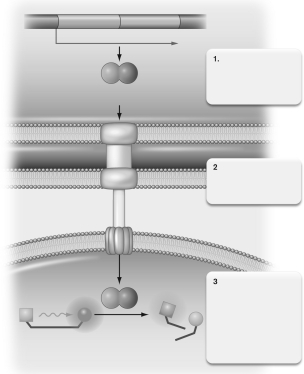
(94) 
The disease filariasis, commonly known as elephantiasis, is caused by a(n)
(Multiple Choice)
4.8/5 (66)
(66) Pathogenicity islands include all of the following EXCEPT that
(Multiple Choice)
4.9/5 (83)
(83) Diphtheria toxin is a classic AB exotoxin. How does it cause host cell damage?
(Essay)
4.8/5 (75)
(75) An example of vertical transmission of infectious agents is
(Multiple Choice)
4.9/5 (83)
(83) 
Filters
- Essay(0)
- Multiple Choice(0)
- Short Answer(0)
- True False(0)
- Matching(0)