



 Chat with AI
Exam 15: Biosynthesis

Exam 1: Microbial Life: Origin and Discovery69 Questions
Exam 2: Observing the Microbial Cell69 Questions
Exam 3: Cell Structure and Function72 Questions
Exam 4: Bacterial Culture, Growth, and Development70 Questions
Exam 5: Environmental Influences and Control of Microbial Growth70 Questions
Exam 6: Viruses70 Questions
Exam 7: Genomes and Chromosomes70 Questions
Exam 8: Transcription, Translation, and Bioinformatics76 Questions
Exam 9: Gene Transfer, Mutations, and Genome Evolution72 Questions
Exam 10: Molecular Regulation73 Questions
Exam 11: Viral Molecular Biology70 Questions
Exam 12: Biotechniques and Synthetic Biology72 Questions
Exam 13: Energetics and Catabolism77 Questions
Exam 14: Electron Flow in Organotrophy, Lithotrophy, and Phototrophy70 Questions
Exam 15: Biosynthesis70 Questions
Exam 16: Food and Industrial Microbiology73 Questions
Exam 17: Origins and Evolution70 Questions
Exam 18: Bacterial Diversity71 Questions
Exam 19: Archaeal Diversity70 Questions
Exam 20: Eukaryotic Diversity70 Questions
Exam 21: Microbial Ecology70 Questions
Exam 22: Microbes in Global Elemental Cycles70 Questions
Exam 23: Human Microbiota and Innate Immunity70 Questions
Exam 24: The Adaptive Immune Response70 Questions
Exam 25: Microbial Pathogenesis70 Questions
Exam 26: Microbial Diseases69 Questions
Exam 27: Antimicrobial Therapy72 Questions
Exam 28: Clinical Microbiology and Epidemiology75 Questions
Select questions type


Nitrogenase is diagrammed below. This particular enzyme is shown in the format just before it begins a cycle of nitrogen reduction. This goal is accomplished in four steps. What is the first step? 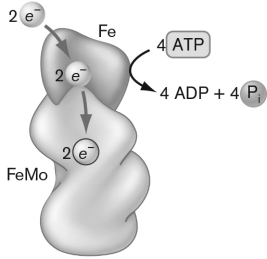
(Multiple Choice)
4.8/5  (78)
(78) Which of the following statements concerning glyceraldehyde-3-phosphate is FALSE?
(Multiple Choice)
4.9/5 (88)
(88) The most ancient CO₂ fixation pathway in methanogens is the
(Multiple Choice)
4.9/5 (66)
(66) Which amino acid is NOT one of the first amino acids produced by ancient cells?
(Multiple Choice)
4.9/5 (75)
(75) Gene expression of nitrogenase through NtrC is downregulated in high concentrations of
(Multiple Choice)
4.8/5 (86)
(86) Two strains of E. coli were developed, each of which overproduced an amino acid, either histidine or tryptophan. When grown together in medium with adequate amino acids, they grew but did not associate with each other. When these strains were grown together in medium without histidine and tryptophan, they grew and formed ________ in order to ________.
(Multiple Choice)
4.7/5 (79)
(79) Industrial nitrogen fixation is achieved through the Haber process
(Multiple Choice)
4.9/5 (71)
(71) Which of the following does NOT serve as an intermediate in the biosynthesis of amino acids?
(Multiple Choice)
4.9/5 (87)
(87) What are polyalkanoates, and what are bacterially produced polyalkanoates used for? Why are they of ecological and medical interest?
(Essay)
4.7/5 (96)
(96) Which of the following statements is NOT true about Rubisco?
(Multiple Choice)
4.8/5 (75)
(75) How does the reductive (reverse) TCA cycle participate in carbon fixation?
(Multiple Choice)
4.9/5 (87)
(87) Certain amino acids are more energetically expensive than others (tryptophan versus glutamate). Thus, when proteins are moved to the cell surface, extended outside the surface, or secreted out of the cell, there is a potential harm. Why is this potentially harmful, and what adaptations do bacteria have for this potential loss? Give an example.
(Essay)
4.7/5 (80)
(80) Discuss evidence that supports the idea that glutamate, aspartate, alanine, glycine, and valine were the first amino acids produced by ancient cells.
(Essay)
4.7/5 (83)
(83) The incorporation of NH₄⁺ into 2-oxoglutarate is the first step in nitrogen assimilation in bacterial cells. This reaction is catalyzed by the enzyme ________ and produces ________.
(Multiple Choice)
4.7/5 (76)
(76) What methods do microorganisms NOT use to minimize energy for biosynthesis?
(Multiple Choice)
4.8/5 (72)
(72) Which of the following molecules CANNOT freely cross biological membranes?
(Multiple Choice)
4.9/5 (93)
(93) The amino acid biosynthetic pathways are designated as families. The ________ family generates only one amino acid.
(Multiple Choice)
4.9/5 (93)
(93) Biological nitrogen fixation is energetically expensive. Assuming that NADPH is used as the reducing equivalent, how many ATPs are used in the enzymatic conversion of N₂ to NH₃?
(Multiple Choice)
4.8/5 (75)
(75) 
Filters
- Essay(0)
- Multiple Choice(0)
- Short Answer(0)
- True False(0)
- Matching(0)