



 Chat with AI
Exam 1: Emergency Department

Exam 1: Emergency Department218 Questions
Exam 2: In-patient Facilities128 Questions
Exam 3: Office/Health Center900 Questions
Select questions type


A 28-year-old woman with fever and lethargy is brought to the emergency department accompanied by her roommate. The roommate reports that the patient appeared well last night but awoke this morning confused. Throughout the morning she became increasingly confused and eventually unarousable, prompting her roommate to call an ambulance. Her past medical history is significant for idiopathic thrombocytopenia purpura. There is no history of recent travel.
Her temperature is 39.4 C (103 F), blood pressure is 84/42 mm Hg, pulse is 122/min, and respirations are 28/min. Oxygen saturation is 90% on room air. Physical examination shows an ill-appearing woman. Pupils are equal and round but sluggish. Lungs have patchy rales. Abdominal examination reveals a surgical scar in the left upper quadrant. There are diffuse ecchymotic areas throughout the torso and lower extremities, with areas of bullae and vesicle formation. There is no rash on the palms or soles. There are no meningeal signs.
Laboratory results as follows:
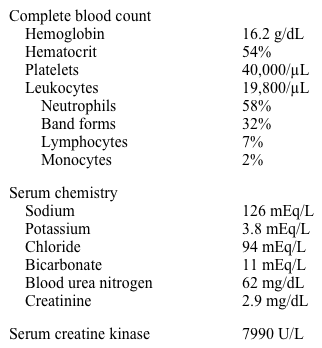 Chest x-ray reveals bilateral pulmonary infiltrates.
Which of the following antibiotics would be most effective at targeting the suspected pathogen?
Chest x-ray reveals bilateral pulmonary infiltrates.
Which of the following antibiotics would be most effective at targeting the suspected pathogen? (Multiple Choice)
4.8/5  (73)
(73) A 22-year-old man is brought to the emergency department by paramedics after his mother found him lying on the bathroom floor. Paramedics found him barely conscious with an empty bottle of bleach lying next to him. His mother states that he drank the entire bottle. He had mentioned to his mother that he wanted to end his life after his recent break-up with his girlfriend. He is lethargic, but complains of severe pain and a burning sensation in his throat.
His other medical problems include major depression and post-traumatic stress disorder. His sister also suffers from depression. His medications include nortriptyline and fluoxetine, which he had not been taking for the past several days. He has no known drug allergies.
His temperature is 37.2 C (99.0 F), blood pressure is 90/60 mm Hg, pulse is 104/min, and respirations are 22/min. Examination shows severe pharyngeal erythema/exudates, clear lungs, and normal first and second heart sounds. His abdomen is soft and tender with decreased bowel sounds. There is no rebound tenderness or rigidity.
Intravenous fluids were started. Chest and abdominal x-rays showed no evidence of free air or pleural effusions and were essentially unremarkable.
Which of the following would be the most appropriate next step in management?
(Multiple Choice)
4.7/5 (84)
(84) A 37-year-old woman comes to the emergency department due to joint pain for the past 3 weeks. The pain is primarily in the lower extremities and is not associated with joint swelling or redness. She has had no skin rashes, chest pain, or urinary symptoms but has had malaise, profound fatigue, and decreased appetite. The patient's symptoms began after she visited her family in Connecticut. She has a history of mitral valve prolapse, and her current medications include oral contraceptives and a multivitamin. The patient works as a paralegal. She does not use tobacco or illicit drugs and drinks alcohol occasionally. Her mother has rheumatoid arthritis.
Temperature is 38 C (100.4 F), blood pressure is 105/70 mm Hg, pulse is 89/min, and respirations are 18/min. BMI is 23 kg/m2. The patient is mildly ill-appearing but in no acute distress. Dental hygiene is poor. Cardiopulmonary auscultation reveals clear lung fields and a 3/6 holosystolic murmur at the cardiac apex that radiates to the axillae. There is tenderness to palpation in the left upper quadrant with an enlarged spleen. No joint swelling or erythema is present, and there is no skin rash or lymphadenopathy.
Laboratory results are as follows:
 Which of the following is most likely to establish the diagnosis in this patient?
 (Multiple Choice)
4.9/5 (69)
(69) A 38-year-old woman comes to the emergency department following an episode of loss of consciousness. She was washing the dishes when she became light-headed, weak, and developed blurry vision. The patient reportedly became limp, passed out on the kitchen floor, and had a few body jerks seconds after falling. She regained consciousness in 3-5 minutes and was not confused or disoriented afterwards. She did not have any tongue biting, headache, palpitations, shortness of breath, or chest pain.
Her medical history is significant for hypertension and diet-controlled type 2 diabetes mellitus. Her medications include lisinopril, amlodipine, and chlorthalidone.
The patient's blood pressure is 112/76 mm Hg and heart rate is 89/min. Chest auscultation reveals no abnormalities. There are no signs of trauma or neurologic deficits. Electrocardiogram is normal.
Which of the following is the most appropriate next step in management of this patient?
(Multiple Choice)
4.7/5 (72)
(72) A 38-year-old woman is brought to the emergency department due to confusion. Her husband says she has had a headache and acted strangely for the past 24 hours. He had difficulty awakening her this morning and observed 2 short episodes of rhythmic jerking of her right arm. The patient has no known medical problems and takes no medications. Family and social history are unremarkable.
Temperature is 39.1 C (102.4 F), blood pressure is 116/62 mm Hg, pulse is 105/min, and respirations are 18/min. BMI is 25 kg/m2. The patient is lethargic and her clothes are soiled with urine. Mucous membranes are moist. Funduscopic examination is normal. The patient responds to verbal stimulation and follows simple commands but is oriented to person only. There is no neck stiffness, and the remainder of the physical examination is normal.
Serum chemistry, complete blood count, and coagulation studies are remarkable only for a leukocyte count of 14,000/mm3 with 88% neutrophils. Chest x-ray and urinalysis are normal. ECG shows sinus tachycardia. Noncontrast CT scan of the head shows no acute intracranial findings. Lumbar puncture results are as follows:
 Cerebrospinal fluid culture and herpes simplex virus PCR are sent, and intravenous acyclovir is ordered. Which of the following additional interventions is most appropriate for this patient?
 (Multiple Choice)
4.9/5 (78)
(78) A 43-year-old man with a history of active intravenous drug use comes to the emergency department with 2 weeks of malaise, dry cough, and increasing dyspnea on exertion. He admits to anorexia and a 5-kg (11-lb) weight loss over the past 3 weeks. About 2 hours ago, he felt sudden, sharp, right-sided chest pain and became acutely dyspneic. Pulse oximetry on ambulance arrival showed 80% on room air. The patient was started on 5 L O2/min with notable improvement of saturation. He has known HIV and chronic hepatitis C infections but is not receiving any therapy. He smokes a pack of cigarettes daily and last sniffed heroin this morning.
His temperature is 37.2 C (99 F), blood pressure is 136/88 mm Hg, pulse is 102/min, and respirations are 18/min. Pulse oximetry shows 94% on 4 L O2/min. Examination shows a cachectic man in mild respiratory distress. The lymph nodes are not enlarged. There is a faint systolic murmur at the left sternal border and tachycardia. Decreased breath sounds are heard on the right with clear lungs on the left. There is hyperresonance to percussion on the right side of the chest. There is no peripheral edema or skin rashes.
Laboratory results are as follows:
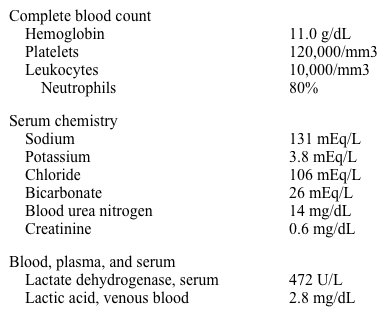 Arterial blood gas analysis shows pH of 7.48, PCO2 of 31 mm Hg, and PO2 of 71 mm Hg.
Chest x-ray shows a 30% right-sided pneumothorax with bibasilar reticular opacities and a thin-walled cavitary lesion in the left upper lung field.
Which of the following is the most likely diagnosis?
Arterial blood gas analysis shows pH of 7.48, PCO2 of 31 mm Hg, and PO2 of 71 mm Hg.
Chest x-ray shows a 30% right-sided pneumothorax with bibasilar reticular opacities and a thin-walled cavitary lesion in the left upper lung field.
Which of the following is the most likely diagnosis? (Multiple Choice)
5.0/5 (66)
(66) A 55-year-old right-handed man is brought to the emergency department after sustaining injuries in a head-on motor vehicle collision. He has a past medical history of migraine headaches, hypertension, and hyperlipidemia. The patient is a chronic smoker, and his medications include aspirin, lisinopril, and atorvastatin. On the way to CT scan, he complains of a severe, sharp headache that radiates to the left side of his neck.
His blood pressure is 135/85 mm Hg and pulse is 102/min and regular. After the head CT is obtained, the patient is unable to speak and develops right-sided weakness. On examination, he is globally aphasic. He has a right homonymous hemianopsia, left pupillary miosis and partial ptosis, and left gaze preference. Neurologic examination shows reduced sensation on the right side of the face and body, right-sided hemiparesis, and an extensor response at the right big toe on plantar cutaneous stimulation.
Which of the following is the most likely diagnosis?
(Multiple Choice)
4.9/5 (68)
(68) A 54-year-old woman who recently received a renal transplant comes to the emergency department due to fevers and malaise for the past 24 hours. She also has had a cough productive of yellow sputum over the past 2 days. No one around her has similar symptoms.
Three weeks ago, the patient underwent cadaveric renal transplant for long-standing renal disease. Her immediate postsurgical course was uneventful, and she was extubated 3 days after surgery. Her other medical problems include gastroesophageal reflux, hyperlipidemia, and eczema.
After the transplantation, she moved in with her sister, who had just donated her 2 cats to a local pet store. The patient does not use tobacco or alcohol. Her current medications include prednisone, tacrolimus, mycophenolate, valganciclovir, sulfamethoxazole/trimethoprim, pravastatin, and omeprazole. She has no known drug allergies.
Her temperature is 38.5 C (101.3 F), blood pressure is 130/80 mm Hg, pulse is 98/min, and respirations are 18/min. Pulse oximetry shows oxygen saturation of 95% on room air. Breath sounds are decreased in the left lung base with mild wheezing over the upper lung fields bilaterally. Her abdomen is soft and nontender without a palpable spleen tip. Neurologic examination is within normal limits.
Laboratory results are as follows:
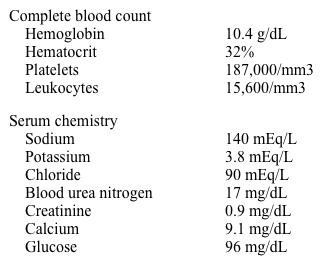 Chest-x ray reveals a left lower lobe infiltrate.
Which of the following is the most likely cause of her condition?
Chest-x ray reveals a left lower lobe infiltrate.
Which of the following is the most likely cause of her condition? (Multiple Choice)
4.8/5 (85)
(85) A 23-year-old woman with known sickle cell disease comes to the emergency department with a 3-day history of malaise, lethargy, and severe exertional dyspnea. She has no cough, chest pain, vomiting, or blood in the stool. Two years ago, she was hospitalized with acute chest syndrome and required mechanical ventilation. Her last hospitalization was 7 months ago for a painful crisis, and she underwent an exchange transfusion at that time. Her current medications are hydroxyurea, folic acid, extended-release morphine, and oxycodone for breakthrough pain.
Her temperature is 100° F (37.8° C), blood pressure is 122/76 mm Hg, and pulse is 112/min and regular. Oxygen saturation is 96% on room air. Examination shows pale palms. Lungs are clear to auscultation. The abdomen is nontender.
Laboratory results are as follows:
 Chest x-ray shows no infiltrates. Blood cultures show no growth.
Which of the following is the most likely cause of her symptoms?
Chest x-ray shows no infiltrates. Blood cultures show no growth.
Which of the following is the most likely cause of her symptoms? (Multiple Choice)
4.8/5 (60)
(60) A 20-year-old woman is brought to the emergency department from a college dorm. She attended a party earlier that night and was brought back to her room by her roommate. The roommate told paramedics that she called for an ambulance because the patient was agitated, combative, and "confused," and then appeared to have a seizure. The patient was obtunded by the time the paramedics arrived. She has a history of psychosis and takes risperidone and diphenhydramine nightly.
Temperature is 39.4 C (103 F), blood pressure is 179/108 mm Hg, pulse is 135/min, and respirations are 24/min. Physical examination shows a young diaphoretic woman who is warm to the touch. Pupils are dilated. There is no nystagmus. Occasional tremors are noted. She is hyperreflexic.
Laboratory results are as follows:
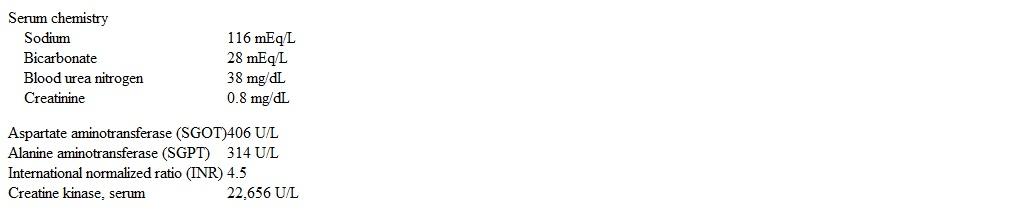 Which of the following is the most likely ingestion causing this patient's findings?
 (Multiple Choice)
4.9/5 (76)
(76) A 62-year-old man comes to the emergency department with 2 episodes of retrosternal pressure-like chest pain over the last 6 hours. Medical history is significant for type 2 diabetes mellitus, hypertension, and end-stage renal disease. He undergoes hemodialysis 3 times a week through a left arm arteriovenous fistula.
Blood pressure is 152/89 mm Hg and pulse is 88/min. The chest is clear on auscultation. There are no heart murmurs.
Bedside finger-stick glucose level is 134 mg/dL. ECG shows normal sinus rhythm with 1-mm horizontal ST-segment depressions in leads II, III, aVF, and V4-V6. The initial troponin I level is 1.5 ng/mL (normal: <0.01).
He is treated with aspirin.
Which of the following is the most appropriate additional treatment for this patient?
(Multiple Choice)
4.9/5 (88)
(88) A 43-year-old man comes to the emergency department with severe abdominal pain and vomiting for the last several days. He has been drinking wine heavily since separating from his wife recently. He was admitted to the hospital for alcohol-related seizures a year ago and left against medical advice. The patient's medical problems also include chronic low back pain and nephrolithiasis. He takes over-the-counter painkillers. His temperature is 38.3 C (101 F), blood pressure is 112/70 mm Hg, pulse is 105/min, and respirations are 18/min. Physical examination is significant for jaundice in the eyes and skin. Breath sounds are normal. The abdomen is distended, with significant tenderness in the right upper quadrant to palpation. There is dullness to percussion in bilateral flank regions.
Laboratory results are as follows:
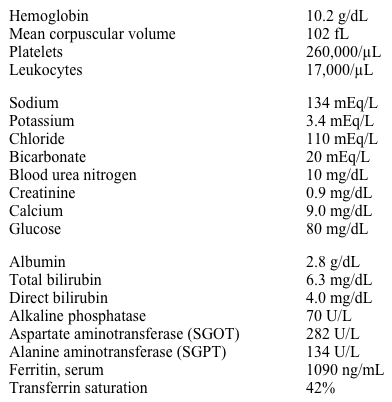 Which of the following is the most likely diagnosis?
 (Multiple Choice)
4.8/5 (92)
(92) A 72-year-old woman undergoes parathyroidectomy for primary hyperparathyroidism. Prior to surgery she complained of bone pain and had a compression fracture of the T11 vertebra.
Laboratory results from the day before surgery are as follows:
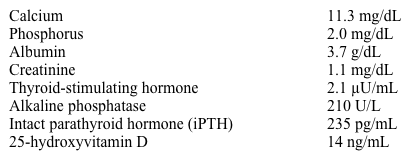 The patient had normal serum calcium on the first postoperative day. She was discharged with a prescription for calcium and vitamin D. Two days after surgery, she comes to the emergency department complaining of perioral numbness and spasms of both hands. On examination, she appears anxious. Her vital signs are normal except for a respiratory rate of 24/min. Chvostek's sign is positive.
Which of the following laboratory results would be expected from blood drawn at this time?
The patient had normal serum calcium on the first postoperative day. She was discharged with a prescription for calcium and vitamin D. Two days after surgery, she comes to the emergency department complaining of perioral numbness and spasms of both hands. On examination, she appears anxious. Her vital signs are normal except for a respiratory rate of 24/min. Chvostek's sign is positive.
Which of the following laboratory results would be expected from blood drawn at this time? (Multiple Choice)
4.7/5 (79)
(79) A 28-year-old woman comes to the emergency department because of worsening shortness of breath and wheezing for the last 2 days. She denies fever, chills, or chest pain. She has a history of asthma and her symptoms occur mainly during the winter months. She denies nocturnal asthma episodes. She uses an albuterol inhaler intermittently, which usually controls her symptoms very well. However, over the last few hours she has taken several puffs of her inhaler, with no improvement of her current symptoms. She has no other medical problems and takes no other medications. She does not use tobacco or illicit drugs.
Her temperature is 36.7 C (98.1 F), blood pressure is 128/76 mm Hg, pulse is 108/min, and respirations are 20/min. She is in moderate respiratory distress. Lung examination reveals bilateral wheezing and prolonged expiration with use of accessory muscles. Her peak flow is 190 L/min.
She is given continuous nebulized albuterol, a dose of corticosteroids, and is admitted to the hospital. The following day, she has marked improvement of her symptoms and there are no wheezes heard on auscultation. She wants to go home.
Apart from a short acting beta agonist, which of the following is the most appropriate discharge medication for this patient?
(Multiple Choice)
4.8/5 (87)
(87) A 23-year-old woman is brought to the emergency department with fever, rash, and decreased level of consciousness. She is accompanied by her boyfriend. Throughout the morning, she became increasingly confused and eventually unarousable, prompting him to call an ambulance. He does not know of any specific medical problems but reports that the patient had abdominal surgery after a bad automobile accident. After initial evaluation, lumbar puncture is performed and empiric antibiotic therapy is started. Cerebral spinal fluid shows Gram-negative diplococci. The patient is transferred to the intensive care unit.
Which of the following is the best initial choice for infectious precaution measures?
(Multiple Choice)
4.9/5 (84)
(84) A 54-year-old man comes to the emergency department with severe chest and neck pain that started 2 hours ago. His past medical history is significant for hypertension treated with amlodipine and irbesartan. His father died suddenly at the age of 43 years. He does not smoke or use illicit drugs.
His blood pressure is 162/100 mmHg and pulse is 101/min. He appears mildly uncomfortable due to pain.
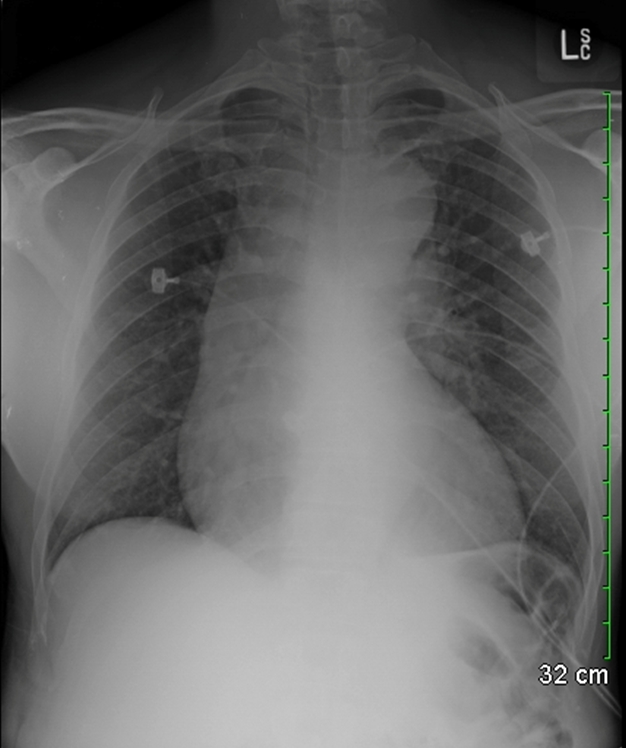
EKG shows sinus tachycardia, voltage criteria for left ventricular hypertrophy, and T wave inversions in leads V5 and V6. Chest x-ray findings are shown below.
 He is initially treated with nitroglycerin.
What is the best next step in managing this patient?
He is initially treated with nitroglycerin.
What is the best next step in managing this patient? (Multiple Choice)
4.8/5 (84)
(84) A 57-year-old man with known liver cirrhosis comes to the physician because of progressive shortness of breath and fatigue for the last few months that has recently worsened. He now becomes short of breath even at rest, particularly in the morning when getting out of bed. He was diagnosed with chronic hepatitis C ten years ago and liver cirrhosis three years ago. He quit using alcohol and IV drugs upon being diagnosed with hepatitis C. He is currently disabled and usually comes to the emergency department for abdominal paracentesis once every 6 to 8 weeks. He has been non-compliant with his outpatient medications. He had a large volume paracentesis 3 days ago.
His temperature is 36.7 C (98 F), blood pressure is 100/70 mm Hg, pulse is 94/min, and respirations are 16/min. The patient's pulse oximetry shows 88% saturation on room air while sitting. After resting supine in a quiet room for 15 min, his blood pressure is 95/68 mm Hg, pulse is 88/min, and oxygen saturation is 93% on room air. He is fully alert and has no asterixis. Breath sounds are mildly decreased at the right base. A moderate amount of ascites is present on abdominal examination. There is no rebound tenderness or rigidity. He has 1+ peripheral edema, a few spider nevi on his chest, and a slight bluish discoloration of his toes and digits.
His platelet count is 50,000 cells/µL and serum creatinine is 1.4 mg/dL. Chest x-ray shows normal heart size and a small right-sided pleural effusion, but is otherwise unremarkable.
Which of the following is most likely to diagnose the cause of this patient's shortness of breath?
(Multiple Choice)
4.9/5 (73)
(73) A 53-year-old man comes to the emergency department in moderate respiratory distress.
On examination, blood pressure is 90/58 mm Hg, pulse is 100/min, and SaO2 is 82%-85% on FiO2 100% via nonrebreather mask. Lung examination reveals crackles and reduced breath sounds in the left base.
The patient undergoes rapid-sequence intubation due to respiratory distress. The endotracheal tube is 26 cm at the lip. The colorimetric end-tidal CO2 device displays a color change, and normal waveform is noted on capnography. Chest auscultation reveals reduced breath sounds in the entire left lung field. Several minutes after intubation, SaO2 remains 82%-85% and blood pressure is 94/56 mm Hg.
Which of the following is the best next step in management of this patient?
(Multiple Choice)
4.7/5 (78)
(78) A 65-year-old man comes to the emergency department because of worsening generalized itching for 7 days. He has experienced abdominal discomfort, bloating, and decreased appetite for several weeks. He states that he has lost 10-12 lbs (4.5-5.4 kg) during this time, which he attributes to excessive stress at work. He denies nausea, vomiting, diarrhea, easy bleeding, or bruising.
His temperature is 36.9 C (98.4 F), blood pressure is 123/70 mm Hg, and pulse is 78/min and regular. On examination, he has icteric conjunctivae and skin. He has bilateral diffuse scratch marks. There is mild tenderness on palpation of his right upper abdominal quadrant. The tip of the spleen is not palpable.
Laboratory results are as follows:
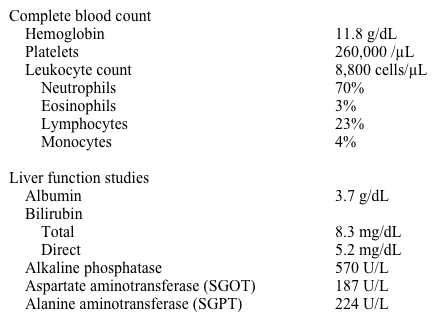 Abdominal ultrasound reveals an enlarged liver with dilated intrahepatic bile ducts. A CT scan of the abdomen reveals an ill-defined 3.5 cm pancreatic mass and several low-attenuating foci in the liver consistent with metastasis.
Which of the following would be the best next step in managing this patient?
Abdominal ultrasound reveals an enlarged liver with dilated intrahepatic bile ducts. A CT scan of the abdomen reveals an ill-defined 3.5 cm pancreatic mass and several low-attenuating foci in the liver consistent with metastasis.
Which of the following would be the best next step in managing this patient? (Multiple Choice)
4.8/5 (73)
(73) A 24-year-old man with sickle cell disease (hemoglobin SS) comes to the emergency department with chest pain and shortness of breath. He has felt unwell for the last several days with increasing extremity, abdominal, and chest pain. The patient took extra doses of oral morphine with little relief. He stopped taking hydroxyurea 4 months ago due to stomach upset.
His blood pressure is 122/72 mm Hg, pulse is 108/min, respirations are 22/min, and oxygen saturation is 84% on room air. Bilateral crackles are heard on chest auscultation. A 2/6 midsystolic murmur is heard at the left upper sternal border. The abdomen is diffusely tender without rebound. There is no swelling of the extremities.
Laboratory results are as follows:
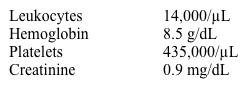 Chest x-ray reveals bilateral dense infiltrates involving both upper and lower right lung fields and the lower left lung field. Intravenous fluids, supplemental oxygen, and antibiotics are initiated.
Which of the following is the best next step in management of this patient?
Chest x-ray reveals bilateral dense infiltrates involving both upper and lower right lung fields and the lower left lung field. Intravenous fluids, supplemental oxygen, and antibiotics are initiated.
Which of the following is the best next step in management of this patient? (Multiple Choice)
4.8/5 (76)
(76) 
Filters
- Essay(0)
- Multiple Choice(0)
- Short Answer(0)
- True False(0)
- Matching(0)