



 Chat with AI
Exam 1: Emergency Department

Exam 1: Emergency Department218 Questions
Exam 2: In-patient Facilities128 Questions
Exam 3: Office/Health Center900 Questions
Select questions type


A 19-year-old man comes to the emergency department with penile pain. He started to get an erection about 2 hours ago, and it has not subsided. He took pain medications without relief. The patient has had no manipulation or trauma to his genitourinary tract. His only medical problem is sickle cell disease (Hb SS), with his usual vasoocclusive crisis being joint and bone pain. His last pain crisis was about 4 months ago. His medications include hydroxyurea, folate, oxycodone, and acetaminophen.
His temperature is 37.8 C (100 F), blood pressure is 140/90 mm Hg, pulse is 120/min, and respirations are 32/min. Pulse oximetry is 95% on room air. Examination shows a very uncomfortable man with an erect penis.
Laboratory results are as follows:
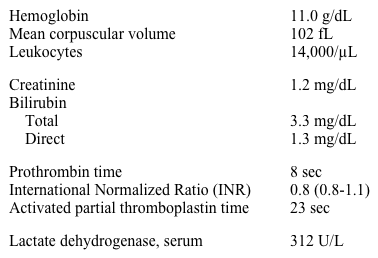 His chest x-ray shows no infiltrates.
Which of the following is the most appropriate next step in management?
His chest x-ray shows no infiltrates.
Which of the following is the most appropriate next step in management? (Multiple Choice)
4.8/5  (64)
(64) A 43-year-old man comes to the emergency department due to 5 days of slowly worsening fever, cough, and malaise. He has a history of HIV infection, and his last known CD4 count 3 months ago was 210/mm3. He also has a distant history of seizures. The patient drinks alcohol daily and was hospitalized for alcohol withdrawal a year ago.
Temperature is 38.3 C (100.9 F), blood pressure is 98/62 mm Hg, pulse is 111/min and regular, and respirations are 20/min. The patient has poor dentition. Small, mobile lymph nodes are palpable in the submandibular area. Scattered rhonchi are heard bilaterally. Heart sounds are normal with no murmur. The tip of the spleen is not palpable, and the liver span is normal.
Laboratory results are as follows:
 CT scan of the chest reveals several bilateral cavitating lesions. Blood cultures grow Staphylococcus aureus in 2 of 2 bottles.
Which of the following is most often associated with this patient's condition?
CT scan of the chest reveals several bilateral cavitating lesions. Blood cultures grow Staphylococcus aureus in 2 of 2 bottles.
Which of the following is most often associated with this patient's condition? (Multiple Choice)
4.9/5 (83)
(83) An 18-year-old man is brought to the emergency department because of acute onset of weakness and confusion. The accompanying family member found him on the floor at home mumbling incoherently and called 911. The patient is in good health, takes no medications, and has no previous history of a similar occurrence.
His temperature is 36.7 C (98 F), blood pressure is 110/70 mm Hg, pulse is 90/min, and oxygen saturation is 97% on room air. The patient is oriented only to person. His lungs are clear to auscultation. His abdomen is soft and non-tender. Cranial nerves are intact. There is flaccid weakness of all four extremities and absent deep tendon reflexes.
Laboratory results are as follows:
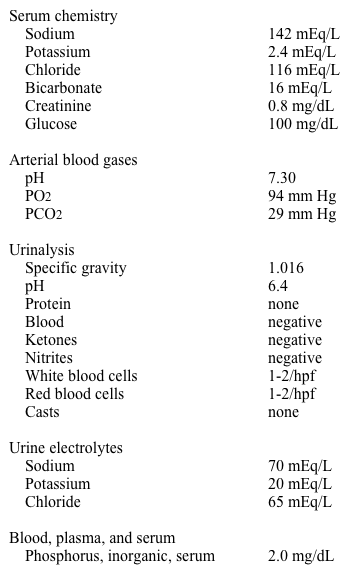 Which of the following is the most likely cause of this patient's condition?
 (Multiple Choice)
4.7/5 (83)
(83) A 43-year-old man comes to the hospital due to substernal chest pressure, dyspnea, and nausea that began an hour ago. He has a history of hypertension, hypercholesterolemia, and type 2 diabetes mellitus. He takes aspirin, lisinopril, rosuvastatin, metformin, and sitagliptin. The patient is triaged in the emergency department, and immediately goes into cardiac arrest. Advanced cardiac life support measures are implemented, including external chest compressions. The cardiac monitor shows ventricular tachycardia, but the first defibrillation attempt fails. Chest compressions are resumed, but no peripheral intravenous line can be obtained for medication administration.
Which of the following is the best way of administering medication to this patient?
(Multiple Choice)
4.9/5 (76)
(76) A 67-year-old woman comes to the emergency department with swelling of her right eyelid and lips. The swelling started an hour earlier and increased slowly until she became alarmed. She reports no trouble breathing and has had no abdominal pain. There is no associated itching or rash. Her past medical history includes congestive heart failure due to nonischemic cardiomyopathy, hypertension, hyperlipidemia, and osteoporosis. The patient's last left ventricular ejection fraction was 38%. She is able to walk 3-4 blocks without shortness of breath. Her current medications include furosemide, ramipril, simvastatin, and metoprolol succinate. There is no family history of similar occurrences.
The patient's blood pressure is 130/80 mm Hg, pulse is 72/min, and respirations are 14/min. Pulse oximetry is 98% on room air. There is non-pitting edema of her right eyelid and upper and lower lips. Cardiac examination reveals a 2/6 holosystolic murmur at the apex. There is no stridor and lung examination is normal. The remainder of the examination is within normal limits.
After observation and recovery, which of the following would be the best therapeutic option for this patient?
(Multiple Choice)
4.8/5 (89)
(89) A 65-year-old man comes to the emergency department because of severe right thigh pain for the last 4 weeks. Over the past two weeks, he has also noticed leg weakness that interferes with his walking. He has never had similar symptoms before. He had an unintentional weight loss of 15 lbs (6.8 kg) over the past 3 months. His other medical problems include type 2 diabetes mellitus, hypertension, and hyperlipidemia. He has no evidence of diabetic retinopathy or nephropathy. He had a right lung lobectomy for early stage, non-small cell lung cancer 7 years ago.
He was evaluated in the emergency department on two occasions over the last 2 months for severe lightheadedness that occurred in the morning while getting out of bed. His medications include glyburide, metformin, simvastatin, lisinopril, and low-dose aspirin.
His temperature is 37.0 C (98.6 F), blood pressure is 145/90 mm Hg (sitting) and 120/80 mm Hg (standing), and pulse is 90/min (sitting) and 105/min (standing). His BMI is 29 kg/m2. Neurological examination reveals normal mental status and cranial nerves. Manual motor testing reveals 3/5 strength in the right iliopsoas, hip adductors, and quadriceps with associated atrophy. Touch, pain, and temperature sensations are mildly decreased in this area. However, the hamstrings and distal muscles have 5/5 strength.
There are no fasciculations or contractures noted. His anal sphincter tone is normal. Deep tendon reflexes are 2+ in the arms and 0 in the lower extremities. Testing for Babinski sign shows down-going toes bilaterally. The remainder of the neurological examination is within normal limits.
Laboratory results are as follows:
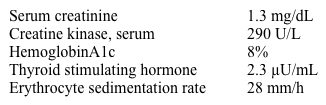 Which of the following is the most likely cause for this patient's current complaints?
 (Multiple Choice)
4.8/5 (80)
(80) A 38-year-old man is brought to the emergency department with generalized tonic-clonic seizures. His wife states that he had a similar episode a month ago but did not seek medical attention. The patient emigrated from Mexico several years ago and is HIV-negative.
On examination, he is lethargic but moves all extremities on command. A CT scan of the head reveals several small cystic lesions in the cortex bilaterally as well as scattered focal areas of calcifications.
Which of the following is the most likely diagnosis?
(Multiple Choice)
4.8/5 (89)
(89) A 38-year-old woman comes to the physician with the complaint of severe abdominal pain for 8 hours. The pain is crampy and periumbilical and occurs every 4 to 5 minutes. It is not improved with positional changes, and there is no radiation to the back. She has vomited 3 times since the pain began. Her last bowel movement was 18 hours ago. She denies any reflux symptoms, hematemesis, melena, or hematochezia. The patient's medical problems include depression, fibromyalgia, and hypothyroidism. Her surgical history includes appendectomy for a ruptured appendix 20 years ago, tonsillectomy, and breast lumpectomy. She does not use tobacco, alcohol, or illicit drugs.
Her temperature is 37.3 C (99.1 F), blood pressure is 110/80 mm Hg, pulse is 92/min, and respirations are 16/min. The abdomen is tender in the periumbilical area. There is no significant abdominal distension, rebound tenderness, or rigidity. Rectal examination shows an empty rectal vault, and test for occult blood is negative.
Laboratory results are as follows:
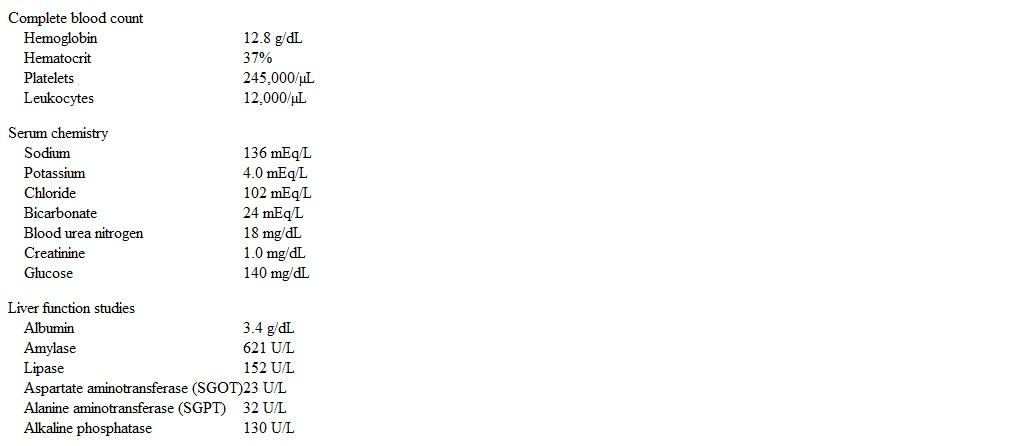 Urine pregnancy test is negative.
Which of the following is the most appropriate next step in this patient's management?
Urine pregnancy test is negative.
Which of the following is the most appropriate next step in this patient's management? (Multiple Choice)
4.9/5 (78)
(78) A 22-year-old woman comes to the emergency department because of pain and swelling in her left knee for the past three days. She denies fever, chills, skin rash, or dysuria. However, she reports a one-week episode of diarrhea one month ago. Stool cultures at that time were positive for Shigella flexneri, and the physician at the student health center prescribed ciprofloxacin for three days. She has no other past medical history and her last menstrual period was one week ago. She is sexually active with her new boyfriend.
Her temperature is 37.2 C (99 F), blood pressure is 117/68 mm Hg, and pulse is 87/min. On physical examination, her left knee is tender to palpation with signs of synovitis. Palpation of the patella evokes pain, but the patella is not ballotable and a fluid wave was not appreciated. The patient keeps the knee in flexion due to pain. She also has mild conjunctival injection, but the remainder of the physical examination is unremarkable.
Her leukocyte count is 9,500 cells/μL and erythrocyte sedimentation rate is 43 mm/hr. Radiographs of the knee do not reveal any fractures, but do confirm an effusion. Knee fluid aspiration shows a leukocyte count of 4,000 cells/μL. There are no crystals and Gram stain is negative. Blood and synovial fluid cultures are pending.
Which of the following is the best next step in managing this patient?
(Multiple Choice)
4.8/5 (65)
(65) A 28-year-old man comes to the emergency department due to a cough, malaise, skin rash, and migratory joint pain that began 5 days ago. Two weeks ago, he returned from a hiking trip in the southwestern United States. The patient has a history of ulcerative colitis diagnosed 2 years ago, which has been in remission since infliximab was started 6 months ago. His tuberculin skin testing was negative 7 months ago.
On examination, temperature is 38.3 C (101 F), blood pressure is 100/70 mm Hg, pulse is 92 /min, and respirations are 14/min. There are several tender, erythematous nodules 2-3 cm in size in both legs over the anterior shins. Oropharyngeal mucosa is dry without any erythema or exudate. On auscultation, fine basal crackles are heard on the left side. There is synovitis and tenderness of both knee joints. The rest of the examination is normal.
Laboratory studies show white blood cells are 16,000/mm3 (72% neutrophils) and platelets are 650,000/mm3. Chest x-ray is unremarkable.
Which of the following is the most likely diagnosis?
(Multiple Choice)
5.0/5 (84)
(84) A 36-year-old man comes to the emergency department due to a sudden onset of chest fluttering, dizziness, and weakness that started after breakfast an hour ago. He has had no chest pain or shortness of breath. The patient had a similar episode a month ago that woke him up from sleep, after which he went to the emergency department and was diagnosed with atrial fibrillation. The episode terminated spontaneously, and he was discharged with metoprolol and low-dose aspirin. Since then, the patient had been feeling well until today's symptoms began. Medical history is otherwise insignificant, and he has no family history of heart disease. The patient jogs 2 miles daily and tries to eat "healthy." He used to drink beer on the weekends, but he has abstained from alcohol for the past month. He is a lifelong nonsmoker.
Blood pressure is 118/67 mm Hg and pulse is 144/min and irregular. BMI is 26 kg/m2. The lungs are clear to auscultation.
ECG shows atrial fibrillation with rapid ventricular response. Transthoracic echocardiogram shows normal left ventricular size and function. Complete blood count and metabolic panel are unremarkable. TSH is 2.5 µU/mL.
After initial evaluation, electrical cardioversion is performed, which successfully restores normal sinus rhythm.
Which of the following is the best next step in management of this patient?
(Multiple Choice)
4.8/5 (84)
(84) A 54-year-old man comes to the emergency department due to several hours of left upper quadrant pain, which is constant and worsens with deep inspiration. The patient came to the emergency department a week ago due to fatigue and low-grade fevers for the past month. Blood cell counts, chest x-ray, and urinalysis were within normal limits, and the patient was discharged home with symptomatic treatment. He has had no cough, shortness of breath, vomiting, or diarrhea but reports a 4.5-kg (10-lb) weight loss over the past month. Medical history includes hypertension, osteoarthritis, and a "heart murmur." The patient is a smoker with a 30-pack-year history, drinks alcohol occasionally, and does not use illicit drugs. He is a livestock farmer in rural Pennsylvania and recently returned from a hunting trip.
Temperature is 38.4 C (101.1 F), blood pressure is 136/72 mm Hg, pulse is 90/min, and respirations are 16/min. The lungs are clear on auscultation. Heart sounds are normal, and a 2/6 early diastolic murmur is present at the right upper sternal border. The abdomen is tender in the left upper quadrant with no guarding or rebound tenderness.
Laboratory results are as follows:
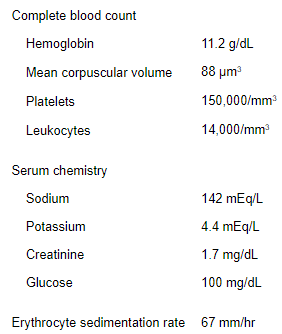 ECG shows sinus rhythm with nonspecific ST- and T-wave changes. CT scan of the abdomen reveals multiple splenic infarcts. Three sets of blood cultures obtained during the previous emergency department visit reveal no growth. Which of the following is the best next step in management of this patient?
 (Multiple Choice)
4.9/5 (88)
(88) A 22-year-old woman is brought to the emergency department by her boyfriend after an episode of syncope. The patient says she feels "fine" and wants to go home. She has no prior medical conditions and takes no medications. Her boyfriend states that she is in good health and that she exercises every day, sometimes even "too much" because she wants to be in great shape. The patient has smoked a pack of cigarettes daily for 2 years but does not use alcohol. She smokes marijuana at least twice a week.
Temperature is 36.7 C (98 F), blood pressure is 100/70 mm Hg, pulse is 114/min, and respirations are 16/min. BMI is 17 kg/m2. Physical examination shows dry mucous membranes and normal jugular venous pressure with no thyromegaly. The lungs are clear on auscultation and heart sounds are normal. The abdomen is soft and nontender. Neurologic examination is within normal limits.
Laboratory results are as follows:
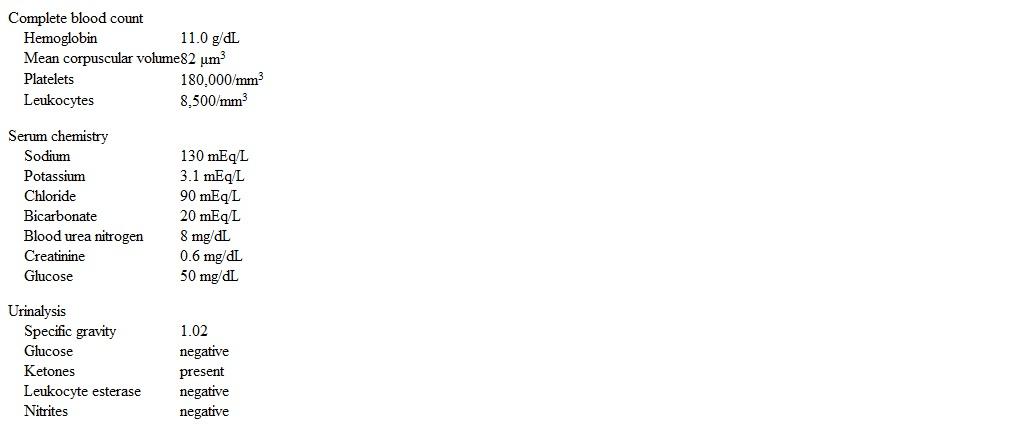 Urine pregnancy test results are negative. In the emergency department, 50% dextrose is administered and normal saline infusion is begun. Two hours later, the patient experiences sudden-onset double vision. On repeat examination, she appears mildly lethargic and there is lateral gaze palsy on the right side.
Which of the following is the most likely cause of this patient's vision disturbance?
Urine pregnancy test results are negative. In the emergency department, 50% dextrose is administered and normal saline infusion is begun. Two hours later, the patient experiences sudden-onset double vision. On repeat examination, she appears mildly lethargic and there is lateral gaze palsy on the right side.
Which of the following is the most likely cause of this patient's vision disturbance? (Multiple Choice)
4.9/5 (90)
(90) A 72-year-old man is brought to the emergency department because of sudden onset shortness of breath and sharp left-sided chest pain. He denies fever, loss of consciousness, or orthopnea. He was diagnosed with metastatic pancreatic cancer three months ago.
Examination reveals clear lungs with normal first and second heart sounds. The abdomen is soft and non-tender. There is trace edema involving the right leg. Neurologic examination is within normal limits.
Laboratory results are as follows:
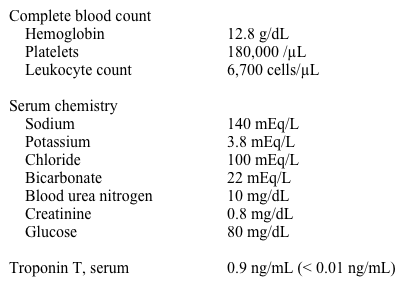 His chest-x ray is clear. Ultrasound of the right leg shows a thrombus in the popliteal vein. CT angiogram of the chest reveals bilateral pulmonary emboli.
Which of the following would be the most effective long-term treatment to prevent recurrent thromboembolism in this patient?
His chest-x ray is clear. Ultrasound of the right leg shows a thrombus in the popliteal vein. CT angiogram of the chest reveals bilateral pulmonary emboli.
Which of the following would be the most effective long-term treatment to prevent recurrent thromboembolism in this patient? (Multiple Choice)
4.9/5 (70)
(70) A 57-year-old woman with known myasthenia gravis is brought to the emergency department after 2 weeks of progressively worsening weakness in her arms and legs, fatigue, and intermittent shortness of breath. She could not eat breakfast today due to difficulty swallowing. Her only other medical problem is hypertension, and her medications include pyridostigmine, olmesartan, and chlorthalidone.
The patient's blood pressure is 122/72 mm Hg, pulse is 78/min, respirations are 14/min, and oxygen saturation is 98% on room air. Physical examination shows clear lung fields and normal first and second heart sounds. There is no nasal flaring or usage of accessory respiratory muscles. There is mild proximal weakness (4/5) in the arms and legs. Pinprick and light touch sensations are intact.
Her vital capacity is 25 mL/kg. Laboratory results include serum potassium of 3.8 mEq/L and serum creatinine of 0.8 mg/dL. Her chest x-ray is clear.
Which of the following is the most appropriate way to monitor this patient's respiratory status?
(Multiple Choice)
4.8/5 (71)
(71) A 25-year-old man is brought to the emergency department due to acute-onset dizziness, weakness, sweating, and confusion. The patient has a blood glucose level of 36 mg/dL, and his symptoms resolve with intravenous dextrose. He has no medical conditions and takes no medications. The patient has smoked intermittently for the last 5 years but does not use alcohol or illicit drugs. He is unemployed and lives with his parents. His father has type 2 diabetes mellitus and takes metformin and glyburide. His mother has hypertension treated with lisinopril.
Physical examination is unremarkable. The patient is hospitalized for observation. On the second day, he develops similar symptoms with a blood glucose level of 34 mg/dL; intravenous dextrose is again administered and his symptoms improve.
Laboratory results drawn during the second episode of hypoglycemia are as follows:
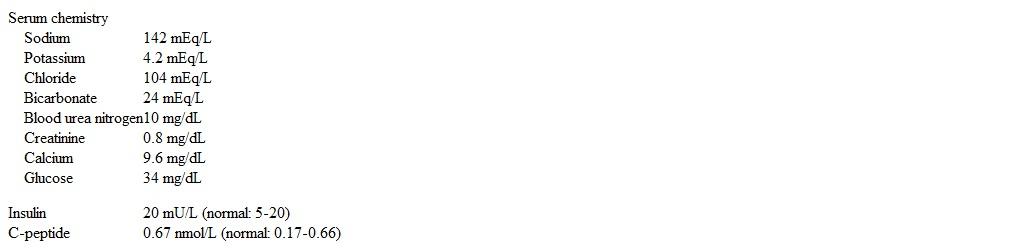 Which of the following is the best next step in evaluation of this patient?
 (Multiple Choice)
4.9/5 (87)
(87) A 43-year-old man comes to the emergency department with a 3-day history of fever, malaise, and chills. He was hospitalized a year ago for alcohol withdrawal symptoms but otherwise no medical history is available. He admits to using intravenous drugs.
The patient's temperature is 38.4 C (101.1 F), blood pressure is 144/90 mm Hg, and pulse is 102/min. He has poor oral dentition. A small white plaque is seen on the buccal mucosa. Cervical lymph nodes are palpable bilaterally but are small and nontender. Lungs are clear on auscultation. There is a short 2/6 early diastolic murmur heard at the right upper sternal border. The abdomen is soft and nontender. Extremity pulses are full and symmetric, and there is no edema.
Laboratory results are as follows:
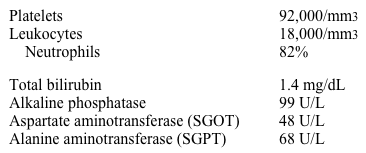 Blood cultures are sent.
Which of the following tests is most important for making treatment decisions at this point?
Blood cultures are sent.
Which of the following tests is most important for making treatment decisions at this point? (Multiple Choice)
4.9/5 (82)
(82) A 78-year-old woman who resides in an assisted living facility is brought to the emergency department after having a tonic-clonic seizure. Her caretakers state that the patient became mildly confused and had a headache yesterday. Earlier today, the patient had involuntary shaking of her right upper and lower extremities followed by a generalized tonic-clonic seizure. The patient's family reports that she has not had any sick contacts or recent travel. She has no cough, shortness of breath, diarrhea, or urinary symptoms. Her other medical problems include hypertension and hyperlipidemia. The patient has no known allergies.
Her temperature is 38.1 C (100.8 F), blood pressure is 140/88 mm Hg, pulse is 90/min and regular, respirations are 13/min, and oxygen saturation is 98% on room air. The general physical examination is unremarkable. On neurologic examination, the patient appears obtunded and does not follow commands. On manual motor testing, she is able to localize to pain bilaterally and to withdraw her lower extremities to pain.
A non-contrast head CT shows no mass, bleeding, or parenchymal abnormalities. Chest x-ray shows no infiltrates. Urinalysis shows clear urine, negative nitrites, negative leukocyte esterase, 5−10 leukocytes/hpf, and few bacteria. A lumbar puncture is attempted but is unsuccessful. Intravenous vancomycin, ampicillin, and ceftriaxone are administered.
Which of the following is the best next step in management of this patient?
(Multiple Choice)
4.7/5 (80)
(80) A 26-year-old man is brought to the emergency department due to a severe headache that started 2 hours ago and has steadily become worse. The patient says the pain is dull, diffuse, and associated with nausea, vomiting, lightheadedness, and blurred vision. Medical history is unremarkable, although he is currently being evaluated for loss of libido and erectile dysfunction. A week ago, laboratory results showed low testosterone, low gonadotropins, and high prolactin levels; TSH and free T4 were normal. The patient does not use tobacco, alcohol, or illicit drugs.
Temperature is 36.7 C (98 F), blood pressure is 80/50 mm Hg, and pulse is 114/min. He is diaphoretic and appears to be in significant distress, although he is awake and oriented to time, place, and person. Pupils are 4 mm, symmetric, and reactive to light. There is ptosis of the right eyelid and decreased adduction of the right eyeball on left gaze. Visual field examination on confrontation shows bitemporal visual field defects. There is no nuchal rigidity. The remainder of the examination is unremarkable.
Laboratory results are as follows:
 What is the most appropriate immediate next step in management of this patient?
 (Multiple Choice)
4.8/5 (75)
(75) A 24-year-old woman comes to the emergency department with a cat bite. There was blood at the puncture site, which she rapidly cleaned with water. The cat demonstrated no abnormal behavior. The patient has no significant past medical history and received a tetanus booster 4 years ago. She developed hives after receiving penicillin 5 years ago but has since tolerated cephalosporins without allergic reaction. She takes no medications.
She is afebrile, her vital signs are normal, and she has no rash. There is a clean-appearing puncture wound on the medial left hand with mild swelling and surrounding erythema. There is no tenderness over the surrounding bone. The wound is cleaned.
Which of the following is the best next step in managing this patient?
(Multiple Choice)
4.8/5 (72)
(72) 
Filters
- Essay(0)
- Multiple Choice(0)
- Short Answer(0)
- True False(0)
- Matching(0)