Multiple Choice
A 24-year-old man with sickle cell disease (hemoglobin SS) comes to the emergency department with chest pain and shortness of breath. He has felt unwell for the last several days with increasing extremity, abdominal, and chest pain. The patient took extra doses of oral morphine with little relief. He stopped taking hydroxyurea 4 months ago due to stomach upset.
His blood pressure is 122/72 mm Hg, pulse is 108/min, respirations are 22/min, and oxygen saturation is 84% on room air. Bilateral crackles are heard on chest auscultation. A 2/6 midsystolic murmur is heard at the left upper sternal border. The abdomen is diffusely tender without rebound. There is no swelling of the extremities.
Laboratory results are as follows: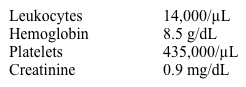
Chest x-ray reveals bilateral dense infiltrates involving both upper and lower right lung fields and the lower left lung field. Intravenous fluids, supplemental oxygen, and antibiotics are initiated.
Which of the following is the best next step in management of this patient?
A) Exchange transfusion
B) Glucocorticoid therapy
C) Hydroxyurea
D) Naloxone
E) Noninvasive ventilation
Correct Answer:

Verified
Correct Answer:
Verified
Q155: A 23-year-old woman is brought to the
Q156: A 54-year-old man comes to the emergency
Q157: A 57-year-old man with known liver cirrhosis
Q158: A 53-year-old man comes to the emergency
Q159: A 65-year-old man comes to the emergency
Q161: A 50-year-old man is brought to the
Q162: A 47-year-old man is brought to the
Q163: A 38-year-old man comes to the emergency
Q164: A 54-year-old man comes to the emergency
Q165: A 21-year-old woman comes to the emergency