



 Chat with AI
Exam 8: Late Antiquity

Exam 1: Art in the Stone Age50 Questions
Exam 2: Ancient Mesopotamia and Persia50 Questions
Exam 3: Egypt From Narmer to Cleopatra50 Questions
Exam 4: The Prehistoric Aegean50 Questions
Exam 5: Ancient Greece50 Questions
Exam 6: The Etruscans50 Questions
Exam 7: The Roman Empire50 Questions
Exam 8: Late Antiquity50 Questions
Exam 9: Byzantium50 Questions
Exam 10: The Islamic World50 Questions
Exam 11: Early Medieval Europe50 Questions
Exam 12: Romanesque Europe50 Questions
Exam 13: Gothic Europe North of the Alps50 Questions
Exam 14: Late Medieval Italy50 Questions
Exam 15: South and Southeast Asia Before 120050 Questions
Exam 16: China and Korea to 127950 Questions
Exam 17: Japan Before 133350 Questions
Exam 18: Native American Cultures Before 130049 Questions
Exam 19: Africa Before 180050 Questions
Exam 20: Late Medieval and Early Renaissance Northern Europe50 Questions
Exam 21: The Renaissance in Quattrocento Italy50 Questions
Exam 22: Renaissance and Mannerism in Cinquecento Italy50 Questions
Exam 23: High Renaissance and Mannerism in Northern Europe and Spain50 Questions
Exam 24: The Baroque in Italy and Spain50 Questions
Exam 25: The Baroque in Northern Europe50 Questions
Exam 26: Rococo to Neoclassicism: the 18th Century in Europe and America50 Questions
Exam 27: Romanticism, Realism, Photography: Europe and America, 1800 to 187050 Questions
Exam 28: Impressionism, Post-Impressionism, Symbolism: Europe and America, 1870 to 190050 Questions
Exam 29: Modernism in Europe, 1900 to 194550 Questions
Exam 30: Modernism in the United States and Mexico, 1900 to 194550 Questions
Exam 31: Modernism and Postmodernism in Europe and America, 1945 to 198050 Questions
Exam 32: Contemporary Art Worldwide50 Questions
Exam 33: South and Southeast Asia, 1200 to 198050 Questions
Exam 34: China and Korea, 1279 to 198050 Questions
Exam 35: Japan, 1333 to 198050 Questions
Exam 36: Native American Cultures, 1300 to 198050 Questions
Exam 37: Oceania Before 198050 Questions
Exam 38: Africa, 1800 to 198050 Questions
Select questions type


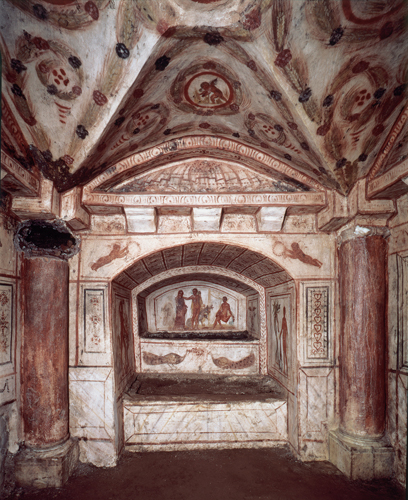 What Greco-Roman figure is celebrated in the painting program of Cubiculum N, seen here?
 (Multiple Choice)
4.9/5  (66)
(66)
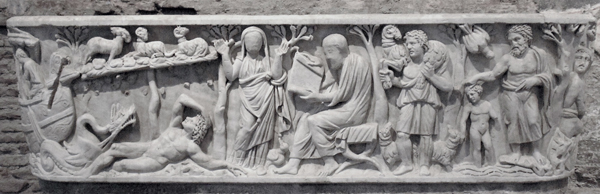 What is the subject of the scene that occupies the left third of the sarcophagus of Santa Maria Antiqua shown here?
 (Multiple Choice)
4.9/5 (90)
(90) How was natural light provided in Early Christian basilicas?
(Multiple Choice)
4.8/5 (83)
(83) Which aspect of Greco-Roman temple architecture was retained in the Early Christian basilica?
(Multiple Choice)
4.8/5 (77)
(77) Why is a family group shown praying in the lunette of the Catacomb of Saints Peter and Marcellinus?
(Multiple Choice)
4.8/5 (76)
(76) The word tessera, used to describe small mosaic tiles, comes from the Latin word for which of the following?
(Multiple Choice)
4.9/5 (85)
(85) The exterior of Santa Sabina in Rome most closely resembled the exterior of which building?
(Multiple Choice)
4.9/5 (87)
(87) Which body of subject matter survives in the decoration of the Mildenhall Treasure, especially the "Great Dish"?
(Multiple Choice)
4.9/5 (85)
(85) What invention greatly aided the distribution of manuscripts during the Early Roman Empire?
(Multiple Choice)
4.8/5 (83)
(83) Which of the following attributes was used to depict Christ after Christianity was officially recognized by Roman authorities?
(Multiple Choice)
4.9/5 (81)
(81)
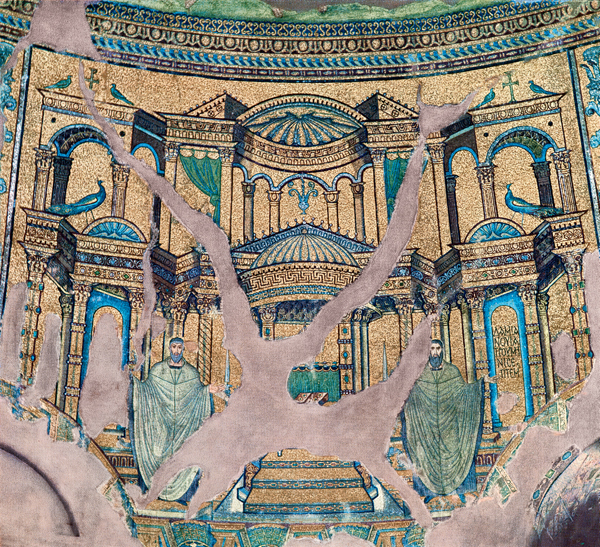 What activity is implied by the gestures of the two male figures in this mosaic?
 (Multiple Choice)
4.8/5 (75)
(75) Which architectural form did Christian architects choose to adopt for the first public buildings where the Christian liturgy would be celebrated?
(Multiple Choice)
4.9/5 (84)
(84) Which phrase best describes the style of the Christ as Good Shepherd mosaic from the Mausoleum of Galla Placidia at Ravenna?
(Multiple Choice)
4.8/5 (63)
(63) Why is the Christian community house in Dura-Europos such a small building?
(Multiple Choice)
4.7/5 (93)
(93)
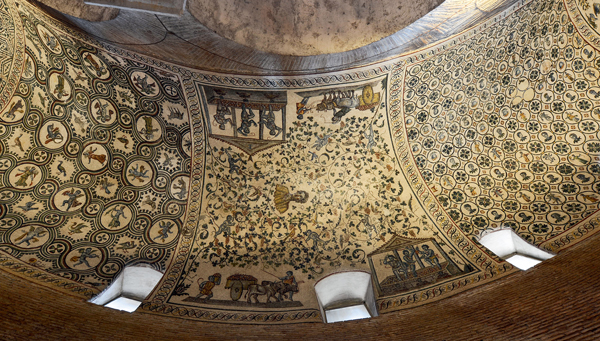 What is the Christian interpretation of these vineyard scenes?
 (Multiple Choice)
4.7/5 (80)
(80) Which Roman monument do the figures in the painting illustrating the Book of Samuel in the synagogue at Dura-Europos LEAST resemble?
(Multiple Choice)
4.9/5 (84)
(84) Which of the following is NOT characteristic of Late Antique Christian art?
(Multiple Choice)
4.8/5 (69)
(69) What do the mural paintings at Dura-Europos suggest was a component of the decoration of many Late Antique synagogues?
(Multiple Choice)
4.8/5 (94)
(94)
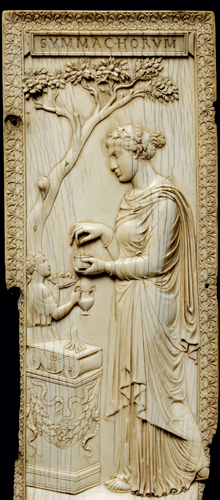 Which motif appearing on this ivory plaque ties the piece to the Christian tradition?
 (Multiple Choice)
4.9/5 (74)
(74) Which of the following is the closest predecessor for Santa Costanza?
(Multiple Choice)
4.8/5 (79)
(79) 
Filters
- Essay(0)
- Multiple Choice(0)
- Short Answer(0)
- True False(0)
- Matching(0)