



 Chat with AI
Exam 5: Ancient Greece

Exam 1: Art in the Stone Age50 Questions
Exam 2: Ancient Mesopotamia and Persia50 Questions
Exam 3: Egypt From Narmer to Cleopatra50 Questions
Exam 4: The Prehistoric Aegean50 Questions
Exam 5: Ancient Greece50 Questions
Exam 6: The Etruscans50 Questions
Exam 7: The Roman Empire50 Questions
Exam 8: Late Antiquity50 Questions
Exam 9: Byzantium50 Questions
Exam 10: The Islamic World50 Questions
Exam 11: Early Medieval Europe50 Questions
Exam 12: Romanesque Europe50 Questions
Exam 13: Gothic Europe North of the Alps50 Questions
Exam 14: Late Medieval Italy50 Questions
Exam 15: South and Southeast Asia Before 120050 Questions
Exam 16: China and Korea to 127950 Questions
Exam 17: Japan Before 133350 Questions
Exam 18: Native American Cultures Before 130049 Questions
Exam 19: Africa Before 180050 Questions
Exam 20: Late Medieval and Early Renaissance Northern Europe50 Questions
Exam 21: The Renaissance in Quattrocento Italy50 Questions
Exam 22: Renaissance and Mannerism in Cinquecento Italy50 Questions
Exam 23: High Renaissance and Mannerism in Northern Europe and Spain50 Questions
Exam 24: The Baroque in Italy and Spain50 Questions
Exam 25: The Baroque in Northern Europe50 Questions
Exam 26: Rococo to Neoclassicism: the 18th Century in Europe and America50 Questions
Exam 27: Romanticism, Realism, Photography: Europe and America, 1800 to 187050 Questions
Exam 28: Impressionism, Post-Impressionism, Symbolism: Europe and America, 1870 to 190050 Questions
Exam 29: Modernism in Europe, 1900 to 194550 Questions
Exam 30: Modernism in the United States and Mexico, 1900 to 194550 Questions
Exam 31: Modernism and Postmodernism in Europe and America, 1945 to 198050 Questions
Exam 32: Contemporary Art Worldwide50 Questions
Exam 33: South and Southeast Asia, 1200 to 198050 Questions
Exam 34: China and Korea, 1279 to 198050 Questions
Exam 35: Japan, 1333 to 198050 Questions
Exam 36: Native American Cultures, 1300 to 198050 Questions
Exam 37: Oceania Before 198050 Questions
Exam 38: Africa, 1800 to 198050 Questions
Select questions type


What would have been the original context of the Geometric krater?
(Multiple Choice)
4.9/5  (81)
(81) 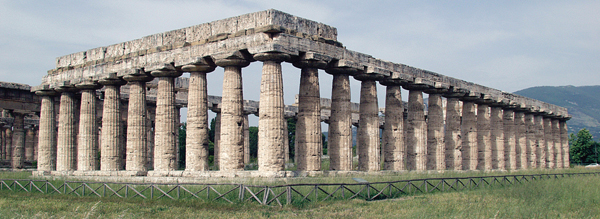 What is the name and location of this monument?
What was the function of one of the side chambers of the Propylaia on the Athenian Acropolis?
(Multiple Choice)
4.9/5 (91)
(91) What technique did the sculptor Polykleitos use in his Doryphoros to impose order on human movement?
(Multiple Choice)
4.8/5 (77)
(77)
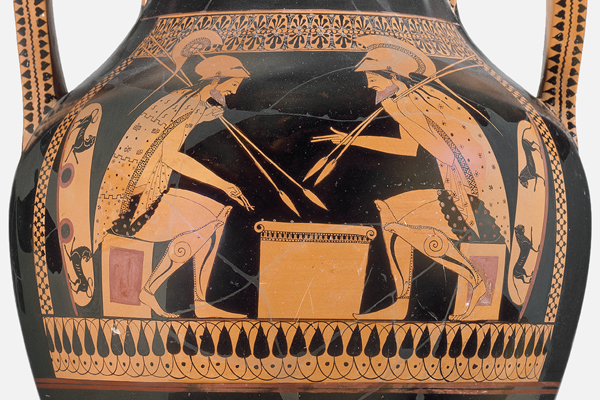 Who is usually given credit for the invention of the red-figure technique, shown here?
 (Multiple Choice)
4.9/5 (84)
(84) What technique was used to create the Charioteer of Delphi ?
(Multiple Choice)
4.8/5 (67)
(67) What is the effect of the drapery worn by the three goddesses in the Parthenon east pediment?
(Multiple Choice)
4.8/5 (82)
(82)
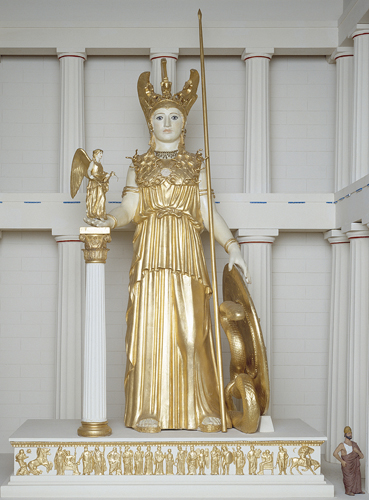 What materials made up the real statue of Athena Parthenos?
 (Multiple Choice)
4.8/5 (71)
(71) What style of Greek vase painting replaced the black-figure style?
(Multiple Choice)
4.8/5 (87)
(87) Which statue is the earliest known example of the use of contrapposto in sculpture?
(Multiple Choice)
4.7/5 (71)
(71)
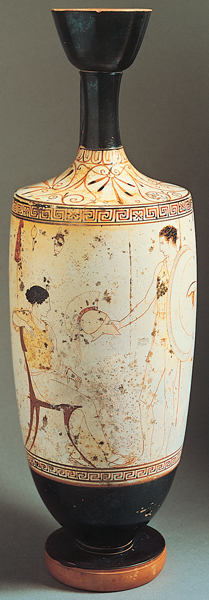 What scene is represented on this Athenian white-ground lekythos by the Achilles Painter?
 (Multiple Choice)
4.8/5 (87)
(87) 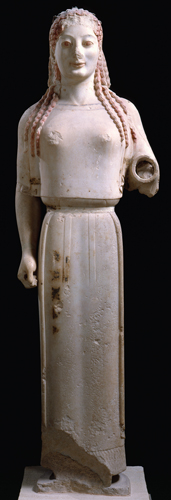 What explains the markings on this statue?
The statue group of Laocoön and his sons shows a scene from which work?
(Multiple Choice)
4.8/5 (71)
(71) Which was the costliest sculptural component of the Athenian Parthenon?
(Multiple Choice)
4.9/5 (71)
(71) Which of the following was not built on the Athenian Acropolis?
(Multiple Choice)
5.0/5 (80)
(80) Which feature supports the hypothesis that the Lady of Auxerre is a kore rather than a goddess?
(Multiple Choice)
4.9/5 (82)
(82) What is the name of the sculpture in which Praxiteles took the unprecedented step of representing a female nude?
(Multiple Choice)
4.8/5 (88)
(88) What is the subject of the tomb painting preserved at Vergina?
(Multiple Choice)
4.9/5 (79)
(79) What do scholars mostly agree is the subject of the lengthy Ionic frieze on the Parthenon?
(Multiple Choice)
4.9/5 (80)
(80) 
Filters
- Essay(0)
- Multiple Choice(0)
- Short Answer(0)
- True False(0)
- Matching(0)