



 Chat with AI
Exam 24: The Baroque in Italy and Spain

Exam 1: Art in the Stone Age50 Questions
Exam 2: Ancient Mesopotamia and Persia50 Questions
Exam 3: Egypt From Narmer to Cleopatra50 Questions
Exam 4: The Prehistoric Aegean50 Questions
Exam 5: Ancient Greece50 Questions
Exam 6: The Etruscans50 Questions
Exam 7: The Roman Empire50 Questions
Exam 8: Late Antiquity50 Questions
Exam 9: Byzantium50 Questions
Exam 10: The Islamic World50 Questions
Exam 11: Early Medieval Europe50 Questions
Exam 12: Romanesque Europe50 Questions
Exam 13: Gothic Europe North of the Alps50 Questions
Exam 14: Late Medieval Italy50 Questions
Exam 15: South and Southeast Asia Before 120050 Questions
Exam 16: China and Korea to 127950 Questions
Exam 17: Japan Before 133350 Questions
Exam 18: Native American Cultures Before 130049 Questions
Exam 19: Africa Before 180050 Questions
Exam 20: Late Medieval and Early Renaissance Northern Europe50 Questions
Exam 21: The Renaissance in Quattrocento Italy50 Questions
Exam 22: Renaissance and Mannerism in Cinquecento Italy50 Questions
Exam 23: High Renaissance and Mannerism in Northern Europe and Spain50 Questions
Exam 24: The Baroque in Italy and Spain50 Questions
Exam 25: The Baroque in Northern Europe50 Questions
Exam 26: Rococo to Neoclassicism: the 18th Century in Europe and America50 Questions
Exam 27: Romanticism, Realism, Photography: Europe and America, 1800 to 187050 Questions
Exam 28: Impressionism, Post-Impressionism, Symbolism: Europe and America, 1870 to 190050 Questions
Exam 29: Modernism in Europe, 1900 to 194550 Questions
Exam 30: Modernism in the United States and Mexico, 1900 to 194550 Questions
Exam 31: Modernism and Postmodernism in Europe and America, 1945 to 198050 Questions
Exam 32: Contemporary Art Worldwide50 Questions
Exam 33: South and Southeast Asia, 1200 to 198050 Questions
Exam 34: China and Korea, 1279 to 198050 Questions
Exam 35: Japan, 1333 to 198050 Questions
Exam 36: Native American Cultures, 1300 to 198050 Questions
Exam 37: Oceania Before 198050 Questions
Exam 38: Africa, 1800 to 198050 Questions
Select questions type


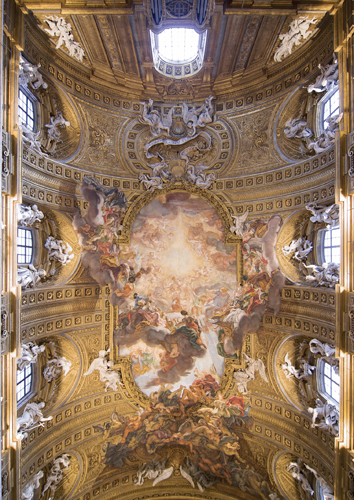 How does Giovanni Battista Gaulli depict Jesus in his ceiling fresco Triumph of the Name of Jesus for Il Gesù?
 (Multiple Choice)
4.8/5  (71)
(71) The quiet and contemplative paintings of Francisco de Zurbarán were well suited to the needs of his patrons, which were primarily who?
(Multiple Choice)
4.9/5 (92)
(92)
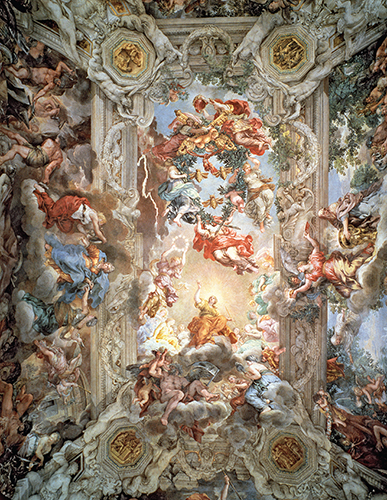 Which painter deployed the drama and majesty offered by the height and scale of a ceiling fresco to glorify the Barberini family in Triumph of the Barberini ?
 (Multiple Choice)
4.8/5 (87)
(87) What symbolism do art historians assign to the three (rather than four) pendentives used by Guarini to support the dome of the chapel of the Santissima Sindone?
(Multiple Choice)
4.8/5 (80)
(80) Why did Pope Paul V have Saint Peter's changed from its central plan with the addition of three nave bays?
(Multiple Choice)
4.9/5 (59)
(59) Which painter was responsible for establishing still life as an important genre of painting in 17th-century Spain?
(Multiple Choice)
4.9/5 (86)
(86) The Baroque element of Bernini's sculptural art is most evident in which aspect of his David ?
(Multiple Choice)
4.7/5 (88)
(88)
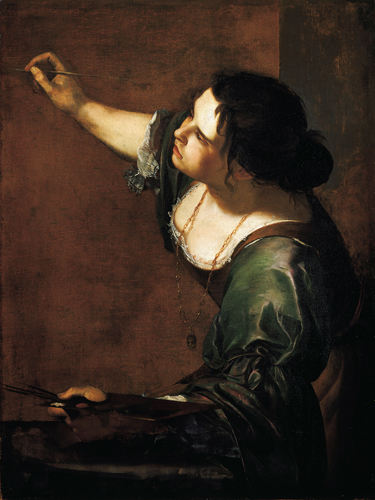 In her depiction of the figure La Pittura , Artemesia Gentileschi took the iconography and attributes of the image from which contemporary handbook?
 (Multiple Choice)
4.9/5 (77)
(77) What was the setting of Pietro da Cartona's Triumph of the Barberini?
(Multiple Choice)
4.8/5 (78)
(78) Which of the following Renaissance churches influenced Maderno's design for Santa Susanna in Rome?
(Multiple Choice)
4.9/5 (79)
(79) 
Filters
- Essay(0)
- Multiple Choice(0)
- Short Answer(0)
- True False(0)
- Matching(0)