



 Chat with AI
Exam 23: High Renaissance and Mannerism in Northern Europe and Spain

Exam 1: Art in the Stone Age50 Questions
Exam 2: Ancient Mesopotamia and Persia50 Questions
Exam 3: Egypt From Narmer to Cleopatra50 Questions
Exam 4: The Prehistoric Aegean50 Questions
Exam 5: Ancient Greece50 Questions
Exam 6: The Etruscans50 Questions
Exam 7: The Roman Empire50 Questions
Exam 8: Late Antiquity50 Questions
Exam 9: Byzantium50 Questions
Exam 10: The Islamic World50 Questions
Exam 11: Early Medieval Europe50 Questions
Exam 12: Romanesque Europe50 Questions
Exam 13: Gothic Europe North of the Alps50 Questions
Exam 14: Late Medieval Italy50 Questions
Exam 15: South and Southeast Asia Before 120050 Questions
Exam 16: China and Korea to 127950 Questions
Exam 17: Japan Before 133350 Questions
Exam 18: Native American Cultures Before 130049 Questions
Exam 19: Africa Before 180050 Questions
Exam 20: Late Medieval and Early Renaissance Northern Europe50 Questions
Exam 21: The Renaissance in Quattrocento Italy50 Questions
Exam 22: Renaissance and Mannerism in Cinquecento Italy50 Questions
Exam 23: High Renaissance and Mannerism in Northern Europe and Spain50 Questions
Exam 24: The Baroque in Italy and Spain50 Questions
Exam 25: The Baroque in Northern Europe50 Questions
Exam 26: Rococo to Neoclassicism: the 18th Century in Europe and America50 Questions
Exam 27: Romanticism, Realism, Photography: Europe and America, 1800 to 187050 Questions
Exam 28: Impressionism, Post-Impressionism, Symbolism: Europe and America, 1870 to 190050 Questions
Exam 29: Modernism in Europe, 1900 to 194550 Questions
Exam 30: Modernism in the United States and Mexico, 1900 to 194550 Questions
Exam 31: Modernism and Postmodernism in Europe and America, 1945 to 198050 Questions
Exam 32: Contemporary Art Worldwide50 Questions
Exam 33: South and Southeast Asia, 1200 to 198050 Questions
Exam 34: China and Korea, 1279 to 198050 Questions
Exam 35: Japan, 1333 to 198050 Questions
Exam 36: Native American Cultures, 1300 to 198050 Questions
Exam 37: Oceania Before 198050 Questions
Exam 38: Africa, 1800 to 198050 Questions
Select questions type


Which of the following paintings cannot be viewed as a moralizing work pertaining to the materialism of earthly existence?
(Multiple Choice)
4.9/5  (82)
(82)
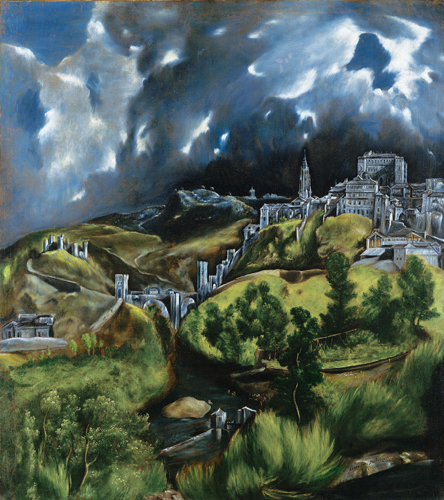 Which Spanish city has El Greco depicted in this painting?
 (Multiple Choice)
4.8/5 (94)
(94) What is the size of Levina Teerlinc's portrait Elizabeth I as a Princess ?
(Multiple Choice)
4.7/5 (85)
(85) Which was the dominant European power at the end of the 16th century, controlling an empire of a vast extent?
(Multiple Choice)
4.9/5 (80)
(80)
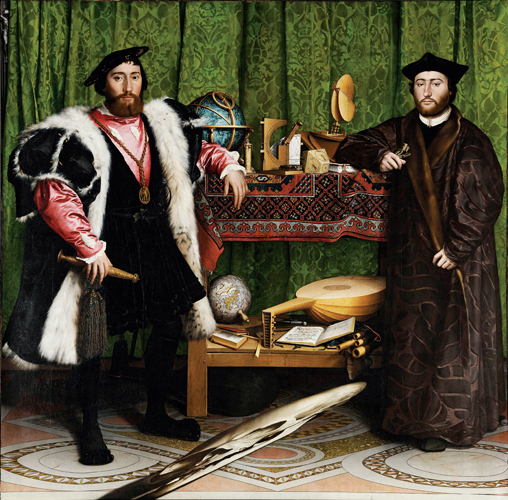 In The French Ambassadors , Holbein has painted the two French ambassadors to England through the lens of which school of thought?
 (Multiple Choice)
4.9/5 (65)
(65)
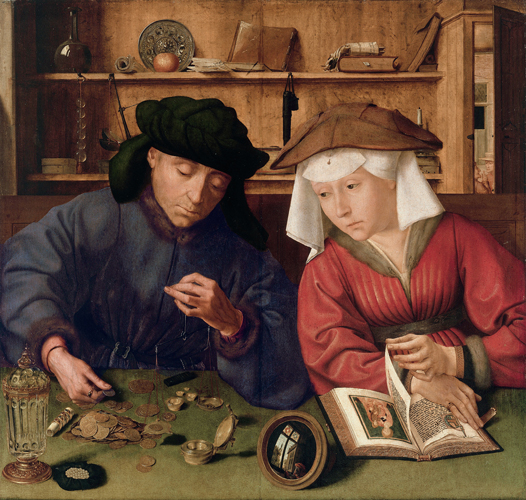 Which of the following everyday objects depicted in Money-Changer and His Wife is NOT a symbol of religion commonly appearing in Netherlandish art?
 (Multiple Choice)
4.8/5 (70)
(70) Which artist provided the illustrations for Luther's translation of the Bible into German?
(Multiple Choice)
4.9/5 (90)
(90) Which statement accurately describes the doctrinal differences between Protestantism and Catholicism regarding religious imagery?
(Multiple Choice)
4.9/5 (89)
(89) Which artist had traveled to Italy yet chose not to incorporate classical elements into his work?
(Multiple Choice)
4.8/5 (90)
(90) Which of the following individuals was not the subject of a portrait painted by Hans Holbein the Younger?
(Multiple Choice)
4.8/5 (79)
(79) Which subject that became common in German art of the 16th century involved macabre scenes and female nudity?
(Multiple Choice)
4.8/5 (91)
(91) Which foreign ruler controlled the region of the Netherlands in the 16th century and attempted to impose Catholicism on its entire population?
(Multiple Choice)
4.9/5 (74)
(74) The portrait Elizabeth I as a Princess , showing her as an elegant, formally attired young Elizabeth was created by which artist?
(Multiple Choice)
4.8/5 (89)
(89)
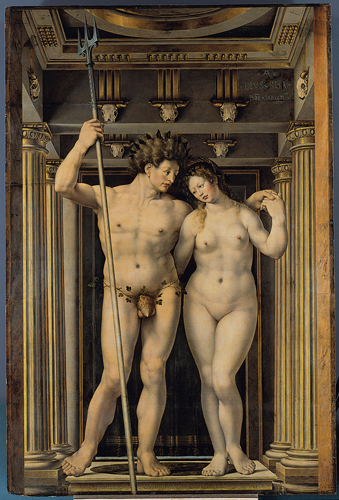 A work by which other artist inspired Gossaert's Neptune and Amphitrite ?
 (Multiple Choice)
4.8/5 (91)
(91) Many aspects of El Greco's works, such as the placement of elongated figures in an undefined space, are characterized as what style?
(Multiple Choice)
4.9/5 (82)
(82) Which saint, associated with the plague, has a prominent role in the Isenheim Altarpiece ?
(Multiple Choice)
4.8/5 (84)
(84) From which source did Albrecht Altdorfer derive the landscape depiction appearing in his painting Battle of Issus ?
(Multiple Choice)
4.9/5 (79)
(79) Saint Anthony and Saint Sebastian appear in Grünewald's Isenheim Altarpiece because of their association with what?
(Multiple Choice)
4.9/5 (79)
(79)
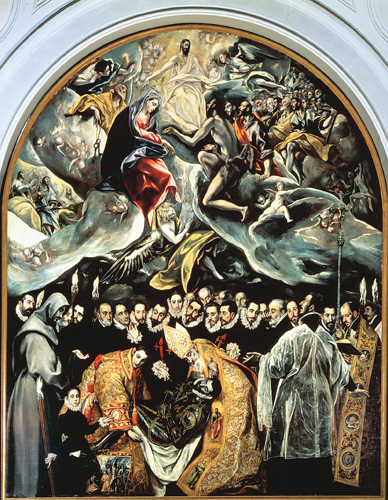 Amid the realism of the earthly realm in Burial of Count Orgaz , El Greco's careful delineation of individual features reveals his talent for what genre?
 (Multiple Choice)
4.7/5 (95)
(95) 
Filters
- Essay(0)
- Multiple Choice(0)
- Short Answer(0)
- True False(0)
- Matching(0)