



 Chat with AI
Exam 20: Late Medieval and Early Renaissance Northern Europe

Exam 1: Art in the Stone Age50 Questions
Exam 2: Ancient Mesopotamia and Persia50 Questions
Exam 3: Egypt From Narmer to Cleopatra50 Questions
Exam 4: The Prehistoric Aegean50 Questions
Exam 5: Ancient Greece50 Questions
Exam 6: The Etruscans50 Questions
Exam 7: The Roman Empire50 Questions
Exam 8: Late Antiquity50 Questions
Exam 9: Byzantium50 Questions
Exam 10: The Islamic World50 Questions
Exam 11: Early Medieval Europe50 Questions
Exam 12: Romanesque Europe50 Questions
Exam 13: Gothic Europe North of the Alps50 Questions
Exam 14: Late Medieval Italy50 Questions
Exam 15: South and Southeast Asia Before 120050 Questions
Exam 16: China and Korea to 127950 Questions
Exam 17: Japan Before 133350 Questions
Exam 18: Native American Cultures Before 130049 Questions
Exam 19: Africa Before 180050 Questions
Exam 20: Late Medieval and Early Renaissance Northern Europe50 Questions
Exam 21: The Renaissance in Quattrocento Italy50 Questions
Exam 22: Renaissance and Mannerism in Cinquecento Italy50 Questions
Exam 23: High Renaissance and Mannerism in Northern Europe and Spain50 Questions
Exam 24: The Baroque in Italy and Spain50 Questions
Exam 25: The Baroque in Northern Europe50 Questions
Exam 26: Rococo to Neoclassicism: the 18th Century in Europe and America50 Questions
Exam 27: Romanticism, Realism, Photography: Europe and America, 1800 to 187050 Questions
Exam 28: Impressionism, Post-Impressionism, Symbolism: Europe and America, 1870 to 190050 Questions
Exam 29: Modernism in Europe, 1900 to 194550 Questions
Exam 30: Modernism in the United States and Mexico, 1900 to 194550 Questions
Exam 31: Modernism and Postmodernism in Europe and America, 1945 to 198050 Questions
Exam 32: Contemporary Art Worldwide50 Questions
Exam 33: South and Southeast Asia, 1200 to 198050 Questions
Exam 34: China and Korea, 1279 to 198050 Questions
Exam 35: Japan, 1333 to 198050 Questions
Exam 36: Native American Cultures, 1300 to 198050 Questions
Exam 37: Oceania Before 198050 Questions
Exam 38: Africa, 1800 to 198050 Questions
Select questions type


Which of the following is NOT one of the significant advances in artistic production that occurred in the 15th century?
(Multiple Choice)
4.9/5  (77)
(77) What is the focus of Dieric Bouts's depiction of the Last Supper in his Altarpiece of the Holy Sacrament ?
(Multiple Choice)
4.8/5 (82)
(82) Which of the following would explain why the Well of Moses created by Claus Sluter did not actually spout water?
(Multiple Choice)
4.7/5 (68)
(68) 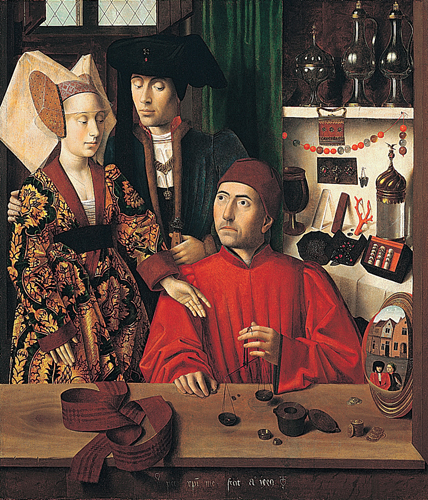 Who painted A Goldsmith in His Shop ?
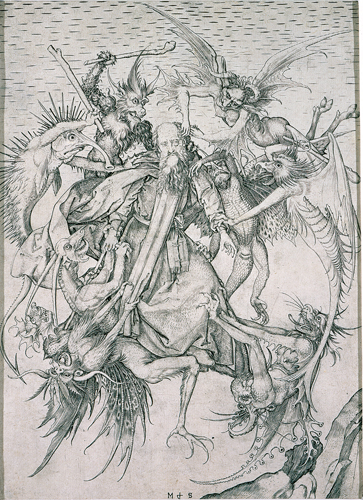 What method was used to produce this artwork?
The illusionism found in French manuscript painting was influenced by contact with which area?
(Multiple Choice)
4.9/5 (71)
(71) Which work do art historians consider to include a detailed self-portrait of Jan van Eyck?
(Multiple Choice)
4.9/5 (76)
(76) What is significant about the landscape depiction in Konrad Witz's Miraculous Draft of Fish ?
(Multiple Choice)
4.8/5 (79)
(79) Which of the following is the title of Martin Schongauer's engraving?
(Multiple Choice)
4.8/5 (74)
(74) Which artist made Agnes Sorel, the mistress of King Charles VII, the model for the Madonna in his painting of the Virgin and Child ?
(Multiple Choice)
4.7/5 (80)
(80) Which of the following was a dynastic symbol of Burgundian power?
(Multiple Choice)
4.8/5 (72)
(72) What term describes portraits of individuals that accompany religious scenes?
(Multiple Choice)
4.9/5 (81)
(81) Which of the following is NOT a technique used by Martin Schongauer to create tonal varieties and textures in his engraving of Saint Anthony?
(Multiple Choice)
4.9/5 (65)
(65) Which Florentine artist reproduced a motif from the Portinari Altarpiece in one of his own works?
(Multiple Choice)
4.8/5 (77)
(77)
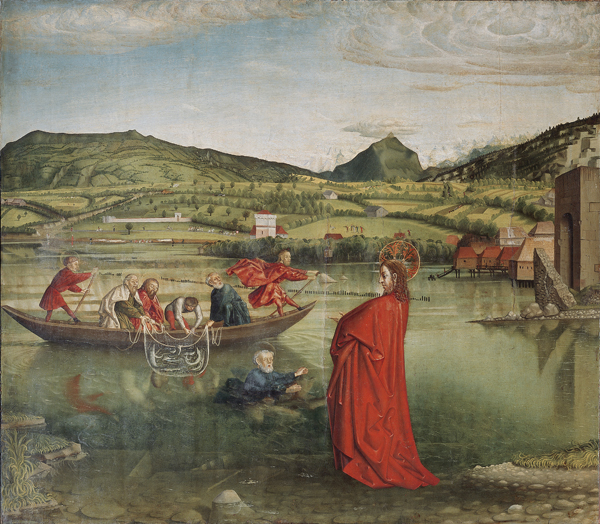 The painting Miraculous Draft of Fish was created in which region?
 (Multiple Choice)
4.9/5 (78)
(78) Which bodies controlled artistic production in Flanders during the Early Renaissance period in northern Europe?
(Multiple Choice)
4.8/5 (75)
(75) Which artist served as the dean of the painters' guild of Ghent and worked for Tommaso Portinari?
(Multiple Choice)
4.9/5 (79)
(79) What is the fountain created by Claus Sluter for the cloister of Chartreuse de Champmol meant to symbolize?
(Multiple Choice)
4.9/5 (90)
(90) Which two entities divided the Burgundian territories after the death of Charles the Bold?
(Multiple Choice)
4.9/5 (80)
(80) Which artistic trend contributed to the decentralization of religious practice?
(Multiple Choice)
4.9/5 (78)
(78) 
Filters
- Essay(0)
- Multiple Choice(0)
- Short Answer(0)
- True False(0)
- Matching(0)