



 Chat with AI
Exam 43: Sensory Systems

Exam 1: A View of Life72 Questions
Exam 2: Atoms and Molecules: the Chemical Basis of Life75 Questions
Exam 3: The Chemistry of Life: Organic Compounds75 Questions
Exam 4: Organization of the Cell76 Questions
Exam 5: Biological Membranes73 Questions
Exam 6: Cell Communication73 Questions
Exam 7: Energy and Metabolism73 Questions
Exam 8: How Cells Make Atp: Energy-Releasing Pathways75 Questions
Exam 9: Photosynthesis: Capturing Light Energy79 Questions
Exam 10: Chromosomes, Mitosis, and Meiosis78 Questions
Exam 11: The Basic Principles of Heredity87 Questions
Exam 12: DNA: The Carrier of Genetic Information83 Questions
Exam 13: Gene Expression92 Questions
Exam 14: Gene Regulation86 Questions
Exam 15: DNA Technology and Genomics98 Questions
Exam 16: Human Genetics and the Human Genome82 Questions
Exam 17: Developmental Genetics90 Questions
Exam 18: Introduction to Darwinian Evolution66 Questions
Exam 19: Evolutionary Change in Populations72 Questions
Exam 20: Speciation and Macroevolution72 Questions
Exam 21: The Origin and Evolutionary History of Life71 Questions
Exam 22: The Evolution of Primates73 Questions
Exam 23: Understanding Diversity: Systematics70 Questions
Exam 24: Viruses and Subviral Agents55 Questions
Exam 25: Bacteria and Archaea63 Questions
Exam 26: Protists76 Questions
Exam 27: Seedless Plants76 Questions
Exam 28: Seed Plants76 Questions
Exam 29: The Fungi78 Questions
Exam 30: An Introduction to Animal Diversity71 Questions
Exam 31: Sponges, Cnidarians, Ctenophores, and Protostomes114 Questions
Exam 32: The Deuterostomes79 Questions
Exam 33: Plant Structure, Growth, and Development94 Questions
Exam 34: Leaf Structure and Function90 Questions
Exam 35: Stem Structure and Transport91 Questions
Exam 36: Roots and Mineral Nutrition105 Questions
Exam 37: Reproduction in Flowering Plants107 Questions
Exam 38: Plant Developmental Responses to External and Internal Signals113 Questions
Exam 39: Animal Structure and Function: an Introduction106 Questions
Exam 40: Protection, Support, and Movement75 Questions
Exam 41: Neural Signaling76 Questions
Exam 42: Neural Regulation81 Questions
Exam 43: Sensory Systems83 Questions
Exam 44: Internal Transport119 Questions
Exam 45: The Immune System: Internal Defense93 Questions
Exam 46: Gas Exchange123 Questions
Exam 47: Processing Food and Nutrition127 Questions
Exam 48: Osmoregulation and Disposal of Metabolic Wastes111 Questions
Exam 49: Endocrine Regulation87 Questions
Exam 50: Reproduction121 Questions
Exam 51: Animal Development117 Questions
Exam 52: Animal Behavior91 Questions
Exam 53: Introduction to Ecology: Population Ecology99 Questions
Exam 54: Community Ecology91 Questions
Exam 55: Ecosystems and the Biosphere101 Questions
Exam 56: Ecology and the Geography of Life99 Questions
Exam 57: Biological Diversity and Conservation Biology82 Questions
Select questions type


Match each sensory receptor with a stimuli that it responds to or energy it transduces. Use each sensory receptor only once.
Premises:
Temperature extremes
Responses:
Nociceptors
Chemoreceptors
Thermoreceptors
Correct Answer: Verified
Premises:
Responses:
(Matching)
4.9/5  (72)
(72) Which of the following correctly describes the order of events that occur when you touch a very hot surface?
1) Action potential in sensory neuron
2) Sensory receptor absorbs energy from stimulus
3) Receptor potential produced
4) Stimulus is transduced into electrical energy
(Multiple Choice)
4.8/5 (74)
(74) Describe the functions of electroreceptors and identify the functions of magnetic reception.
(Essay)
4.8/5 (80)
(80) Which statement concerning gravity detection in humans is true?
(Multiple Choice)
4.7/5 (67)
(67) Figure 43-2
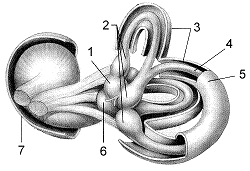
The function of the statocyst was demonstrated by replacing the sand grains with filings of which of the following elements?
The function of the statocyst was demonstrated by replacing the sand grains with filings of which of the following elements? (Multiple Choice)
4.8/5 (86)
(86) The function of the malleus, incus, and stapes in the middle ear is to:
(Multiple Choice)
4.9/5 (63)
(63) You observe a group of fish turn almost simultaneously in the same direction. Which receptors are they using?
(Multiple Choice)
5.0/5 (61)
(61) Discuss how a rod responds differently in the light than in the dark.
(Essay)
4.8/5 (77)
(77) Which of the following is an INCORRECT statement regarding thermoreceptors?
(Multiple Choice)
5.0/5 (90)
(90) Figure 43-1
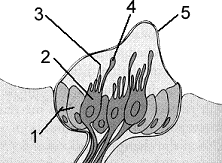
Refer to the accompanying figure with the lateral line organs of fishe s . The structures indicated by label 1 are:
Refer to the accompanying figure with the lateral line organs of fishe s . The structures indicated by label 1 are: (Multiple Choice)
4.9/5 (85)
(85) Rods of the human eye allow detection of shape, movement, and color.
(True/False)
4.8/5 (83)
(83) Trace the path of a sound wave beginning from its entry into the ear to its transmission to the brain.
(Essay)
4.8/5 (80)
(80) Which animal(s) are likely relying on their electromagnetic receptors?
(Multiple Choice)
4.9/5 (70)
(70) 
Filters
- Essay(0)
- Multiple Choice(0)
- Short Answer(0)
- True False(0)
- Matching(0)