



 Chat with AI
Exam 4: Organization of the Cell

Exam 1: A View of Life72 Questions
Exam 2: Atoms and Molecules: the Chemical Basis of Life75 Questions
Exam 3: The Chemistry of Life: Organic Compounds75 Questions
Exam 4: Organization of the Cell76 Questions
Exam 5: Biological Membranes73 Questions
Exam 6: Cell Communication73 Questions
Exam 7: Energy and Metabolism73 Questions
Exam 8: How Cells Make Atp: Energy-Releasing Pathways75 Questions
Exam 9: Photosynthesis: Capturing Light Energy79 Questions
Exam 10: Chromosomes, Mitosis, and Meiosis78 Questions
Exam 11: The Basic Principles of Heredity87 Questions
Exam 12: DNA: The Carrier of Genetic Information83 Questions
Exam 13: Gene Expression92 Questions
Exam 14: Gene Regulation86 Questions
Exam 15: DNA Technology and Genomics98 Questions
Exam 16: Human Genetics and the Human Genome82 Questions
Exam 17: Developmental Genetics90 Questions
Exam 18: Introduction to Darwinian Evolution66 Questions
Exam 19: Evolutionary Change in Populations72 Questions
Exam 20: Speciation and Macroevolution72 Questions
Exam 21: The Origin and Evolutionary History of Life71 Questions
Exam 22: The Evolution of Primates73 Questions
Exam 23: Understanding Diversity: Systematics70 Questions
Exam 24: Viruses and Subviral Agents55 Questions
Exam 25: Bacteria and Archaea63 Questions
Exam 26: Protists76 Questions
Exam 27: Seedless Plants76 Questions
Exam 28: Seed Plants76 Questions
Exam 29: The Fungi78 Questions
Exam 30: An Introduction to Animal Diversity71 Questions
Exam 31: Sponges, Cnidarians, Ctenophores, and Protostomes114 Questions
Exam 32: The Deuterostomes79 Questions
Exam 33: Plant Structure, Growth, and Development94 Questions
Exam 34: Leaf Structure and Function90 Questions
Exam 35: Stem Structure and Transport91 Questions
Exam 36: Roots and Mineral Nutrition105 Questions
Exam 37: Reproduction in Flowering Plants107 Questions
Exam 38: Plant Developmental Responses to External and Internal Signals113 Questions
Exam 39: Animal Structure and Function: an Introduction106 Questions
Exam 40: Protection, Support, and Movement75 Questions
Exam 41: Neural Signaling76 Questions
Exam 42: Neural Regulation81 Questions
Exam 43: Sensory Systems83 Questions
Exam 44: Internal Transport119 Questions
Exam 45: The Immune System: Internal Defense93 Questions
Exam 46: Gas Exchange123 Questions
Exam 47: Processing Food and Nutrition127 Questions
Exam 48: Osmoregulation and Disposal of Metabolic Wastes111 Questions
Exam 49: Endocrine Regulation87 Questions
Exam 50: Reproduction121 Questions
Exam 51: Animal Development117 Questions
Exam 52: Animal Behavior91 Questions
Exam 53: Introduction to Ecology: Population Ecology99 Questions
Exam 54: Community Ecology91 Questions
Exam 55: Ecosystems and the Biosphere101 Questions
Exam 56: Ecology and the Geography of Life99 Questions
Exam 57: Biological Diversity and Conservation Biology82 Questions
Select questions type


Specialized structures within a living cell are known as ___________.
(Multiple Choice)
4.7/5  (77)
(77) What is the purpose of the cristae of the inner membrane of mitochondria?
(Multiple Choice)
4.9/5 (82)
(82) Which technique is used to separate different part of cells so that they can be studied by both physical and chemical methods?
(Multiple Choice)
4.9/5 (83)
(83) Briefly explain the relationship between the surface area and volume of a cell and overall cell size. List two ways in which organisms have successfully "solved" this problem.
(Essay)
4.9/5 (79)
(79) You isolate a cellular structure and determine that it is composed of α-tubulin and β-tubulin. Based on this evidence, you correctly identify this structure as a(n):
(Multiple Choice)
4.8/5 (78)
(78) Which of the following is a key component of the cytoskeleton?
(Multiple Choice)
4.8/5 (71)
(71) What type of microscopy uses a laser to excite fluorophores in a thin "slice" through a cell?
(Multiple Choice)
4.7/5 (84)
(84) Intermediate filaments are most closely associated with which of the following?
(Multiple Choice)
5.0/5 (86)
(86) Plants lack organ systems for disposing of toxic metabolic waste products. Their cells' vacuoles are similar to which animal cell organelle?
(Multiple Choice)
4.8/5 (71)
(71) The outer membrane of the nuclear envelope is continuous with the membrane of the ____ and is usually covered with attached ribosomes.
(Multiple Choice)
4.8/5 (80)
(80) What protects a cell and may help keep other cells at a distance?
(Multiple Choice)
4.9/5 (76)
(76) The smooth ER is the primary site for the synthesis of proteins and cholesterol needed to make membranes.
(True/False)
4.8/5 (78)
(78) During an infection, white blood cells travel to the infected site and phagocytize the pathogens. After phagocytosis, primary lysosomes fuse with the phagocytic vesicle to form a larger vesicle called a secondary lysosome. The purpose for this process is to:
(Multiple Choice)
4.8/5 (81)
(81) While testing an experimental drip on a vertebrate cell, you notice that the cell cortex becomes more fluid and the cell loses its ability to move. Despite this, you determine that cell strength is maintained. Based on these observations, you correctly conclude that the drug most directly affects:
(Multiple Choice)
4.8/5 (89)
(89) If a bacterial toxin destroys ribosomes, what cellular activity will be affected first?
(Multiple Choice)
4.8/5 (69)
(69) Figure 4-1
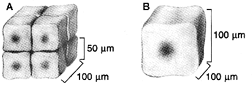 Which statement about the accompanying figures is true?
 (Multiple Choice)
4.7/5 (88)
(88) 
Filters
- Essay(0)
- Multiple Choice(0)
- Short Answer(0)
- True False(0)
- Matching(0)