



 Chat with AI
Exam 18: International Trade and Finance

Exam 1: Introducing the Economic Way of Thinking176 Questions
Exam 2: Production Possibilities, Opportunity Cost, and Economic Growth200 Questions
Exam 3: Market Demand and Supply348 Questions
Exam 4: Markets in Action261 Questions
Exam 5: Gross Domestic Product223 Questions
Exam 6: Business Cycles and Unemployment194 Questions
Exam 7: Inflation126 Questions
Exam 8: The Keynesian Model235 Questions
Exam 9: The Keynesian Model in Action202 Questions
Exam 10: Aggregate Demand and Supply187 Questions
Exam 11: Fiscal Policy223 Questions
Exam 12: The Public Sector127 Questions
Exam 13: Federal Deficits, Surpluses, and the National Debt99 Questions
Exam 14: Money and the Federal Reserve System154 Questions
Exam 15: Money Creation243 Questions
Exam 16: Monetary Policy213 Questions
Exam 17: The Phillips Curve and Expectations Theory120 Questions
Exam 18: International Trade and Finance248 Questions
Exam 19: Economies in Transition104 Questions
Exam 20: Growth and the Less-Developed Countries117 Questions
Exam 21: Applying Graphs to Economics68 Questions
Exam 22: Consumer Surplus, Producer Surplus, and Market Efficiency68 Questions
Exam 23: the Self-Correcting Aggregate Demand and Supply Model83 Questions
Exam 24: Policy Disputes Using the Self-Correcting Aggregate Demand and Supply Model36 Questions
Select questions type


If a Japanese stereo priced at 1,000,000 yen can be purchased for $1,000, the exchange rate is:
(Multiple Choice)
4.7/5  (98)
(98) Exhibit 15-3 Potatoes and wheat output (tons per day) 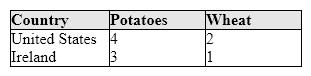 In Exhibit 15-3, the United States has an absolute advantage in producing:
 (Multiple Choice)
4.8/5 (76)
(76) A decrease in the supply of dollars to holders of Mexican pesos would cause the:
(Multiple Choice)
4.9/5 (82)
(82) What are the benefits and costs to a nation that participates in international trade? Do the benefits outweigh the costs or do the costs outweigh the benefits?
(Essay)
4.9/5 (90)
(90) Exhibit 15-4 Coffee and tea output (pounds per hour)
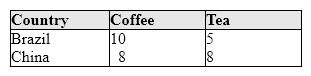 If specialization were carried out by each country in Exhibit 15-4 on the basis of comparative advantage, then:
 (Multiple Choice)
4.8/5 (79)
(79) Opening trade between nations enables each nation's consumption possibilities to go beyond the confines of its own production possibilities curve.
(True/False)
4.9/5 (91)
(91) Exhibit 15-1 Production possibilities curves 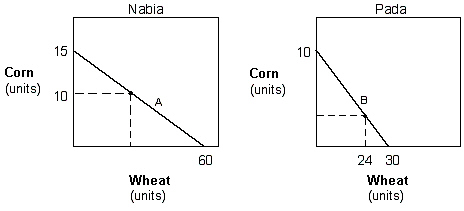 In Exhibit 15-1, the production possibilities curves of wheat and corn for Nabia and Pada are presented. Suppose Nabia produces at point A on its PPC. How many units of wheat is the country able to produce?
 (Multiple Choice)
4.8/5 (94)
(94) An itemized account of a nation's foreign economic transactions is its:
(Multiple Choice)
4.8/5 (74)
(74) Most industrialized nations today use a gold standard to establish exchange rates.
(True/False)
4.9/5 (65)
(65) If the exchange rate between the yen and the dollar changes from 110 yen = $1 to 100 yen = $1, then:
(Multiple Choice)
4.8/5 (66)
(66) Which of the following transactions would be excluded in the capital account?
(Multiple Choice)
4.9/5 (70)
(70) Suppose a U.S.-made machine costs $500 and the exchange rate is 100 yen = $1. Now the exchange rate changes to 90 yen = $1. Then the:
(Multiple Choice)
4.9/5 (85)
(85) The current account balance tabulates the value of a country's exports of goods and services minus the value of its imports of goods and services.
(True/False)
4.8/5 (83)
(83) According to the infant industry argument, a new domestic industry needs protection because it has higher costs than established foreign competitors.
(True/False)
4.9/5 (82)
(82) 
Filters
- Essay(0)
- Multiple Choice(0)
- Short Answer(0)
- True False(0)
- Matching(0)