



 Chat with AI
Exam 18: International Trade and Finance

Exam 1: Introducing the Economic Way of Thinking176 Questions
Exam 2: Production Possibilities, Opportunity Cost, and Economic Growth200 Questions
Exam 3: Market Demand and Supply348 Questions
Exam 4: Markets in Action261 Questions
Exam 5: Gross Domestic Product223 Questions
Exam 6: Business Cycles and Unemployment194 Questions
Exam 7: Inflation126 Questions
Exam 8: The Keynesian Model235 Questions
Exam 9: The Keynesian Model in Action202 Questions
Exam 10: Aggregate Demand and Supply187 Questions
Exam 11: Fiscal Policy223 Questions
Exam 12: The Public Sector127 Questions
Exam 13: Federal Deficits, Surpluses, and the National Debt99 Questions
Exam 14: Money and the Federal Reserve System154 Questions
Exam 15: Money Creation243 Questions
Exam 16: Monetary Policy213 Questions
Exam 17: The Phillips Curve and Expectations Theory120 Questions
Exam 18: International Trade and Finance248 Questions
Exam 19: Economies in Transition104 Questions
Exam 20: Growth and the Less-Developed Countries117 Questions
Exam 21: Applying Graphs to Economics68 Questions
Exam 22: Consumer Surplus, Producer Surplus, and Market Efficiency68 Questions
Exam 23: the Self-Correcting Aggregate Demand and Supply Model83 Questions
Exam 24: Policy Disputes Using the Self-Correcting Aggregate Demand and Supply Model36 Questions
Select questions type


If real interest rates in the United States are higher than those of our trading partners, what will tend to happen to the foreign exchange value of the dollar and the U.S. current account deficit or surplus?
(Multiple Choice)
4.8/5  (76)
(76) Suppose that Spain has a comparative advantage in hats and Portugal has a comparative advantage in doormats. Under a system of free trade, each country specializes and then trades with the other. If the price starts at four hats per doormat, and then increases to five hats per doormat, then:
(Multiple Choice)
4.9/5 (74)
(74) If Japan gives up ten bushels of rice to produce one bicycle, while the United States gives up five bushels of rice to produce one bicycle, then:
(Multiple Choice)
4.8/5 (74)
(74) Exhibit 15-3 Potatoes and wheat output (tons per day) 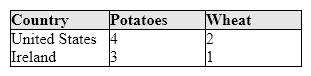 If each nation in Exhibit 15-3 specializes in producing the good for which it has a comparative advantage, then:
 (Multiple Choice)
4.8/5 (72)
(72) Who would benefit if the exchange rate with yen (in U.S. dollars)increased?
(Multiple Choice)
4.8/5 (78)
(78) Expenditures for services such as tourism, income for foreign investment, and foreign gifts are tabulated in the:
(Multiple Choice)
4.9/5 (86)
(86) Suppose a country with a large domestic textile industry removed all tariffs on imported textiles, we would expect domestic:
(Multiple Choice)
4.8/5 (83)
(83) The nice thing about foreign exchange markets is that the goods are money, and they are paid for with money. This means that if the U.S. dollar ____ the Japanese yen ____.
(Multiple Choice)
4.7/5 (83)
(83) In terms of production possibilities curves, the benefits of trade between two nations are that each nation moves to a higher:
(Multiple Choice)
4.9/5 (80)
(80) The Japanese demand curve for dollars is downward-sloping because a:
(Multiple Choice)
4.9/5 (76)
(76) Assume the United States can use a given amount of its resources to produce either 20 airplanes or 8 automobiles and Japan can employ the same amount of its resources to produce either 20 airplanes or 10 automobiles. The U.S. should specialize in:
(Multiple Choice)
4.8/5 (76)
(76) Absolute advantage is the ability of a country to produce a good with ________ than another country.
(Multiple Choice)
4.8/5 (90)
(90) Exhibit 15-1 Production possibilities curves 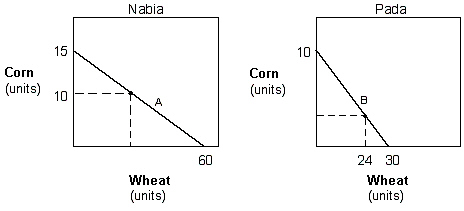 In Exhibit 15-1, the production possibilities curves of wheat and corn for Nabia and Pada are presented. In Nabia the cost of producing one more unit of wheat is equal to:
 (Multiple Choice)
4.7/5 (79)
(79) Exhibit 15-1 Production possibilities curves 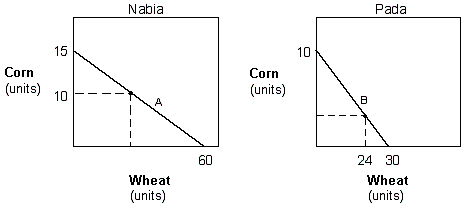 In Exhibit 15-1, the production possibilities curves of wheat and corn for Nabia and Pada are presented. In Nabia the cost of producing one more unit of corn is equal to:
 (Multiple Choice)
4.7/5 (91)
(91) Exhibit 15-6 Dollars per British pound
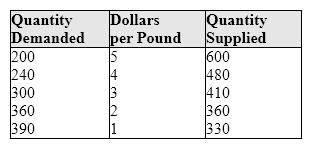 In Exhibit 15-6, the equilibrium exchange rate is:
 (Multiple Choice)
4.8/5 (84)
(84) The main problem with using the infant industries argument to justify protecting an industry from foreign competition is that:
(Multiple Choice)
4.8/5 (90)
(90) 
Filters
- Essay(0)
- Multiple Choice(0)
- Short Answer(0)
- True False(0)
- Matching(0)