



 Chat with AI
Exam 5: Gross Domestic Product

Exam 1: Introducing the Economic Way of Thinking176 Questions
Exam 2: Production Possibilities, Opportunity Cost, and Economic Growth200 Questions
Exam 3: Market Demand and Supply348 Questions
Exam 4: Markets in Action261 Questions
Exam 5: Gross Domestic Product223 Questions
Exam 6: Business Cycles and Unemployment194 Questions
Exam 7: Inflation126 Questions
Exam 8: The Keynesian Model235 Questions
Exam 9: The Keynesian Model in Action202 Questions
Exam 10: Aggregate Demand and Supply187 Questions
Exam 11: Fiscal Policy223 Questions
Exam 12: The Public Sector127 Questions
Exam 13: Federal Deficits, Surpluses, and the National Debt99 Questions
Exam 14: Money and the Federal Reserve System154 Questions
Exam 15: Money Creation243 Questions
Exam 16: Monetary Policy213 Questions
Exam 17: The Phillips Curve and Expectations Theory120 Questions
Exam 18: International Trade and Finance248 Questions
Exam 19: Economies in Transition104 Questions
Exam 20: Growth and the Less-Developed Countries117 Questions
Exam 21: Applying Graphs to Economics68 Questions
Exam 22: Consumer Surplus, Producer Surplus, and Market Efficiency68 Questions
Exam 23: the Self-Correcting Aggregate Demand and Supply Model83 Questions
Exam 24: Policy Disputes Using the Self-Correcting Aggregate Demand and Supply Model36 Questions
Select questions type


Discuss how economists calculate NI, PI and DI.

Free
(Essay)
4.8/5  (71)
(71) Correct Answer: Verified
GDP - depreciation = NI - profits - FICA + transfer payments + net interest + dividends = PI - personal income taxes = DI.
More than 70 percent of national income can be attributed to:
Free
(Multiple Choice)
4.8/5 (74)
(74) Correct Answer:Verified
VerifiedA
Exhibit 5-9 GDP data (billions of dollars)
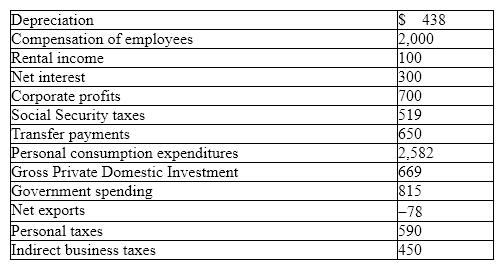 In Exhibit 5-10, and using the expenditures approach, compute personal consumption expenditures. Which of the following is correct?
 (Multiple Choice)
4.9/5 (71)
(71) The circular flow model illustrates that aggregate spending in the product markets equals 70 percent of aggregate income earned in the factor markets.
(True/False)
4.9/5 (81)
(81) Nominal gross domestic product is based on the existing prices at which final goods are actually sold.
(True/False)
4.9/5 (69)
(69) Personal consumption expenditures is the smallest component of total spending.
(True/False)
4.9/5 (71)
(71) Payments to households not in exchange for goods and services currently produced are:
(Multiple Choice)
4.8/5 (84)
(84) Exhibit 5-9 GDP data (billions of dollars)
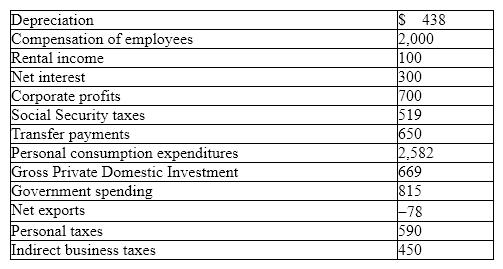 In Exhibit 5-9, personal income (PI)equals:
 (Multiple Choice)
5.0/5 (80)
(80) Durable and nondurable goods and services lumped together in the expenditure approach to measuring GDP are called:
(Multiple Choice)
4.9/5 (82)
(82) The circular flow model represents the establishment of market value for:
(Multiple Choice)
4.9/5 (80)
(80) The GDP chain price index is designed to adjust nominal GDP for changes in:
(Multiple Choice)
4.8/5 (82)
(82) Gross private domestic investment or simply business investment spending (I):
(Multiple Choice)
4.8/5 (102)
(102) 
Filters
- Essay(0)
- Multiple Choice(0)
- Short Answer(0)
- True False(0)
- Matching(0)