



 Chat with AI
Exam 11: Fiscal Policy

Exam 1: Introducing the Economic Way of Thinking176 Questions
Exam 2: Production Possibilities, Opportunity Cost, and Economic Growth200 Questions
Exam 3: Market Demand and Supply348 Questions
Exam 4: Markets in Action261 Questions
Exam 5: Gross Domestic Product223 Questions
Exam 6: Business Cycles and Unemployment194 Questions
Exam 7: Inflation126 Questions
Exam 8: The Keynesian Model235 Questions
Exam 9: The Keynesian Model in Action202 Questions
Exam 10: Aggregate Demand and Supply187 Questions
Exam 11: Fiscal Policy223 Questions
Exam 12: The Public Sector127 Questions
Exam 13: Federal Deficits, Surpluses, and the National Debt99 Questions
Exam 14: Money and the Federal Reserve System154 Questions
Exam 15: Money Creation243 Questions
Exam 16: Monetary Policy213 Questions
Exam 17: The Phillips Curve and Expectations Theory120 Questions
Exam 18: International Trade and Finance248 Questions
Exam 19: Economies in Transition104 Questions
Exam 20: Growth and the Less-Developed Countries117 Questions
Exam 21: Applying Graphs to Economics68 Questions
Exam 22: Consumer Surplus, Producer Surplus, and Market Efficiency68 Questions
Exam 23: the Self-Correcting Aggregate Demand and Supply Model83 Questions
Exam 24: Policy Disputes Using the Self-Correcting Aggregate Demand and Supply Model36 Questions
Select questions type


Supply-siders' policy recommendations include:

Free
(Multiple Choice)
4.8/5  (75)
(75) Correct Answer: Verified
B
The balanced budget multiplier is equal to one.
Free
(True/False)
4.7/5 (85)
(85) Correct Answer:Verified
VerifiedTrue
Which of the following is not an automatic stabilizer?
Free
(Multiple Choice)
4.8/5 (82)
(82) Correct Answer:Verified
VerifiedD
Exhibit 11-2 Aggregate demand and supply model 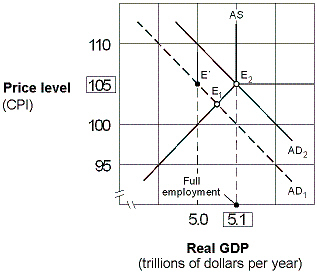 Suppose the economy in Exhibit 11-2 is in equilibrium at point E1 and the marginal propensity to consume (MPC)is 0.75. Following Keynesian economics, the federal government can move the economy to full employment at point E2 by:
 (Multiple Choice)
4.8/5 (71)
(71) If your income increases from $40,000 to $48,000 and your consumption increases from $35,000 to $39,000, your marginal propensity to consume (MPC)is:
(Multiple Choice)
4.9/5 (78)
(78) If the marginal propensity to consume is 0.80, the value of the spending multiplier will be 5.
(True/False)
4.8/5 (72)
(72) If an inflationary boom exists, the appropriate fiscal policy is to:
(Multiple Choice)
4.9/5 (81)
(81) If the economy is experiencing unemployment, then the most appropriate government policy would be to:
(Multiple Choice)
4.8/5 (75)
(75) When households' marginal propensity to consume (MPC)increases, the size of the spending multiplier:
(Multiple Choice)
4.9/5 (77)
(77) According to supply-side fiscal policy, reducing tax rates on wages and profits will:
(Multiple Choice)
4.7/5 (88)
(88) The Laffer curve is a graph of the relationship between tax rates and:
(Multiple Choice)
4.9/5 (84)
(84) "Tax cuts, by providing incentives to work, save, and invest, will raise employment and lower the price level." This argument is made by the:
(Multiple Choice)
4.7/5 (84)
(84) Which economist(s)argued that high tax rates produce less tax revenues and limit the expansion of real GDP and employment?
(Multiple Choice)
4.8/5 (79)
(79) Automatic stabilizers create ________ during recessions from increased government spending on welfare and unemployment insurance, and reduced tax revenues, and create _________ during peak growth periods of the economy from reduced government welfare spending and increased tax revenues.
(Multiple Choice)
4.9/5 (84)
(84) 
Filters
- Essay(0)
- Multiple Choice(0)
- Short Answer(0)
- True False(0)
- Matching(0)