



 Chat with AI
Exam 11: Fiscal Policy

Exam 1: Introducing the Economic Way of Thinking176 Questions
Exam 2: Production Possibilities, Opportunity Cost, and Economic Growth200 Questions
Exam 3: Market Demand and Supply348 Questions
Exam 4: Markets in Action261 Questions
Exam 5: Gross Domestic Product223 Questions
Exam 6: Business Cycles and Unemployment194 Questions
Exam 7: Inflation126 Questions
Exam 8: The Keynesian Model235 Questions
Exam 9: The Keynesian Model in Action202 Questions
Exam 10: Aggregate Demand and Supply187 Questions
Exam 11: Fiscal Policy223 Questions
Exam 12: The Public Sector127 Questions
Exam 13: Federal Deficits, Surpluses, and the National Debt99 Questions
Exam 14: Money and the Federal Reserve System154 Questions
Exam 15: Money Creation243 Questions
Exam 16: Monetary Policy213 Questions
Exam 17: The Phillips Curve and Expectations Theory120 Questions
Exam 18: International Trade and Finance248 Questions
Exam 19: Economies in Transition104 Questions
Exam 20: Growth and the Less-Developed Countries117 Questions
Exam 21: Applying Graphs to Economics68 Questions
Exam 22: Consumer Surplus, Producer Surplus, and Market Efficiency68 Questions
Exam 23: the Self-Correcting Aggregate Demand and Supply Model83 Questions
Exam 24: Policy Disputes Using the Self-Correcting Aggregate Demand and Supply Model36 Questions
Select questions type


Following Keynesian economics, and assuming a marginal propensity to consume (MPC)of 0.75, an increase in federal government spending of $100 billion at below full employment would be expected to shift the aggregate demand curve by $300 billion to the right.
(True/False)
4.8/5  (67)
(67) If your income increases from $30,000 to $35,000 and your consumption increases from $11,000 to $12,000, your marginal propensity to consume (MPC)is:
(Multiple Choice)
4.8/5 (73)
(73) The result of the balanced budget multiplier is that aggregate demand changes by the amount of the change in:
(Multiple Choice)
4.8/5 (69)
(69) Supply-side economic policies are designed to shift the aggregate supply curve to the left, whereas Keynesian economic policies focus on shifting the aggregate demand curve to the right during recessions and to the left during economic expansions.
(True/False)
4.8/5 (70)
(70) Exhibit 11-3 Aggregate demand and supply model 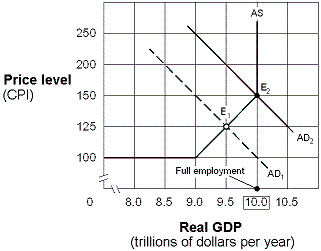 Suppose the economy in Exhibit 11-3 is in equilibrium at point E1 and the marginal propensity to consume (MPC)is 0.80. Following Keynesian economics, to restore full employment, the government should increase its spending by:
 (Multiple Choice)
4.9/5 (75)
(75) If the marginal propensity to consume (MPC)is 0.75, and if policy makers wish to increase real GDP by $300 million, then by how much would they have to change taxes?
(Multiple Choice)
4.8/5 (71)
(71) Supply-side economic policies are designed to shift the aggregate supply curve to the right, whereas Keynesian economic policies focus on shifting the aggregate demand curve to the right during recessions and to the left during an economic expansion.
(True/False)
4.8/5 (79)
(79) If an economy were experiencing a high rate of unemployment as the result of insufficient aggregate demand, a Keynesian economist would favor:
(Multiple Choice)
4.8/5 (72)
(72) The nation has its own MPC. When national income increases from $300 billion to $400 billion, national consumption increases from $300 billion to $360 billion. At Y = $400 billion, the MPC is:
(Multiple Choice)
4.8/5 (78)
(78) Changes in government spending and\or taxes as the result of legislation is called:
(Multiple Choice)
4.9/5 (84)
(84) If no fiscal policy changes are implemented to fight inflation, suppose the aggregate demand curve will exceed the current aggregate demand curve by $900 billion at any level of prices. Assuming the marginal propensity to consume is 0.90, this increase in aggregate demand could be prevented by:
(Multiple Choice)
4.8/5 (73)
(73) If the marginal propensity to consume (MPC)is 0.90, the value of the spending multiplier is 90.
(True/False)
4.8/5 (86)
(86) The ratio of the change in GDP to an initial change in aggregate spending is the:
(Multiple Choice)
4.9/5 (82)
(82) As the marginal propensity to consume (MPC)increases, the spending multiplier:
(Multiple Choice)
4.7/5 (85)
(85) The marginal propensity to save plus the marginal propensity to consume always equals 1.
(True/False)
4.9/5 (77)
(77) 
Filters
- Essay(0)
- Multiple Choice(0)
- Short Answer(0)
- True False(0)
- Matching(0)