



 Chat with AI
Exam 22: Consumer Surplus, Producer Surplus, and Market Efficiency

Exam 1: Introducing the Economic Way of Thinking176 Questions
Exam 2: Production Possibilities, Opportunity Cost, and Economic Growth200 Questions
Exam 3: Market Demand and Supply348 Questions
Exam 4: Markets in Action261 Questions
Exam 5: Gross Domestic Product223 Questions
Exam 6: Business Cycles and Unemployment194 Questions
Exam 7: Inflation126 Questions
Exam 8: The Keynesian Model235 Questions
Exam 9: The Keynesian Model in Action202 Questions
Exam 10: Aggregate Demand and Supply187 Questions
Exam 11: Fiscal Policy223 Questions
Exam 12: The Public Sector127 Questions
Exam 13: Federal Deficits, Surpluses, and the National Debt99 Questions
Exam 14: Money and the Federal Reserve System154 Questions
Exam 15: Money Creation243 Questions
Exam 16: Monetary Policy213 Questions
Exam 17: The Phillips Curve and Expectations Theory120 Questions
Exam 18: International Trade and Finance248 Questions
Exam 19: Economies in Transition104 Questions
Exam 20: Growth and the Less-Developed Countries117 Questions
Exam 21: Applying Graphs to Economics68 Questions
Exam 22: Consumer Surplus, Producer Surplus, and Market Efficiency68 Questions
Exam 23: the Self-Correcting Aggregate Demand and Supply Model83 Questions
Exam 24: Policy Disputes Using the Self-Correcting Aggregate Demand and Supply Model36 Questions
Select questions type


Consumer surplus measures the value between the price consumers are willing to pay for a product and the preference price.

Free
(True/False)
4.8/5  (102)
(102) Correct Answer: Verified
False
Assuming peaches are a normal good and consumer incomes rise, producer surplus in the peach market:
Free
(Multiple Choice)
4.9/5 (77)
(77) Correct Answer:Verified
VerifiedA
Exhibit 3A-1 Comparison of Market Efficiency and Deadweight Loss 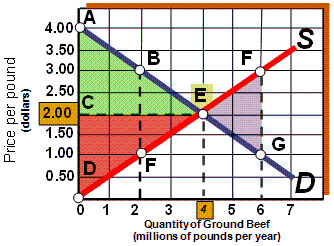 As shown in Exhibit 3A-1, if the market price falls from $2.00 to $1.00, then area ____ appears.
Free
(Multiple Choice)
4.9/5 (69)
(69) Correct Answer:Verified
VerifiedC
The points along the demand curve represent the maximum willingness of consumers to purchase a product.
(True/False)
4.8/5 (78)
(78) If the quantity demanded exceeds the quantity supplied in a market, then the result is which of the following?
(Multiple Choice)
4.7/5 (84)
(84) Exhibit 3A-2 Comparison of Market Efficiency and Deadweight Loss 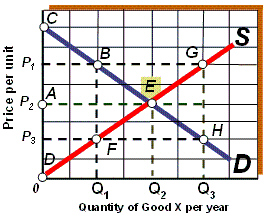 As shown in Exhibit 3A-2, if the market price falls from P1 to P2, then:
 (Multiple Choice)
4.7/5 (72)
(72) The points along the supply curve represent the maximum willingness of firms to accept payment for a product offered for sale at various prices.
(True/False)
4.9/5 (82)
(82) Exhibit 3A-1 Comparison of Market Efficiency and Deadweight Loss 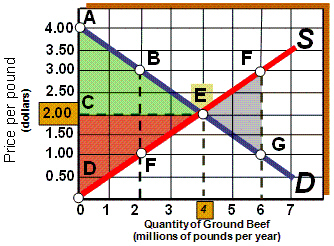 As shown in Exhibit 3A-1, if the quantity supplied is 2 million pounds of ground beef per year, the result is a deadweight loss represented by area:
 (Multiple Choice)
4.8/5 (80)
(80) At $30 each, Jack will buy 1 Blu-ray and at $25, he will purchase 2. If the price is $20, Jack's consumer surplus is:
(Multiple Choice)
4.9/5 (63)
(63) Suppose Jones sells a good for $100 at a yard sale. If the producer surplus from the sale is $75, Jones's cost of the good must have been:
(Multiple Choice)
4.8/5 (77)
(77) Exhibit 3A-2 Comparison of Market Efficiency and Deadweight Loss 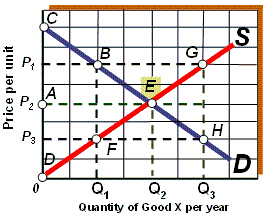 As shown in Exhibit 3A-2, if the market price falls from P2 to P3, then area ____ appears.
 (Multiple Choice)
4.9/5 (87)
(87) A drought destroys much of the peach crop. As a result, consumer surplus in the peach market:
(Multiple Choice)
4.8/5 (78)
(78) Suppose Alice sells a good for $60 on eBay. If the producer surplus from the sale is $25, Alice's cost of the good must have been:
(Multiple Choice)
4.8/5 (89)
(89) Suppose Sue's buys a good for $60 on eBay. If the consumer surplus from the sale is $25, Sue would have been willing to pay:
(Multiple Choice)
4.9/5 (86)
(86) Suppose Gizmo Inc. is willing to sell one gizmo for $10, a second gizmo for $12, a third for $14, and a fourth for $20, and the market price is $20. What is Gizmo Inc.'s producer surplus?
(Multiple Choice)
4.7/5 (86)
(86) Suppose Sam buys a good for $100 at a yard sale. If consumer surplus from the sale is $75, Sam would have been willing to pay:
(Multiple Choice)
4.9/5 (82)
(82) Total producer surplus is the area below the equilibrium price and above the supply curve.
(True/False)
4.9/5 (82)
(82) 
Filters
- Essay(0)
- Multiple Choice(0)
- Short Answer(0)
- True False(0)
- Matching(0)