



 Chat with AI
Exam 4: Markets in Action

Exam 1: Introducing the Economic Way of Thinking176 Questions
Exam 2: Production Possibilities, Opportunity Cost, and Economic Growth200 Questions
Exam 3: Market Demand and Supply348 Questions
Exam 4: Markets in Action261 Questions
Exam 5: Gross Domestic Product223 Questions
Exam 6: Business Cycles and Unemployment194 Questions
Exam 7: Inflation126 Questions
Exam 8: The Keynesian Model235 Questions
Exam 9: The Keynesian Model in Action202 Questions
Exam 10: Aggregate Demand and Supply187 Questions
Exam 11: Fiscal Policy223 Questions
Exam 12: The Public Sector127 Questions
Exam 13: Federal Deficits, Surpluses, and the National Debt99 Questions
Exam 14: Money and the Federal Reserve System154 Questions
Exam 15: Money Creation243 Questions
Exam 16: Monetary Policy213 Questions
Exam 17: The Phillips Curve and Expectations Theory120 Questions
Exam 18: International Trade and Finance248 Questions
Exam 19: Economies in Transition104 Questions
Exam 20: Growth and the Less-Developed Countries117 Questions
Exam 21: Applying Graphs to Economics68 Questions
Exam 22: Consumer Surplus, Producer Surplus, and Market Efficiency68 Questions
Exam 23: the Self-Correcting Aggregate Demand and Supply Model83 Questions
Exam 24: Policy Disputes Using the Self-Correcting Aggregate Demand and Supply Model36 Questions
Select questions type


Which of the following is not a market failure?

Free
(Multiple Choice)
4.8/5  (87)
(87) Correct Answer: Verified
B
Which of the following is not an example of market failure?
Free
(Multiple Choice)
4.8/5 (75)
(75) Correct Answer:Verified
VerifiedC
Pete throws leftover bread onto his front lawn because he enjoys watching the pigeons feeding. His neighbor John is not happy about the pigeons, since they leave a mess on his property. This is an example of:
Free
(Multiple Choice)
4.9/5 (92)
(92) Correct Answer:Verified
VerifiedA
Exhibit 4-9 Data on supply and demand
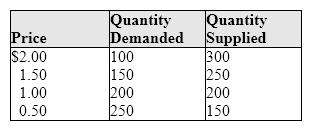 In Exhibit 4-9 the equilibrium price and quantity in the market are:
 (Multiple Choice)
4.9/5 (83)
(83) Exhibit 4-8 Demand and supply curves  In Exhibit 4-8, a movement from A to B in which price has decreased and quantity has increased is best explained by a(n):
 (Multiple Choice)
4.9/5 (98)
(98) If consumers switch away from eating margarine at the same time that the number of margarine suppliers increases, then:
(Multiple Choice)
4.7/5 (97)
(97) Which of the following is the best example of a public good?
(Multiple Choice)
4.9/5 (81)
(81) Using supply and demand analysis, customers will stand in line for gasoline when a price ceiling is in force, even if the price ceiling is at a level higher than the equilibrium price.
(True/False)
4.8/5 (78)
(78) Why do negative externalities like pollution result in inefficiency?
(Multiple Choice)
4.8/5 (76)
(76) Assume a ceiling price is set above the equilibrium price. The eventual result is a shortage.
(True/False)
4.9/5 (95)
(95) Exhibit 4-4 Supply and demand curves for good X  A decrease in buyers' income, assuming good X is a normal good, combined with a decrease in the wage rate paid to workers producing good X would be represented by which of the following changes in equilibrium shown in Graph C of Exhibit 4-4?
 (Multiple Choice)
4.8/5 (93)
(93) An increase in demand and a decrease in supply cause which of the following?
(Multiple Choice)
5.0/5 (94)
(94) If the equilibrium price of good X is $5 and a price ceiling is imposed at $4, the result will be a(n):
(Multiple Choice)
4.8/5 (84)
(84) Exhibit 4-3 Supply and demand curves  The market shown in Exhibit 4-3 is initially in equilibrium at E4. Changes in market conditions result in a new equilibrium at E3. This change is stated as a(n):
 (Multiple Choice)
4.8/5 (65)
(65) Exhibit 4-3 Supply and demand curves  In Exhibit 4-3, an increase in quantity supplied would cause a movement from which equilibrium point to another, other things being equal?
 (Multiple Choice)
4.8/5 (81)
(81) Exhibit 4-6 Demand and supply curves  If market supply decreases and, simultaneously, market demand increases, the new equilibrium will show:
 (Multiple Choice)
4.9/5 (87)
(87) 
Filters
- Essay(0)
- Multiple Choice(0)
- Short Answer(0)
- True False(0)
- Matching(0)