



 Chat with AI
Exam 4: Markets in Action

Exam 1: Introducing the Economic Way of Thinking176 Questions
Exam 2: Production Possibilities, Opportunity Cost, and Economic Growth200 Questions
Exam 3: Market Demand and Supply348 Questions
Exam 4: Markets in Action261 Questions
Exam 5: Gross Domestic Product223 Questions
Exam 6: Business Cycles and Unemployment194 Questions
Exam 7: Inflation126 Questions
Exam 8: The Keynesian Model235 Questions
Exam 9: The Keynesian Model in Action202 Questions
Exam 10: Aggregate Demand and Supply187 Questions
Exam 11: Fiscal Policy223 Questions
Exam 12: The Public Sector127 Questions
Exam 13: Federal Deficits, Surpluses, and the National Debt99 Questions
Exam 14: Money and the Federal Reserve System154 Questions
Exam 15: Money Creation243 Questions
Exam 16: Monetary Policy213 Questions
Exam 17: The Phillips Curve and Expectations Theory120 Questions
Exam 18: International Trade and Finance248 Questions
Exam 19: Economies in Transition104 Questions
Exam 20: Growth and the Less-Developed Countries117 Questions
Exam 21: Applying Graphs to Economics68 Questions
Exam 22: Consumer Surplus, Producer Surplus, and Market Efficiency68 Questions
Exam 23: the Self-Correcting Aggregate Demand and Supply Model83 Questions
Exam 24: Policy Disputes Using the Self-Correcting Aggregate Demand and Supply Model36 Questions
Select questions type


John paints the exterior of his house and, as a result, his neighbor Christine is able to sell her home for $5,000 more than she could have before. John's house painting:
(Multiple Choice)
4.7/5  (69)
(69) There are apartments in Chicago whose rooftops overlook Wrigley Field. On game day you can find free riders on the roof enjoying ____.
(Multiple Choice)
4.8/5 (86)
(86) People who enjoy the benefits of a public good without paying for them are called:
(Multiple Choice)
4.9/5 (88)
(88) If the demand for a good decreased, what would be the effect on the equilibrium price and quantity?
(Multiple Choice)
4.9/5 (90)
(90) Exhibit 4-3 Supply and demand curves 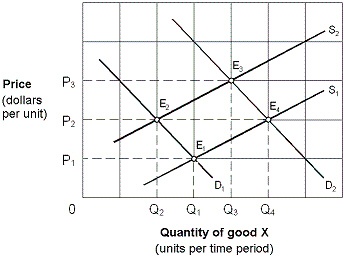 Beginning from an equilibrium at point E2 in Exhibit 4-3, an increase in demand for good X, other things being equal, would move the equilibrium point to:
 (Multiple Choice)
4.7/5 (76)
(76) A price ceiling that sets the price of a good below market equilibrium will cause:
(Multiple Choice)
4.8/5 (80)
(80) Which of the following is the best example of a public good?
(Multiple Choice)
5.0/5 (81)
(81) Assume that the production of a good imposes external costs upon third parties. If the price and quantity of this good is set by supply and demand the price will be too:
(Multiple Choice)
4.9/5 (63)
(63) Over a ten year period, the monthly charge for cellular phone service decreased from $120 per month to $30 per month. At the same time, the number of subscribers increased from less than 10 million to more than 75 million. Which of the following provides the best explanation for these changes?
(Multiple Choice)
4.8/5 (80)
(80) Suppose prices for new homes have risen, yet sales of new homes have also risen. We can conclude that:
(Multiple Choice)
4.8/5 (74)
(74) A cost imposed on people other than the consumers of a good or service is a:
(Multiple Choice)
4.8/5 (77)
(77) A side effect of a price floor set above the equilibrium price is:
(Multiple Choice)
4.9/5 (78)
(78) A black market may arise when government imposes a price ceiling.
(True/False)
4.8/5 (80)
(80) Suppose a price ceiling is set by the government below the market equilibrium price. Which of the following will result?
(Multiple Choice)
5.0/5 (68)
(68) The existence of an externality is proof that there is a(n):
(Multiple Choice)
4.9/5 (69)
(69) Assume a price floor is set above the equilibrium price. The result is a surplus.
(True/False)
4.8/5 (75)
(75) Exhibit 4-3 Supply and demand curves 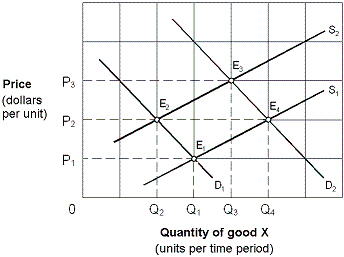 The market shown in Exhibit 4-3 is initially in equilibrium at point E4. Union negotiations result in a wage increase. Other things being equal, which of the following is the new equilibrium after this wage increase is in effect?
 (Multiple Choice)
4.9/5 (90)
(90) 
Filters
- Essay(0)
- Multiple Choice(0)
- Short Answer(0)
- True False(0)
- Matching(0)