



 Chat with AI
Exam 4: Markets in Action

Exam 1: Introducing the Economic Way of Thinking176 Questions
Exam 2: Production Possibilities, Opportunity Cost, and Economic Growth200 Questions
Exam 3: Market Demand and Supply348 Questions
Exam 4: Markets in Action261 Questions
Exam 5: Gross Domestic Product223 Questions
Exam 6: Business Cycles and Unemployment194 Questions
Exam 7: Inflation126 Questions
Exam 8: The Keynesian Model235 Questions
Exam 9: The Keynesian Model in Action202 Questions
Exam 10: Aggregate Demand and Supply187 Questions
Exam 11: Fiscal Policy223 Questions
Exam 12: The Public Sector127 Questions
Exam 13: Federal Deficits, Surpluses, and the National Debt99 Questions
Exam 14: Money and the Federal Reserve System154 Questions
Exam 15: Money Creation243 Questions
Exam 16: Monetary Policy213 Questions
Exam 17: The Phillips Curve and Expectations Theory120 Questions
Exam 18: International Trade and Finance248 Questions
Exam 19: Economies in Transition104 Questions
Exam 20: Growth and the Less-Developed Countries117 Questions
Exam 21: Applying Graphs to Economics68 Questions
Exam 22: Consumer Surplus, Producer Surplus, and Market Efficiency68 Questions
Exam 23: the Self-Correcting Aggregate Demand and Supply Model83 Questions
Exam 24: Policy Disputes Using the Self-Correcting Aggregate Demand and Supply Model36 Questions
Select questions type


Exhibit 4-6 Demand and supply curves  If the market supply increases and, simultaneously, market demand decreases, the new equilibrium will show:
 (Multiple Choice)
4.9/5  (78)
(78) Which of the following is an example of a pure public good?
(Multiple Choice)
4.8/5 (77)
(77) Exhibit 4-9 Data on supply and demand
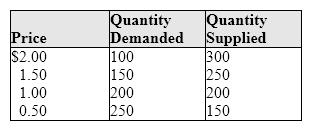 In Exhibit 4-9, if a price ceiling is set at $1.50 the market result after adjustment is:
 (Multiple Choice)
4.8/5 (78)
(78) Denise is thinking about setting up a butterfly garden in her backyard. She estimates that it will cost her $2,000 to purchase and install special plants and an irrigation system to attract butterflies. The benefit she expects to receive is $1,800. In addition, neighbor Billy will receive a benefit of $150 and neighbor Sammy will receive a benefit of $100. From this, we can conclude that:
(Multiple Choice)
4.9/5 (75)
(75) If there is a decrease in demand for lettuce, we would expect:
(Multiple Choice)
4.8/5 (87)
(87) Assuming supply is held constant, an increase in demand for a product will cause an increase in the equilibrium price and the amount bought and sold.
(True/False)
4.8/5 (99)
(99) If the cost of fertilizer rises, then the price of corn will:
(Multiple Choice)
4.9/5 (88)
(88) Either an increase in demand with the supply curve held constant or a decrease in supply with the demand curve held constant will raise a market's equilibrium price.
(True/False)
4.7/5 (71)
(71) Exhibit 4-4 Supply and demand curves for good X  An increase in buyers' income, assuming good X is a normal good, combined with an increase in the wage rate paid to workers producing good X would be represented by which of the following changes in equilibrium shown in Graph C of Exhibit 4-4?
 (Multiple Choice)
4.8/5 (78)
(78) An increase in consumers' incomes will have what effect on the equilibrium in the restaurant meals market?
(Multiple Choice)
4.8/5 (86)
(86) If the free market is called upon to provide public goods, then:
(Multiple Choice)
4.9/5 (82)
(82) Exhibit 4-7 Demand and supply schedules for movie tickets
 In Exhibit 4-7, the equilibrium price of a movie ticket is:
 (Multiple Choice)
4.9/5 (84)
(84) Which of the following is the best example of an action that imposes an external cost?
(Multiple Choice)
4.9/5 (67)
(67) Exhibit 4-2 Supply and demand curves  Beginning from an equilibrium at point E1 in Exhibit 4-2, an increase in demand for good X, other things being equal, would move the equilibrium point to:
 (Multiple Choice)
4.8/5 (79)
(79) A market consequence of the establishment of a price floor program is that price will be:
(Multiple Choice)
4.8/5 (73)
(73) Which of the following would generate positive externalities?
(Multiple Choice)
4.9/5 (70)
(70) A cost or benefit of a good imposed on people other than the consumers or producer of a good is called a(n):
(Multiple Choice)
4.8/5 (82)
(82) Most economists believe that there are positive externalities in education. One can conclude that a free market would fail to give the socially optimal outcome because the equilibrium:
(Multiple Choice)
4.8/5 (83)
(83) 
Filters
- Essay(0)
- Multiple Choice(0)
- Short Answer(0)
- True False(0)
- Matching(0)