



 Chat with AI
Exam 6: Business Cycles and Unemployment

Exam 1: Introducing the Economic Way of Thinking176 Questions
Exam 2: Production Possibilities, Opportunity Cost, and Economic Growth200 Questions
Exam 3: Market Demand and Supply348 Questions
Exam 4: Markets in Action261 Questions
Exam 5: Gross Domestic Product223 Questions
Exam 6: Business Cycles and Unemployment194 Questions
Exam 7: Inflation126 Questions
Exam 8: The Keynesian Model235 Questions
Exam 9: The Keynesian Model in Action202 Questions
Exam 10: Aggregate Demand and Supply187 Questions
Exam 11: Fiscal Policy223 Questions
Exam 12: The Public Sector127 Questions
Exam 13: Federal Deficits, Surpluses, and the National Debt99 Questions
Exam 14: Money and the Federal Reserve System154 Questions
Exam 15: Money Creation243 Questions
Exam 16: Monetary Policy213 Questions
Exam 17: The Phillips Curve and Expectations Theory120 Questions
Exam 18: International Trade and Finance248 Questions
Exam 19: Economies in Transition104 Questions
Exam 20: Growth and the Less-Developed Countries117 Questions
Exam 21: Applying Graphs to Economics68 Questions
Exam 22: Consumer Surplus, Producer Surplus, and Market Efficiency68 Questions
Exam 23: the Self-Correcting Aggregate Demand and Supply Model83 Questions
Exam 24: Policy Disputes Using the Self-Correcting Aggregate Demand and Supply Model36 Questions
Select questions type


Which one of the following people would not be considered a part of the labor force?

Free
(Multiple Choice)
5.0/5  (80)
(80) Correct Answer: Verified
B
The business cycle is the periodic but recurrent fluctuations in real GDP.
Free
(True/False)
4.7/5 (71)
(71) Correct Answer:Verified
VerifiedTrue
Which of the following groups of people are members of the labor force?
Free
(Multiple Choice)
4.9/5 (77)
(77) Correct Answer:Verified
VerifiedC
Whom does the Bureau of Labor Statistics include in the discouraged workers group?
(Multiple Choice)
4.9/5 (84)
(84) Which one of the following people is not a member of the labor force?
(Multiple Choice)
4.8/5 (68)
(68) Economic growth is measured by the annual percentage increase in a nation's level of:
(Multiple Choice)
4.9/5 (72)
(72) When people become unemployed because of a higher minimum wage, this type of unemployment is called:
(Multiple Choice)
4.9/5 (88)
(88) Find the size of the civilian labor force from the following data: frictional unemployment = 150, structural unemployment = 200, cyclical unemployment = 225, discouraged workers = 25, underemployed workers = 75, fully employed workers = 850, total population = 2,000.
(Multiple Choice)
4.9/5 (76)
(76) Sally lost her job when her company went out of business because of a recession. This is an example of:
(Multiple Choice)
4.9/5 (78)
(78) In the United States, the unemployment rate for blacks is roughly the same as the unemployment rate for whites.
(True/False)
4.8/5 (75)
(75) When individuals are unemployed because they lack the qualifications to fill available jobs, this is called:
(Multiple Choice)
4.8/5 (74)
(74) The term "recovery" refers to the maximum point of the business cycle.
(True/False)
4.8/5 (75)
(75) Which of the following people is counted in the labor force?
(Multiple Choice)
4.9/5 (88)
(88) Exhibit 6-1 Business cycle 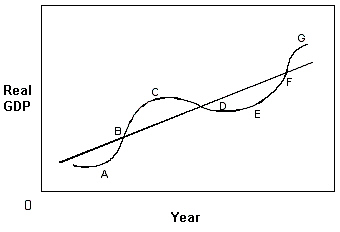 In Exhibit 6-1, the recovery phase of the business cycle can be represented by points:
 (Multiple Choice)
4.7/5 (86)
(86) The phase in the business cycle in which real GDP declines is called a:
(Multiple Choice)
4.9/5 (82)
(82) Unemployment that is caused by a mismatch of the demand for workers with certain skills and the skills of unemployed workers is:
(Multiple Choice)
4.9/5 (84)
(84) Part-time workers who want full-time work are counted as only partially employed in the official unemployment statistic.
(True/False)
4.8/5 (71)
(71) 
Filters
- Essay(0)
- Multiple Choice(0)
- Short Answer(0)
- True False(0)
- Matching(0)