



 Chat with AI
Exam 18: International Trade and Finance

Exam 1: Introducing the Economic Way of Thinking176 Questions
Exam 2: Production Possibilities, Opportunity Cost, and Economic Growth200 Questions
Exam 3: Market Demand and Supply348 Questions
Exam 4: Markets in Action261 Questions
Exam 5: Gross Domestic Product223 Questions
Exam 6: Business Cycles and Unemployment194 Questions
Exam 7: Inflation126 Questions
Exam 8: The Keynesian Model235 Questions
Exam 9: The Keynesian Model in Action202 Questions
Exam 10: Aggregate Demand and Supply187 Questions
Exam 11: Fiscal Policy223 Questions
Exam 12: The Public Sector127 Questions
Exam 13: Federal Deficits, Surpluses, and the National Debt99 Questions
Exam 14: Money and the Federal Reserve System154 Questions
Exam 15: Money Creation243 Questions
Exam 16: Monetary Policy213 Questions
Exam 17: The Phillips Curve and Expectations Theory120 Questions
Exam 18: International Trade and Finance248 Questions
Exam 19: Economies in Transition104 Questions
Exam 20: Growth and the Less-Developed Countries117 Questions
Exam 21: Applying Graphs to Economics68 Questions
Exam 22: Consumer Surplus, Producer Surplus, and Market Efficiency68 Questions
Exam 23: the Self-Correcting Aggregate Demand and Supply Model83 Questions
Exam 24: Policy Disputes Using the Self-Correcting Aggregate Demand and Supply Model36 Questions
Select questions type


If there is bilateral currency trade between Japan and the U.S., then as the supply of U.S. dollars on the world foreign exchange market ________, the price of a dollar in terms of Japanese yen will ________.

Free
(Multiple Choice)
4.9/5  (77)
(77) Correct Answer: Verified
A
Exhibit 15-4 Coffee and tea output (pounds per hour) 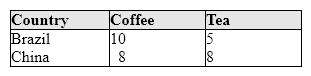 As shown in Exhibit 15-4, the opportunity cost to Brazil of producing one pound of coffee is:
Free
(Multiple Choice)
4.9/5 (78)
(78) Correct Answer:Verified
VerifiedC
If a nation follows a policy of being self-sufficient, its:
Free
(Multiple Choice)
4.8/5 (80)
(80) Correct Answer:Verified
VerifiedA
A country should export the goods in which it has an absolute advantage.
(True/False)
4.8/5 (92)
(92) "More productive workers receive higher wages than less productive workers." This observation is a major flaw in which of the following arguments for protectionism?
(Multiple Choice)
4.9/5 (85)
(85) Exhibit 15-3 Potatoes and wheat output (tons per day) 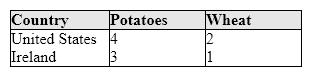 In Exhibit 15-3, Ireland's opportunity cost of producing one unit of wheat is:
 (Multiple Choice)
4.9/5 (72)
(72) Which of the following would cause the U.S. dollar to depreciate against the Japanese yen?
(Multiple Choice)
4.8/5 (72)
(72) Which of the following statements is true with respect to a tariff on imported cheese?
(Multiple Choice)
4.8/5 (84)
(84) Trade restrictions imposed in the name of national security have been recommended by protectionists in order to:
(Multiple Choice)
4.8/5 (78)
(78) Which of the following changes in the exchange rate represents a depreciation of the dollar?
(Multiple Choice)
4.9/5 (86)
(86) According to the principle of comparative advantage, total output and consumption levels will be highest when goods are produced in nations according to which of the following conditions?
(Multiple Choice)
4.8/5 (81)
(81) Following the principle of comparative advantage, specialization:
(Multiple Choice)
4.9/5 (80)
(80) Which of the following is not an argument used in favor of protectionism?
(Multiple Choice)
4.8/5 (84)
(84) Exhibit 15-6 Dollars per British pound 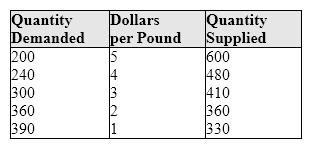 In Exhibit 15-6, the exchange rate will have no tendency to change when it is equal to:
 (Multiple Choice)
4.9/5 (72)
(72) Which of the following would not be counted in the U.S. BOP current account?
(Multiple Choice)
4.7/5 (71)
(71) In a two good, two-country world, a country has a comparative advantage in any good for which it has a:
(Multiple Choice)
4.7/5 (84)
(84) Comparative advantage is the ability of a country to produce a good at a ________ opportunity cost relative to other countries.
(Multiple Choice)
4.9/5 (77)
(77) 
Filters
- Essay(0)
- Multiple Choice(0)
- Short Answer(0)
- True False(0)
- Matching(0)