



 Chat with AI
Exam 18: International Trade and Finance

Exam 1: Introducing the Economic Way of Thinking176 Questions
Exam 2: Production Possibilities, Opportunity Cost, and Economic Growth200 Questions
Exam 3: Market Demand and Supply348 Questions
Exam 4: Markets in Action261 Questions
Exam 5: Gross Domestic Product223 Questions
Exam 6: Business Cycles and Unemployment194 Questions
Exam 7: Inflation126 Questions
Exam 8: The Keynesian Model235 Questions
Exam 9: The Keynesian Model in Action202 Questions
Exam 10: Aggregate Demand and Supply187 Questions
Exam 11: Fiscal Policy223 Questions
Exam 12: The Public Sector127 Questions
Exam 13: Federal Deficits, Surpluses, and the National Debt99 Questions
Exam 14: Money and the Federal Reserve System154 Questions
Exam 15: Money Creation243 Questions
Exam 16: Monetary Policy213 Questions
Exam 17: The Phillips Curve and Expectations Theory120 Questions
Exam 18: International Trade and Finance248 Questions
Exam 19: Economies in Transition104 Questions
Exam 20: Growth and the Less-Developed Countries117 Questions
Exam 21: Applying Graphs to Economics68 Questions
Exam 22: Consumer Surplus, Producer Surplus, and Market Efficiency68 Questions
Exam 23: the Self-Correcting Aggregate Demand and Supply Model83 Questions
Exam 24: Policy Disputes Using the Self-Correcting Aggregate Demand and Supply Model36 Questions
Select questions type


Suppose a German bank purchases a U.S. Treasury bond. This transaction would be recorded in the:
(Multiple Choice)
4.8/5  (83)
(83) Exhibit 15-1 Production possibilities curves 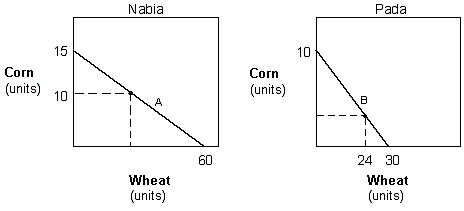 In Exhibit 15-1, the production possibilities curves of wheat and corn for Nabia and Pada are presented. If these two nations trade, Nabia should specialize in the production of:
 (Multiple Choice)
4.9/5 (75)
(75) An increase in the value of the dollar in international exchange rate markets will cause the relative price of U.S. produced goods to foreigners to rise, the relative price of foreign produced goods to Americans to fall, causing U.S. exports to fall and U.S. imports to rise.
(True/False)
4.8/5 (89)
(89) The U.S. supply curve of dollars is upward-sloping because a:
(Multiple Choice)
4.9/5 (83)
(83) If you were told that the exchange rate between the U.S. dollar and the Canadian dollar was 1.2, that would mean that Canadians would have to spend ____ to buy a $12 watch in New York City.
(Multiple Choice)
4.8/5 (73)
(73) If the exchange rate of yen for dollars increases from 100 yen = $1 to 110 yen = $1, then:
(Multiple Choice)
4.9/5 (84)
(84) A country's balance on current account will always equal its balance on capital account.
(True/False)
4.9/5 (82)
(82) If foreign exchange rates are determined by the interaction of supply and demand forces for the various currencies, then the exchange rate is:
(Multiple Choice)
4.9/5 (99)
(99) Which of the following would cause the U.S. demand curve for Japanese yen to shift to the right?
(Multiple Choice)
4.9/5 (62)
(62) Juanita, a lawyer, can type faster than Jill, her secretary. Jill, on the other hand, does not have the ability or skills to practice law. Applying the principles of international trade to this situation, an economic consultant advises Juanita to:
(Multiple Choice)
4.9/5 (75)
(75) The main explanation for why the cheap foreign labor argument is a poor reason for restricting international trade is that:
(Multiple Choice)
4.8/5 (75)
(75) Exhibit 15-1 Production possibilities curves 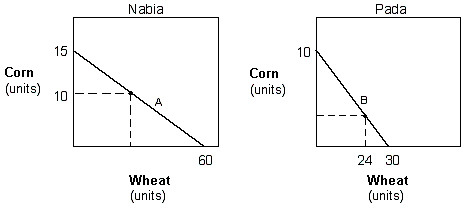 In Exhibit 15-1, the production possibilities curves of wheat and corn for Nabia and Pada are presented. If these two nations trade, Pada should specialize in the production of:
 (Multiple Choice)
4.9/5 (73)
(73) Which of the following is not included in the current account?
(Multiple Choice)
4.8/5 (87)
(87) If a country has a comparative advantage in oil, then this means that the opportunity cost of producing oil is:
(Multiple Choice)
4.9/5 (86)
(86) Borrowing from foreign banks by U.S. firms represents a capital inflow.
(True/False)
4.8/5 (79)
(79) 
Filters
- Essay(0)
- Multiple Choice(0)
- Short Answer(0)
- True False(0)
- Matching(0)