



 Chat with AI
Exam 18: International Trade and Finance

Exam 1: Introducing the Economic Way of Thinking176 Questions
Exam 2: Production Possibilities, Opportunity Cost, and Economic Growth200 Questions
Exam 3: Market Demand and Supply348 Questions
Exam 4: Markets in Action261 Questions
Exam 5: Gross Domestic Product223 Questions
Exam 6: Business Cycles and Unemployment194 Questions
Exam 7: Inflation126 Questions
Exam 8: The Keynesian Model235 Questions
Exam 9: The Keynesian Model in Action202 Questions
Exam 10: Aggregate Demand and Supply187 Questions
Exam 11: Fiscal Policy223 Questions
Exam 12: The Public Sector127 Questions
Exam 13: Federal Deficits, Surpluses, and the National Debt99 Questions
Exam 14: Money and the Federal Reserve System154 Questions
Exam 15: Money Creation243 Questions
Exam 16: Monetary Policy213 Questions
Exam 17: The Phillips Curve and Expectations Theory120 Questions
Exam 18: International Trade and Finance248 Questions
Exam 19: Economies in Transition104 Questions
Exam 20: Growth and the Less-Developed Countries117 Questions
Exam 21: Applying Graphs to Economics68 Questions
Exam 22: Consumer Surplus, Producer Surplus, and Market Efficiency68 Questions
Exam 23: the Self-Correcting Aggregate Demand and Supply Model83 Questions
Exam 24: Policy Disputes Using the Self-Correcting Aggregate Demand and Supply Model36 Questions
Select questions type


What are the different types of trade barriers? What are the arguments for trade barriers? What are the consequences of trade barriers?
(Essay)
4.8/5  (80)
(80) The average National Basketball Association player is over 6 feet tall. The average horse jockey is shorter than 5 1\2 feet tall. This is because height provides NBA players with:
(Multiple Choice)
4.9/5 (80)
(80) If it costs the DuPont Chemical Company more to make the chemical flaxinate in the United States than it does to make it in Formosa, the Formosans must have:
(Multiple Choice)
4.9/5 (79)
(79) Exhibit 15-5 International currency markets 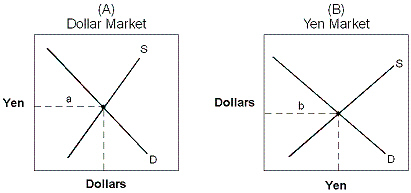 Exhibit 15-5 displays the international currency market for yen in terms of dollars and dollars in terms of yen. The demand curve in graph 15-5(A)is determined by:
 (Multiple Choice)
4.9/5 (88)
(88) The theory of comparative advantage suggests that nations should produce a good if they:
(Multiple Choice)
4.9/5 (69)
(69) Exhibit 15-7 Foreign exchange market for U.S. dollars and British pounds 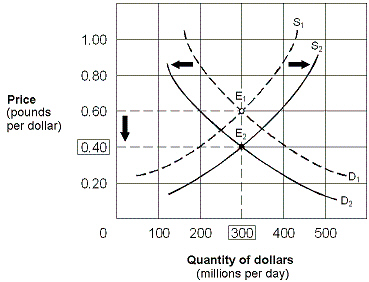 Which of the following could cause the dollar-pound exchange rates to change as shown in Exhibit 15-7?
 (Multiple Choice)
4.9/5 (68)
(68) An increase in the real rate of interest that can be earned on U.S. investments above the rate that can be earned on investments in India would:
(Multiple Choice)
4.9/5 (98)
(98) Without trade, the consumption possibilities for two nations are:
(Multiple Choice)
4.8/5 (74)
(74) Exhibit 15-3 Potatoes and wheat output (tons per day) 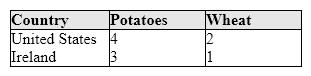 In Exhibit 15-3, the United States has a comparative advantage in producing:
 (Multiple Choice)
4.8/5 (77)
(77) An increase in the price level in Japan relative to the price level in the United States will shift the demand curve for dollars leftward and the dollar depreciates or becomes weaker.
(True/False)
4.8/5 (82)
(82) When Brazil can generate a product using fewer labor hours and resources than the United States, an economist would say that Brazil had:
(Multiple Choice)
4.9/5 (80)
(80) Which of the following changes in the exchange rate represents an appreciation of the dollar?
(Multiple Choice)
4.9/5 (74)
(74) Since World War II, tariff reductions have occurred in large part because of negotiations under the:
(Multiple Choice)
4.8/5 (72)
(72) Persistent negative current account balances will lead to ____.
(Multiple Choice)
4.9/5 (75)
(75) 
Filters
- Essay(0)
- Multiple Choice(0)
- Short Answer(0)
- True False(0)
- Matching(0)