



 Chat with AI
Exam 18: International Trade and Finance

Exam 1: Introducing the Economic Way of Thinking176 Questions
Exam 2: Production Possibilities, Opportunity Cost, and Economic Growth200 Questions
Exam 3: Market Demand and Supply348 Questions
Exam 4: Markets in Action261 Questions
Exam 5: Gross Domestic Product223 Questions
Exam 6: Business Cycles and Unemployment194 Questions
Exam 7: Inflation126 Questions
Exam 8: The Keynesian Model235 Questions
Exam 9: The Keynesian Model in Action202 Questions
Exam 10: Aggregate Demand and Supply187 Questions
Exam 11: Fiscal Policy223 Questions
Exam 12: The Public Sector127 Questions
Exam 13: Federal Deficits, Surpluses, and the National Debt99 Questions
Exam 14: Money and the Federal Reserve System154 Questions
Exam 15: Money Creation243 Questions
Exam 16: Monetary Policy213 Questions
Exam 17: The Phillips Curve and Expectations Theory120 Questions
Exam 18: International Trade and Finance248 Questions
Exam 19: Economies in Transition104 Questions
Exam 20: Growth and the Less-Developed Countries117 Questions
Exam 21: Applying Graphs to Economics68 Questions
Exam 22: Consumer Surplus, Producer Surplus, and Market Efficiency68 Questions
Exam 23: the Self-Correcting Aggregate Demand and Supply Model83 Questions
Exam 24: Policy Disputes Using the Self-Correcting Aggregate Demand and Supply Model36 Questions
Select questions type


Which of the following will most likely cause a nation's currency to appreciate on the foreign exchange market?
(Multiple Choice)
4.8/5  (71)
(71) Exhibit 15-1 Production possibilities curves 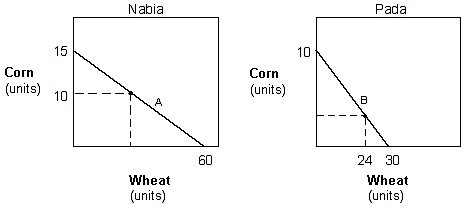 In Exhibit 15-1, the production possibilities curves of wheat and corn for Nabia and Pada are presented. In Pada the cost of producing one more unit of wheat is equal to:
 (Multiple Choice)
4.9/5 (72)
(72) Absolute advantage occurs when one nation can produce a good ____ its trading partners.
(Multiple Choice)
4.9/5 (72)
(72) The demand curve for Japanese yen is downward sloping because when the exchange rate (measured in dollars per yen)falls,
(Multiple Choice)
4.7/5 (93)
(93) When an exchange rate is determined strictly by the demands and supplies for a nation's currency, it is called:
(Multiple Choice)
4.9/5 (88)
(88) When a nation totally bans trade with another country, it is imposing a(n):
(Multiple Choice)
4.8/5 (77)
(77) A restriction on the quantity of a good that can be imported into a country is a(n):
(Multiple Choice)
4.8/5 (82)
(82) Suppose there are two countries, X and Y. If the exchange rate, as measured in X's currency, is currently 9, what do citizens of the nation of Y see when they read their newspapers?
(Multiple Choice)
4.9/5 (92)
(92) Exhibit 15-5 International currency markets 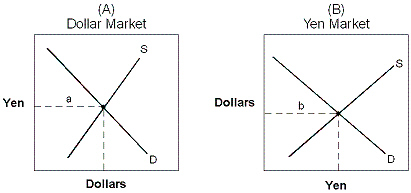 Exhibit 15-5 displays the international currency market for yen in terms of dollars and dollars in terms of yen. The demand curve in graph 15-5(B)is determined by:
 (Multiple Choice)
4.8/5 (76)
(76) Purchases of foreign assets by U.S. residents are tabulated in the U.S. balance of payments as a:
(Multiple Choice)
4.9/5 (92)
(92) Which of the following is an infant-industry argument in favor of restrictions on foreign trade?
(Multiple Choice)
4.9/5 (69)
(69) The theory of comparative advantage suggests that nations should produce a good if they:
(Multiple Choice)
4.8/5 (86)
(86) If the U.S. dollar appreciates relative to the British pound, then we pay fewer dollars for a pound.
(True/False)
4.7/5 (77)
(77) A lawyer once said, "I could paint my house and fix my plumbing if I just had some technical training and good tools. But, I would rather hire a painter and a plumber." When it comes to fixing a leaking sink, the plumber:
(Multiple Choice)
4.9/5 (80)
(80) Protectionist policies such as tariffs and quotas are beneficial to the nation imposing those trade barriers.
(True/False)
4.7/5 (89)
(89) 
Filters
- Essay(0)
- Multiple Choice(0)
- Short Answer(0)
- True False(0)
- Matching(0)