



 Chat with AI
Exam 18: International Trade and Finance

Exam 1: Introducing the Economic Way of Thinking176 Questions
Exam 2: Production Possibilities, Opportunity Cost, and Economic Growth200 Questions
Exam 3: Market Demand and Supply348 Questions
Exam 4: Markets in Action261 Questions
Exam 5: Gross Domestic Product223 Questions
Exam 6: Business Cycles and Unemployment194 Questions
Exam 7: Inflation126 Questions
Exam 8: The Keynesian Model235 Questions
Exam 9: The Keynesian Model in Action202 Questions
Exam 10: Aggregate Demand and Supply187 Questions
Exam 11: Fiscal Policy223 Questions
Exam 12: The Public Sector127 Questions
Exam 13: Federal Deficits, Surpluses, and the National Debt99 Questions
Exam 14: Money and the Federal Reserve System154 Questions
Exam 15: Money Creation243 Questions
Exam 16: Monetary Policy213 Questions
Exam 17: The Phillips Curve and Expectations Theory120 Questions
Exam 18: International Trade and Finance248 Questions
Exam 19: Economies in Transition104 Questions
Exam 20: Growth and the Less-Developed Countries117 Questions
Exam 21: Applying Graphs to Economics68 Questions
Exam 22: Consumer Surplus, Producer Surplus, and Market Efficiency68 Questions
Exam 23: the Self-Correcting Aggregate Demand and Supply Model83 Questions
Exam 24: Policy Disputes Using the Self-Correcting Aggregate Demand and Supply Model36 Questions
Select questions type


If Country A has an absolute advantage over Country B in the production of every commodity:
(Multiple Choice)
4.7/5  (77)
(77) The primary benefits derived from tariffs usually accrue to the:
(Multiple Choice)
4.8/5 (70)
(70) Suppose the United States decides to impose a $1,000 tax on every Japanese minivan sold in the United States. This is an example of:
(Multiple Choice)
4.9/5 (73)
(73) One big difference between tariffs and quotas is that tariffs:
(Multiple Choice)
4.9/5 (73)
(73) Exhibit 15-5 International currency markets 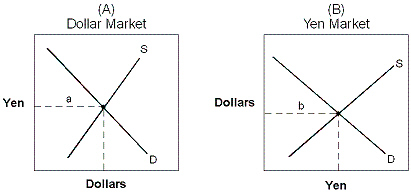 Exhibit 15-5 displays the international currency market for yen in terms of dollars and dollars in terms of yen. The supply curve in graph 15-5(B)is determined by:
 (Multiple Choice)
4.8/5 (66)
(66) An increase in inflation in the United States relative to the rate in France would make:
(Multiple Choice)
4.9/5 (80)
(80) Which of the following transactions would be recorded as a credit in the U.S. current account?
(Multiple Choice)
4.9/5 (79)
(79) A limit on the quantity of a good that may be imported in a given time period is called:
(Multiple Choice)
4.8/5 (86)
(86) Suppose rice can be produced in country X at a lower cost than in country Y, while tuna can be produced in country Y at a lower cost than in country X. International competition will:
(Multiple Choice)
4.9/5 (78)
(78) An increase in a nation's trade deficit occurs when that nation's exports rise and\or its imports fall.
(True/False)
4.8/5 (84)
(84) If one country can produce a good with fewer resources than another country, this is called:
(Multiple Choice)
4.9/5 (72)
(72) Which of the following would be expected if the tariff on foreign-produced shoes were decreased?
(Multiple Choice)
4.9/5 (85)
(85) If nation A has an absolute advantage over nation B in the production of a product, this implies that:
(Multiple Choice)
4.8/5 (66)
(66) If a box of Swiss chocolate priced at 100 francs can be purchased for $50, the exchange rate is:
(Multiple Choice)
4.8/5 (86)
(86) International trade forces countries to consume a combination of goods that is inside their production possibilities curve.
(True/False)
4.9/5 (77)
(77) If the Japanese price level falls relative to the price level in the United States, then:
(Multiple Choice)
5.0/5 (82)
(82) If the current account and capital account are both in surplus, the official reserve account does not have to be in deficit.
(True/False)
4.8/5 (85)
(85) 
Filters
- Essay(0)
- Multiple Choice(0)
- Short Answer(0)
- True False(0)
- Matching(0)