



 Chat with AI
Exam 11: Fiscal Policy

Exam 1: Introducing the Economic Way of Thinking176 Questions
Exam 2: Production Possibilities, Opportunity Cost, and Economic Growth200 Questions
Exam 3: Market Demand and Supply348 Questions
Exam 4: Markets in Action261 Questions
Exam 5: Gross Domestic Product223 Questions
Exam 6: Business Cycles and Unemployment194 Questions
Exam 7: Inflation126 Questions
Exam 8: The Keynesian Model235 Questions
Exam 9: The Keynesian Model in Action202 Questions
Exam 10: Aggregate Demand and Supply187 Questions
Exam 11: Fiscal Policy223 Questions
Exam 12: The Public Sector127 Questions
Exam 13: Federal Deficits, Surpluses, and the National Debt99 Questions
Exam 14: Money and the Federal Reserve System154 Questions
Exam 15: Money Creation243 Questions
Exam 16: Monetary Policy213 Questions
Exam 17: The Phillips Curve and Expectations Theory120 Questions
Exam 18: International Trade and Finance248 Questions
Exam 19: Economies in Transition104 Questions
Exam 20: Growth and the Less-Developed Countries117 Questions
Exam 21: Applying Graphs to Economics68 Questions
Exam 22: Consumer Surplus, Producer Surplus, and Market Efficiency68 Questions
Exam 23: the Self-Correcting Aggregate Demand and Supply Model83 Questions
Exam 24: Policy Disputes Using the Self-Correcting Aggregate Demand and Supply Model36 Questions
Select questions type


As the marginal propensity to consume (MPC)decreases, the spending multiplier:
(Multiple Choice)
4.8/5  (83)
(83) Suppose inflation is a threat because the current aggregate demand curve will increase by $600 billion at any price level. If the marginal propensity to consume is 0.75, federal policymakers can follow Keynesian economics and restrain inflation by:
(Multiple Choice)
4.9/5 (72)
(72) If the MPC is 0.80, and if the goal is to increase real GDP by $200 million, then by how much would government spending have to change to generate this increase in real GDP?
(Multiple Choice)
4.7/5 (86)
(86) The change in saving divided by the change in income is the:
(Multiple Choice)
4.9/5 (69)
(69) According to Keynesian economics, fiscal policy should create a deficit during economic contractions.
(True/False)
4.9/5 (68)
(68) If no fiscal policy changes are made, suppose the current aggregate demand curve will increase horizontally by $1,000 billion and cause inflation. If the marginal propensity to consume (MPC)is 0.80, federal policymakers could follow Keynesian economics and restrain inflation by decreasing:
(Multiple Choice)
4.8/5 (80)
(80) The sum of the marginal propensity to consume (MPC)and the marginal propensity to save (MPS)always equals:
(Multiple Choice)
4.9/5 (73)
(73) Assume that an economy's real GDP multiplier is 4. If this economy is in equilibrium at $2,000 billion, then which one of the following actions will bring it to a full-employment equilibrium of $1,500 billion?
(Multiple Choice)
4.8/5 (94)
(94) Exhibit 11-6 Aggregate demand and supply model 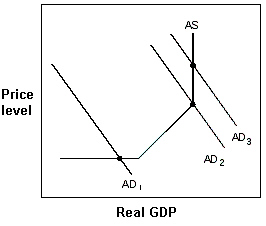 In Exhibit 11-6, if the aggregate demand curve is at AD1, the government should:
 (Multiple Choice)
4.9/5 (82)
(82) If the marginal propensity to consume (MPC)is 0.75, and if the goal is to increase real GDP by $400 million, then by how much would government spending have to change to generate this increase in real GDP?
(Multiple Choice)
4.9/5 (81)
(81) Keynesian economics focuses on the role of aggregate spending in determining the level of real GDP.
(True/False)
4.9/5 (85)
(85) If the economy is experiencing demand-pull inflation, then the appropriate government policy would be to shift the:
(Multiple Choice)
4.8/5 (77)
(77) If the marginal propensity to consume (MPC)is 0.96, the value of the spending multiplier is:
(Multiple Choice)
4.7/5 (86)
(86) A tax multiplier equal to - 4.30 would imply that a $100 tax increase would lead to a:
(Multiple Choice)
4.9/5 (57)
(57) Exhibit 11-3 Aggregate demand and supply model 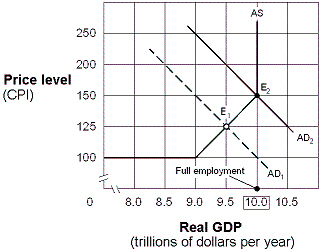 Suppose the economy in Exhibit 11-3 is in equilibrium at point E1, and the marginal propensity to consume (MPC)is 0.75. Following Keynesian economics, to restore full employment, the government should cut taxes by:
 (Multiple Choice)
4.9/5 (86)
(86) Which of the following would be an appropriate discretionary fiscal policy to use when the economy is in a recession?
(Multiple Choice)
4.8/5 (86)
(86) 
Filters
- Essay(0)
- Multiple Choice(0)
- Short Answer(0)
- True False(0)
- Matching(0)