



 Chat with AI
Exam 11: Fiscal Policy

Exam 1: Introducing the Economic Way of Thinking176 Questions
Exam 2: Production Possibilities, Opportunity Cost, and Economic Growth200 Questions
Exam 3: Market Demand and Supply348 Questions
Exam 4: Markets in Action261 Questions
Exam 5: Gross Domestic Product223 Questions
Exam 6: Business Cycles and Unemployment194 Questions
Exam 7: Inflation126 Questions
Exam 8: The Keynesian Model235 Questions
Exam 9: The Keynesian Model in Action202 Questions
Exam 10: Aggregate Demand and Supply187 Questions
Exam 11: Fiscal Policy223 Questions
Exam 12: The Public Sector127 Questions
Exam 13: Federal Deficits, Surpluses, and the National Debt99 Questions
Exam 14: Money and the Federal Reserve System154 Questions
Exam 15: Money Creation243 Questions
Exam 16: Monetary Policy213 Questions
Exam 17: The Phillips Curve and Expectations Theory120 Questions
Exam 18: International Trade and Finance248 Questions
Exam 19: Economies in Transition104 Questions
Exam 20: Growth and the Less-Developed Countries117 Questions
Exam 21: Applying Graphs to Economics68 Questions
Exam 22: Consumer Surplus, Producer Surplus, and Market Efficiency68 Questions
Exam 23: the Self-Correcting Aggregate Demand and Supply Model83 Questions
Exam 24: Policy Disputes Using the Self-Correcting Aggregate Demand and Supply Model36 Questions
Select questions type


Supply-side fiscal policies focus on improving the incentives to work, save, and invest.
(True/False)
4.9/5  (84)
(84) Assume the marginal propensity to consume (MPC)is 0.80 and the government increases taxes by $100 billion. The aggregate demand curve will shift to the:
(Multiple Choice)
4.7/5 (77)
(77) A government spending and taxation policy to achieve macroeconomic goals is known as:
(Multiple Choice)
4.9/5 (70)
(70) Exhibit 11-1 Disposable income and consumption data 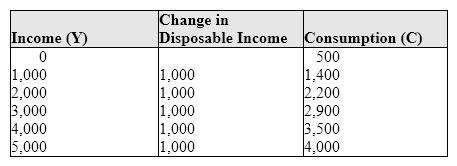 In Exhibit 11-1, when disposable income (Y)is increased from $1,000 to $2,000, the marginal propensity to consume is:
 (Multiple Choice)
5.0/5 (73)
(73) Automatic stabilizers "lean against the prevailing wind" of the business cycle because:
(Multiple Choice)
4.8/5 (76)
(76) Because of the automatic stabilizers, a decline in the level of economic activity will cause:
(Multiple Choice)
4.8/5 (74)
(74) If the marginal propensity to consume (MPC)is 0.50, the value of the spending multiplier is:
(Multiple Choice)
4.9/5 (86)
(86) Contractionary fiscal policy is deliberate government action to influence aggregate demand and the level of real GDP through:
(Multiple Choice)
4.7/5 (89)
(89) Exhibit 11-7 Aggregate demand and supply model 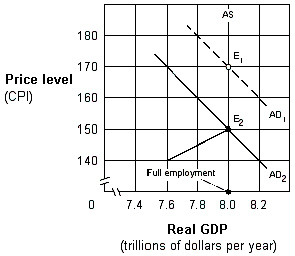 Beginning at equilibrium E1 in Exhibit 11-7, assume the marginal propensity to consume (MPC)is 0.90 and the government increases taxes by $100 billion. The aggregate demand curve will shift to the:
 (Multiple Choice)
4.8/5 (94)
(94) The government wishes to close an inflationary gap by reducing real GDP by $400 billion. Assuming a tax multiplier of 4 and an income multiplier of 5, which of the following policy prescriptions would reduce the inflationary gap by $400 billion?
(Multiple Choice)
4.9/5 (81)
(81) Assume Congress enacts a $10 billion increase in spending and a $10 billion tax increase to finance the additional government spending. The result of this balanced-budget approach is a:
(Multiple Choice)
4.9/5 (85)
(85) Mathematically, the value of the tax multiplier in terms of the marginal propensity to consume (MPC)is given by the formula:
(Multiple Choice)
5.0/5 (86)
(86) Supply-side fiscal policies were advocated by the Reagan administration.
(True/False)
4.8/5 (80)
(80) Exhibit 11-1 Disposable income and consumption data
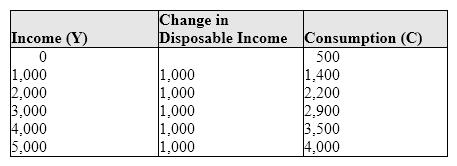 In Exhibit 11-1, when disposable income (Y)is increased from $0 to $1,000 to $2,000, the marginal propensity to consume:
 (Multiple Choice)
4.9/5 (84)
(84) Assume the economy is in recession and real GDP is below full employment. The marginal propensity to consume (MPC)is 0.50, and the government follows Keynesian economics by using expansionary fiscal policy to increase aggregate demand (total spending). If an increase of $1,000 billion aggregate demand can restore full employment, the government should:
(Multiple Choice)
4.9/5 (82)
(82) The size of the spending multiplier depends on the marginal propensity to consume (MPC).
(True/False)
4.7/5 (81)
(81) When the government levies a $100 million tax on people's income and puts the $100 million back into the economy in the form of a spending program, such as new interstate highway construction, the:
(Multiple Choice)
4.9/5 (86)
(86) 
Filters
- Essay(0)
- Multiple Choice(0)
- Short Answer(0)
- True False(0)
- Matching(0)