



 Chat with AI
Exam 11: Fiscal Policy

Exam 1: Introducing the Economic Way of Thinking176 Questions
Exam 2: Production Possibilities, Opportunity Cost, and Economic Growth200 Questions
Exam 3: Market Demand and Supply348 Questions
Exam 4: Markets in Action261 Questions
Exam 5: Gross Domestic Product223 Questions
Exam 6: Business Cycles and Unemployment194 Questions
Exam 7: Inflation126 Questions
Exam 8: The Keynesian Model235 Questions
Exam 9: The Keynesian Model in Action202 Questions
Exam 10: Aggregate Demand and Supply187 Questions
Exam 11: Fiscal Policy223 Questions
Exam 12: The Public Sector127 Questions
Exam 13: Federal Deficits, Surpluses, and the National Debt99 Questions
Exam 14: Money and the Federal Reserve System154 Questions
Exam 15: Money Creation243 Questions
Exam 16: Monetary Policy213 Questions
Exam 17: The Phillips Curve and Expectations Theory120 Questions
Exam 18: International Trade and Finance248 Questions
Exam 19: Economies in Transition104 Questions
Exam 20: Growth and the Less-Developed Countries117 Questions
Exam 21: Applying Graphs to Economics68 Questions
Exam 22: Consumer Surplus, Producer Surplus, and Market Efficiency68 Questions
Exam 23: the Self-Correcting Aggregate Demand and Supply Model83 Questions
Exam 24: Policy Disputes Using the Self-Correcting Aggregate Demand and Supply Model36 Questions
Select questions type


Automatic stabilizers stabilize the level of real GDP because:
(Multiple Choice)
4.8/5  (85)
(85) Which of the following is an example of expansionary fiscal policy?
(Multiple Choice)
4.9/5 (86)
(86) Unemployment insurance payments act as automatic stabilizers by:
(Multiple Choice)
5.0/5 (80)
(80) If consumption is $800 when income is $1,000, the marginal propensity to consume (MPC)must be 0.80.
(True/False)
4.9/5 (85)
(85) The marginal propensity to consume (MPC)is computed as the change in consumption divided by the change in:
(Multiple Choice)
4.8/5 (82)
(82) Exhibit 11-5 Aggregate demand and supply model 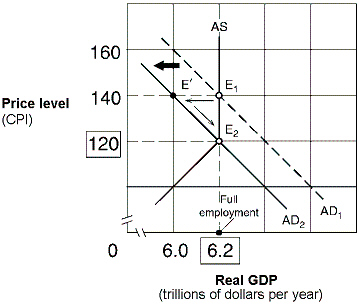 Suppose the economy in Exhibit 11-5 is in equilibrium at point E1 and the marginal propensity to consume (MPC)is 0.75. Following Keynesian economics, the federal government can move the economy to point E2 and reduce inflation by:
 (Multiple Choice)
4.8/5 (75)
(75) The Laffer curve belongs to which of the following schools of economic thought?
(Multiple Choice)
4.8/5 (75)
(75) Which of the following favors government policies to stimulate the economy by creating incentives for individuals and businesses to increase their productive efforts?
(Multiple Choice)
4.9/5 (87)
(87) "Lower marginal tax rates encourage people to work, save, and invest, resulting in more output and a larger tax base." This statement most closely reflects which of the following schools of economic thought?
(Multiple Choice)
4.8/5 (83)
(83) According to the Laffer curve, when the tax rate is 100 percent, tax revenue will be:
(Multiple Choice)
4.8/5 (87)
(87) Which of the following is emphasized by supply-side economics?
(Multiple Choice)
4.8/5 (81)
(81) Assume the marginal propensity to consume (MPC)is 0.75 and the government cuts taxes by $250 billion. The aggregate demand curve will shift to the:
(Multiple Choice)
4.8/5 (88)
(88) If your income increases from $30,000 to $40,000 and your savings increases from $2,000 to $4,000, your marginal propensity to save (MPS)is:
(Multiple Choice)
4.9/5 (75)
(75) If the economy is experiencing inflation, then the most appropriate government policy would be to:
(Multiple Choice)
4.9/5 (85)
(85) Mathematically, the value of the spending multiplier in terms of the marginal propensity to consume (MPC)is given by the formula:
(Multiple Choice)
4.9/5 (77)
(77) The school of economic thought which argues that through tax reductions, and deregulation, government creates the proper incentives for the private sector to increase aggregate supply is known as the:
(Multiple Choice)
4.9/5 (90)
(90) The greater the marginal propensity to consume (MPC)in the economy, the greater the spending multiplier.
(True/False)
4.7/5 (77)
(77) Assume that we want to drive our economy out of recession by generating a $400 billion change in real GDP. The MPC is 0.80. Which of the following policy prescriptions would generate the targeted $400 billion change in income?
(Multiple Choice)
4.9/5 (80)
(80) The government can reduce unemployment or reduce inflation by:
(Multiple Choice)
4.9/5 (73)
(73) 
Filters
- Essay(0)
- Multiple Choice(0)
- Short Answer(0)
- True False(0)
- Matching(0)