



 Chat with AI
Exam 5: Gross Domestic Product

Exam 1: Introducing the Economic Way of Thinking176 Questions
Exam 2: Production Possibilities, Opportunity Cost, and Economic Growth200 Questions
Exam 3: Market Demand and Supply348 Questions
Exam 4: Markets in Action261 Questions
Exam 5: Gross Domestic Product223 Questions
Exam 6: Business Cycles and Unemployment194 Questions
Exam 7: Inflation126 Questions
Exam 8: The Keynesian Model235 Questions
Exam 9: The Keynesian Model in Action202 Questions
Exam 10: Aggregate Demand and Supply187 Questions
Exam 11: Fiscal Policy223 Questions
Exam 12: The Public Sector127 Questions
Exam 13: Federal Deficits, Surpluses, and the National Debt99 Questions
Exam 14: Money and the Federal Reserve System154 Questions
Exam 15: Money Creation243 Questions
Exam 16: Monetary Policy213 Questions
Exam 17: The Phillips Curve and Expectations Theory120 Questions
Exam 18: International Trade and Finance248 Questions
Exam 19: Economies in Transition104 Questions
Exam 20: Growth and the Less-Developed Countries117 Questions
Exam 21: Applying Graphs to Economics68 Questions
Exam 22: Consumer Surplus, Producer Surplus, and Market Efficiency68 Questions
Exam 23: the Self-Correcting Aggregate Demand and Supply Model83 Questions
Exam 24: Policy Disputes Using the Self-Correcting Aggregate Demand and Supply Model36 Questions
Select questions type


National income is derived from gross domestic product by subtracting:
(Multiple Choice)
4.9/5  (76)
(76) Exhibit 5-2 Gross domestic product data 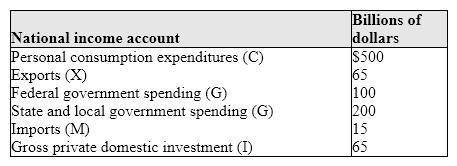 As shown in Exhibit 5-2, total expenditures by households for domestically produced goods is:
 (Multiple Choice)
4.9/5 (85)
(85) Because GDP does not account for improvements in the quality of goods, the GDP calculation:
(Multiple Choice)
5.0/5 (87)
(87) Suppose in 2000, GDP was $7,242 billion and the GDP chain price index is 117.5. Real GDP in constant 1996 dollars is:
(Multiple Choice)
4.9/5 (78)
(78) The lower portion of the circular flow model contains factor markets in which households provide:
(Multiple Choice)
4.8/5 (84)
(84) Exhibit 5-9 GDP data (billions of dollars)
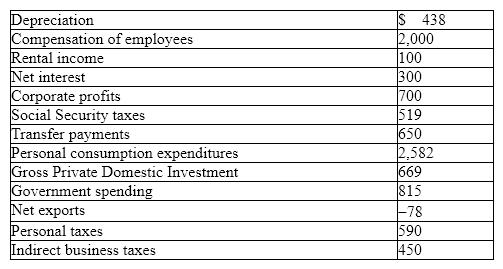 In Exhibit 5-10, compute personal income (PI). Which of the following is correct?
 (Multiple Choice)
4.8/5 (74)
(74) Which of the following would be counted as a final good for inclusion in GDP?
(Multiple Choice)
4.8/5 (70)
(70) Economic values that are measured in units per period of time are referred to as:
(Multiple Choice)
4.8/5 (75)
(75) Which one of the following is an example of the circular flow model and shows the interdependence of households and firms?
(Multiple Choice)
4.8/5 (70)
(70) GDP provides substantial information about an economy's income distribution.
(True/False)
5.0/5 (79)
(79) Exhibit 5-7 GDP data (billions of dollars) 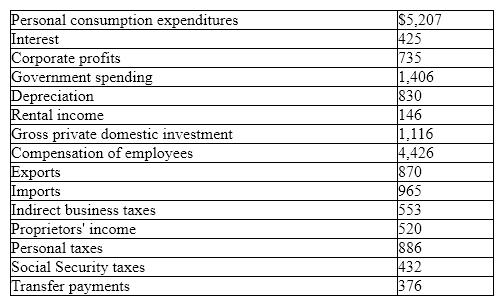 In Exhibit 5-7, and using the expenditures approach, gross domestic product (GDP)is:
 (Multiple Choice)
4.9/5 (75)
(75) Which of the following would not be included in the gross private domestic investment (I)category of GDP?
(Multiple Choice)
4.8/5 (94)
(94) Capital goods, like factories and machinery, are classified as intermediate goods.
(True/False)
4.9/5 (83)
(83) Exhibit 5-11 GDP data (billions of dollars) 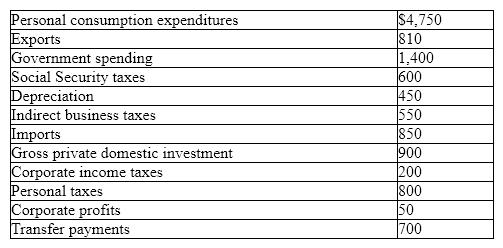 In Exhibit 5-11, national income (NI)equals:
 (Multiple Choice)
4.9/5 (64)
(64) Exhibit 5-7 GDP data (billions of dollars) 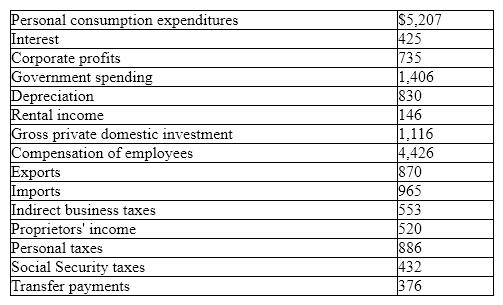 In Exhibit 5-7, national income (NI)is:
 (Multiple Choice)
4.8/5 (76)
(76) 
Filters
- Essay(0)
- Multiple Choice(0)
- Short Answer(0)
- True False(0)
- Matching(0)