



 Chat with AI
Exam 5: Gross Domestic Product

Exam 1: Introducing the Economic Way of Thinking176 Questions
Exam 2: Production Possibilities, Opportunity Cost, and Economic Growth200 Questions
Exam 3: Market Demand and Supply348 Questions
Exam 4: Markets in Action261 Questions
Exam 5: Gross Domestic Product223 Questions
Exam 6: Business Cycles and Unemployment194 Questions
Exam 7: Inflation126 Questions
Exam 8: The Keynesian Model235 Questions
Exam 9: The Keynesian Model in Action202 Questions
Exam 10: Aggregate Demand and Supply187 Questions
Exam 11: Fiscal Policy223 Questions
Exam 12: The Public Sector127 Questions
Exam 13: Federal Deficits, Surpluses, and the National Debt99 Questions
Exam 14: Money and the Federal Reserve System154 Questions
Exam 15: Money Creation243 Questions
Exam 16: Monetary Policy213 Questions
Exam 17: The Phillips Curve and Expectations Theory120 Questions
Exam 18: International Trade and Finance248 Questions
Exam 19: Economies in Transition104 Questions
Exam 20: Growth and the Less-Developed Countries117 Questions
Exam 21: Applying Graphs to Economics68 Questions
Exam 22: Consumer Surplus, Producer Surplus, and Market Efficiency68 Questions
Exam 23: the Self-Correcting Aggregate Demand and Supply Model83 Questions
Exam 24: Policy Disputes Using the Self-Correcting Aggregate Demand and Supply Model36 Questions
Select questions type


Exhibit 5-9 GDP data (billions of dollars)
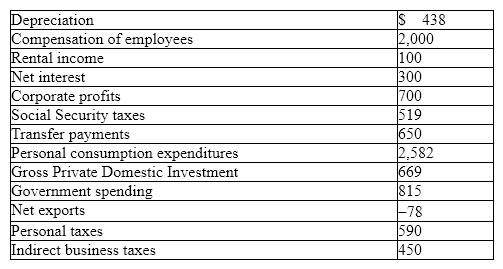 In Exhibit 5-9, national income (NI)equals:
 (Multiple Choice)
5.0/5  (79)
(79) If you buy a book of U.S. postage stamps to use to mail love letters to your sweetheart, the purchase is considered part of:
(Multiple Choice)
4.9/5 (88)
(88) The unreported or illegal production of goods and services in the economy that is not counted in GDP is termed:
(Multiple Choice)
4.8/5 (87)
(87) Exhibit 5-3 Expenditure approach 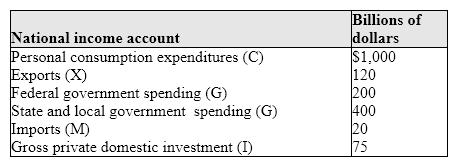 As shown in Exhibit 5-3, using the expenditure approach, GDP is:
 (Multiple Choice)
4.8/5 (81)
(81) The largest component of household consumption spending is expenditures on:
(Multiple Choice)
4.8/5 (78)
(78) Using the income approach, indirect business taxes have to be added to get gross domestic product because the:
(Multiple Choice)
4.8/5 (77)
(77) Exhibit 5-4 Gross domestic product data
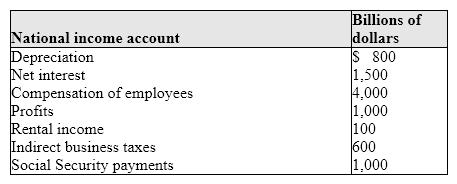 As shown in Exhibit 5-4, national income (NI)is:
 (Multiple Choice)
4.9/5 (91)
(91) The three components of personal consumption expenditures are:
(Multiple Choice)
4.9/5 (72)
(72) Compensation of employees is the largest component of GDP using the income approach.
(True/False)
4.8/5 (81)
(81) In 1980, U.S. nominal GDP was $2,784 billion and the GDP chain price index is 60.4. Real GDP in 1996 dollars is:
(Multiple Choice)
4.8/5 (90)
(90) Exhibit 5-9 GDP data (billions of dollars) 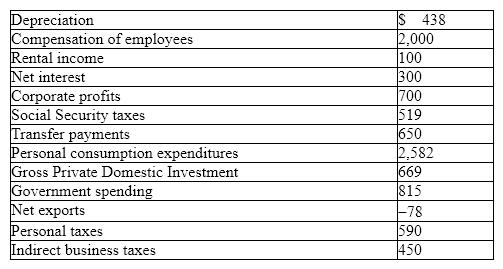 In Exhibit 5-9, personal disposable personal income (DI)equals:
 (Multiple Choice)
4.9/5 (77)
(77) Explain why GDP was never intended to be a measure of social well being.
(Essay)
5.0/5 (68)
(68) Personal income minus personal taxes equals disposable personal income.
(True/False)
4.8/5 (79)
(79) In contrast with nominal GDP, real GDP refers to nominal GDP:
(Multiple Choice)
4.9/5 (84)
(84) Gross domestic product is the sum of the purchase price multiplied by the quantity of:
(Multiple Choice)
4.8/5 (77)
(77) 
Filters
- Essay(0)
- Multiple Choice(0)
- Short Answer(0)
- True False(0)
- Matching(0)