



 Chat with AI
Exam 13: The Costs of Production

Exam 1: Ten Lessons From Economics146 Questions
Exam 2: Thinking Like an Economist133 Questions
Exam 3: Interdependence and the Gains From Trade139 Questions
Exam 4: The Market Forces of Supply and Demand215 Questions
Exam 5: Elasticity and Its Application178 Questions
Exam 6: Supply, Demand and Government Policies145 Questions
Exam 7: Consumers, Producers and the Efficiency of Markets171 Questions
Exam 8: Application: the Costs of Taxation135 Questions
Exam 9: Application: International Trade151 Questions
Exam 10: Externalities199 Questions
Exam 11: Public Goods and Common Resources178 Questions
Exam 12: The Design of the Tax System154 Questions
Exam 13: The Costs of Production191 Questions
Exam 14: Firms in Competitive Markets198 Questions
Exam 15: Monopoly212 Questions
Exam 16: Monopolistic Competition212 Questions
Exam 17: Business Strategy and Oligopoly179 Questions
Exam 18: Competition Policy103 Questions
Exam 19: The Markets for the Factors of Production214 Questions
Exam 20: Earnings, Unions and Discrimination201 Questions
Exam 21: Income Inequity and Poverty111 Questions
Exam 22: The Theory of Consumer Choice158 Questions
Exam 23: Frontiers of Microeconomics111 Questions
Exam 24: Measuring a Nations Income51 Questions
Exam 25: Measuring the Cost of Living55 Questions
Exam 26: Production and Growth62 Questions
Exam 27: Saving, Investment and the Financial System62 Questions
Exam 28: The Natural Rate of Unemployment58 Questions
Exam 29: The Monetary System66 Questions
Exam 30: Inflation: Its Causes and Costs74 Questions
Exam 31: Open-Economy Macroeconomics: Basic Concepts68 Questions
Exam 32: A Macroeconomic Theory of the Open Economy61 Questions
Exam 33: Aggregate Demand and Aggregate Supply81 Questions
Exam 34: The Influence of Monetary and Fiscal Policy on Aggregate Demand73 Questions
Exam 35: The Short-Run Trade-Off Between Inflation and Unemployment57 Questions
Exam 36: Global Financial Crisis of 2008 and Beyond37 Questions
Exam 37: Five Debates Over Macroeconomic Policy38 Questions
Select questions type


Thirsty Thelma owns and operates a small lemonade stand.When Thelma is producing a small quantity of lemonade, she has few workers and her equipment is not being fully utilised.Because she can easily put her idle resources to use:
(Multiple Choice)
4.9/5  (80)
(80) Graph 13-1  This graph depicts a production function for a firm that produces cookies.Use the
graph to answer the following question(s).
-Refer to Graph 13-1.The slope of the total product curve reveals information about the:
This graph depicts a production function for a firm that produces cookies.Use the
graph to answer the following question(s).
-Refer to Graph 13-1.The slope of the total product curve reveals information about the: (Multiple Choice)
4.8/5 (76)
(76) Table 13-2
Adrienne's Premium Boxing Service subcontracts with a chocolate manufacturer to box premium chocolates for their mail order catalogue business.Adrienne rents a small room for $150 a week in the downtown business district that serves as her factory.She can hire workers for $275 a week.Costs are in dollars per week. 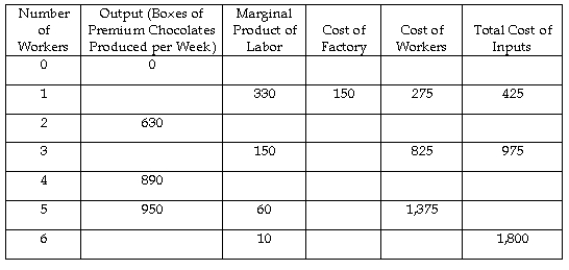 -Refer to Table 13-2.Adrienne has received an order for 3000 boxes of chocolates for next week.If she expects that the trend in the marginal product of labour will continue in the same direction, it is most likely that her best decision will be to:
 (Multiple Choice)
5.0/5 (83)
(83) If a firm wants to capitalise on economies of scale, it may be able to do so by:
(Multiple Choice)
4.8/5 (68)
(68) Graph 13-2 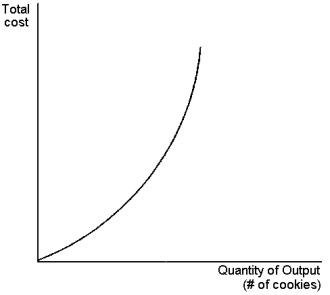 This graph depicts a total cost function for a firm that produces cookies.Use the graph to answer the following question(s).
-Refer to Graph 13-2.Which of the statements below is most consistent with the shape of the total cost curve?
This graph depicts a total cost function for a firm that produces cookies.Use the graph to answer the following question(s).
-Refer to Graph 13-2.Which of the statements below is most consistent with the shape of the total cost curve? (Multiple Choice)
5.0/5 (79)
(79) The shape of the total cost curve is unrelated to the shape of the production function.
(True/False)
4.9/5 (70)
(70) Accountants keep track of the money that flows into and out of firms.
(True/False)
4.9/5 (81)
(81) Average total cost necessarily rises due to which of the following?
(i) rising marginal cost
(ii) increasing marginal product
(iii) decreasing marginal cost
(Multiple Choice)
4.8/5 (100)
(100) Graph 13-6 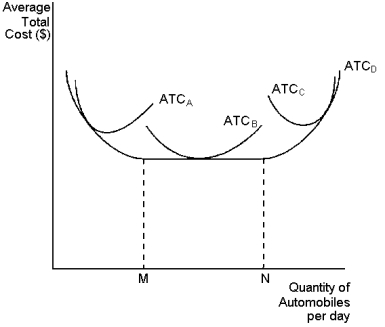 This graph depicts average total cost functions for a firm that produces automobiles.Use the graph to answer the following question(s).
-Refer to Graph 13-6.In the long run, the firm can operate on which of the following average total cost curves?
This graph depicts average total cost functions for a firm that produces automobiles.Use the graph to answer the following question(s).
-Refer to Graph 13-6.In the long run, the firm can operate on which of the following average total cost curves? (Multiple Choice)
4.9/5 (78)
(78) Which of the following is an implicit cost?
(i) a business owner forgoing an opportunity to earn a large salary working for a Wall Street brokerage firm
(ii) interest on debt
(iii) uncollected revenue
(Multiple Choice)
4.9/5 (93)
(93) According to the information provided, Amy's accounting profit equals:
(Multiple Choice)
4.9/5 (91)
(91) At all levels of production beyond the point where the marginal cost curve crosses the average variable cost curve, average variable cost:
(Multiple Choice)
4.8/5 (78)
(78) Diminishing marginal product exists when the production function becomes flatter as inputs increase.
(True/False)
4.8/5 (98)
(98) Which of the following is equivalent to economic profit?
(i) total revenue less explicit costs and less implicit costs
(ii) total revenue less opportunity costs
(iii) accounting profit
(Multiple Choice)
4.7/5 (72)
(72) If the total cost curve becomes flatter as output increases, then this reveals diminishing marginal product.
(True/False)
4.8/5 (76)
(76) Several related measures of cost can be derived from a firm's total cost.
(True/False)
4.8/5 (79)
(79) Table 13-1
Measures of Cost for Splashy Cardboard Kayak Factory. 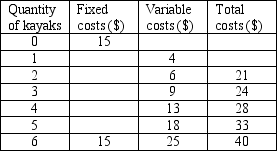 -Refer to Table 13-1.The average fixed cost of producing five kayaks is:
 (Multiple Choice)
4.9/5 (77)
(77) 
Filters
- Essay(0)
- Multiple Choice(0)
- Short Answer(0)
- True False(0)
- Matching(0)