



 Chat with AI
Exam 13: The Costs of Production

Exam 1: Ten Lessons From Economics146 Questions
Exam 2: Thinking Like an Economist133 Questions
Exam 3: Interdependence and the Gains From Trade139 Questions
Exam 4: The Market Forces of Supply and Demand215 Questions
Exam 5: Elasticity and Its Application178 Questions
Exam 6: Supply, Demand and Government Policies145 Questions
Exam 7: Consumers, Producers and the Efficiency of Markets171 Questions
Exam 8: Application: the Costs of Taxation135 Questions
Exam 9: Application: International Trade151 Questions
Exam 10: Externalities199 Questions
Exam 11: Public Goods and Common Resources178 Questions
Exam 12: The Design of the Tax System154 Questions
Exam 13: The Costs of Production191 Questions
Exam 14: Firms in Competitive Markets198 Questions
Exam 15: Monopoly212 Questions
Exam 16: Monopolistic Competition212 Questions
Exam 17: Business Strategy and Oligopoly179 Questions
Exam 18: Competition Policy103 Questions
Exam 19: The Markets for the Factors of Production214 Questions
Exam 20: Earnings, Unions and Discrimination201 Questions
Exam 21: Income Inequity and Poverty111 Questions
Exam 22: The Theory of Consumer Choice158 Questions
Exam 23: Frontiers of Microeconomics111 Questions
Exam 24: Measuring a Nations Income51 Questions
Exam 25: Measuring the Cost of Living55 Questions
Exam 26: Production and Growth62 Questions
Exam 27: Saving, Investment and the Financial System62 Questions
Exam 28: The Natural Rate of Unemployment58 Questions
Exam 29: The Monetary System66 Questions
Exam 30: Inflation: Its Causes and Costs74 Questions
Exam 31: Open-Economy Macroeconomics: Basic Concepts68 Questions
Exam 32: A Macroeconomic Theory of the Open Economy61 Questions
Exam 33: Aggregate Demand and Aggregate Supply81 Questions
Exam 34: The Influence of Monetary and Fiscal Policy on Aggregate Demand73 Questions
Exam 35: The Short-Run Trade-Off Between Inflation and Unemployment57 Questions
Exam 36: Global Financial Crisis of 2008 and Beyond37 Questions
Exam 37: Five Debates Over Macroeconomic Policy38 Questions
Select questions type


Lettuce Eat, a vegetarian cafe, exhibits diminishing returns to labour.If the cost of each meal is constant and labour is the only other input, then the total cost-curve will:
(Multiple Choice)
4.8/5  (93)
(93) Table 13-1
Measures of Cost for Splashy Cardboard Kayak Factory. 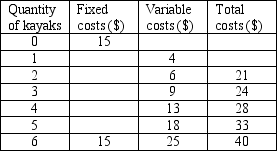 -Refer to Table 13-1.What is the variable cost of producing five kayaks?
 (Multiple Choice)
4.8/5 (75)
(75) During the summer Jeremy, a small business owner, can hire extra staff to help him repair boats.On his own Jeremy can repair 10 boats a day, adding a second staff member sees 15 boats a day repaired, and adding a third sees 18 boats a day repaired.The marginal product of the third worker is:
(Multiple Choice)
4.9/5 (76)
(76) Julia runs a home construction business and owns a variety of construction equipment.She normally uses her equipment to build and sell homes herself, however when times are tough she rents out the equipment to other builders.Which of the following should Julia not include when looking at the costs of building a new home:
(Multiple Choice)
4.8/5 (76)
(76) Graph 13-6 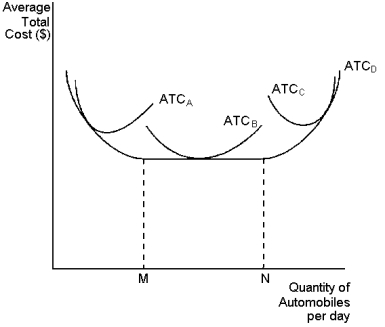 This graph depicts average total cost functions for a firm that produces automobiles.Use the graph to answer the following question(s).
-Refer to Graph 13-6.Which curve represents the long-run average total cost?
This graph depicts average total cost functions for a firm that produces automobiles.Use the graph to answer the following question(s).
-Refer to Graph 13-6.Which curve represents the long-run average total cost? (Multiple Choice)
4.8/5 (75)
(75) Table 13-1
Measures of Cost for Splashy Cardboard Kayak Factory.
-Refer to Table 13-1.The average total cost of producing four kayaks is:
-Refer to Table 13-1.The average total cost of producing four kayaks is: (Multiple Choice)
4.9/5 (69)
(69) Jeremy, a small business owner, earns $50 an hour repairing boats.One afternoon he takes five hours off work to build a gazebo in his garden, spending $200 on materials.If the addition of a gazebo increases his home's value by $400, then his accounting profit will be:
(Multiple Choice)
4.7/5 (75)
(75) Suppose that as a firm expands and notices that its long-run average total costs are declining.The most likely explanation for this is economies of scale.
(True/False)
4.9/5 (73)
(73) Table 13-2
Adrienne's Premium Boxing Service subcontracts with a chocolate manufacturer to box premium chocolates for their mail order catalogue business.Adrienne rents a small room for $150 a week in the downtown business district that serves as her factory.She can hire workers for $275 a week.Costs are in dollars per week. 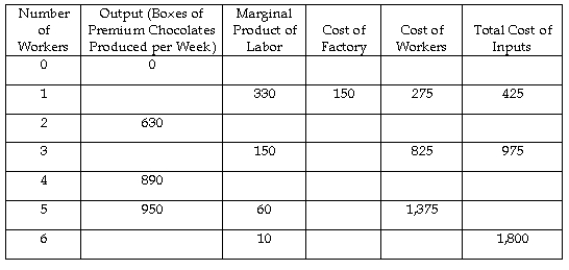 -Refer to Table 13-2.During the week of 25 April, Adrienne doesn't box any chocolates.What are her costs during the week?
 (Multiple Choice)
4.8/5 (78)
(78) Graph 13-1  This graph depicts a production function for a firm that produces cookies.Use the
graph to answer the following question(s).
-Refer to Graph 13-1.With regard to cookie production, the figure implies:
This graph depicts a production function for a firm that produces cookies.Use the
graph to answer the following question(s).
-Refer to Graph 13-1.With regard to cookie production, the figure implies: (Multiple Choice)
4.9/5 (81)
(81) Table 13-1
Measures of Cost for Splashy Cardboard Kayak Factory.
-Refer to Table 13-1.What is the variable cost of producing zero kayaks?
-Refer to Table 13-1.What is the variable cost of producing zero kayaks? (Multiple Choice)
4.8/5 (84)
(84) A sawmill processes logs into timber.Identify the costs below that are an example of a fixed cost.(i) rent paid on the factory
(ii) maintenance of the trucks used for transport of logs
(iii) wages of the workers
(Multiple Choice)
5.0/5 (83)
(83) Table 13-1
Measures of Cost for Splashy Cardboard Kayak Factory.
-Refer to Table 13-1.The marginal cost of producing the sixth kayak is:
-Refer to Table 13-1.The marginal cost of producing the sixth kayak is: (Multiple Choice)
4.9/5 (84)
(84) Table 13-3
Consider the following firm which makes high-performance racing bicycles.All costs are given in dollars.Output is shown on a monthly basis.The firm's fixed costs include a rent of $800 and a lease cost of $400 per month. 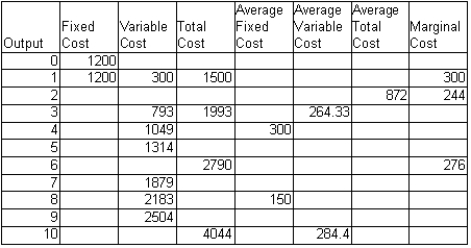 -Refer to Table 13-3.One month the firm worked overtime to produce 16 bicycles.What was the average fixed cost for that month?
 (Multiple Choice)
4.9/5 (79)
(79) Costs are a key determinate of a firm's production and pricing decisions.
(True/False)
4.8/5 (67)
(67) One assumption that distinguishes short-run cost analysis from long-run cost analysis for a profit-maximising firm is that, in the short run:
(Multiple Choice)
4.8/5 (78)
(78) 
Filters
- Essay(0)
- Multiple Choice(0)
- Short Answer(0)
- True False(0)
- Matching(0)