



 Chat with AI
Exam 13: The Costs of Production

Exam 1: Ten Lessons From Economics146 Questions
Exam 2: Thinking Like an Economist133 Questions
Exam 3: Interdependence and the Gains From Trade139 Questions
Exam 4: The Market Forces of Supply and Demand215 Questions
Exam 5: Elasticity and Its Application178 Questions
Exam 6: Supply, Demand and Government Policies145 Questions
Exam 7: Consumers, Producers and the Efficiency of Markets171 Questions
Exam 8: Application: the Costs of Taxation135 Questions
Exam 9: Application: International Trade151 Questions
Exam 10: Externalities199 Questions
Exam 11: Public Goods and Common Resources178 Questions
Exam 12: The Design of the Tax System154 Questions
Exam 13: The Costs of Production191 Questions
Exam 14: Firms in Competitive Markets198 Questions
Exam 15: Monopoly212 Questions
Exam 16: Monopolistic Competition212 Questions
Exam 17: Business Strategy and Oligopoly179 Questions
Exam 18: Competition Policy103 Questions
Exam 19: The Markets for the Factors of Production214 Questions
Exam 20: Earnings, Unions and Discrimination201 Questions
Exam 21: Income Inequity and Poverty111 Questions
Exam 22: The Theory of Consumer Choice158 Questions
Exam 23: Frontiers of Microeconomics111 Questions
Exam 24: Measuring a Nations Income51 Questions
Exam 25: Measuring the Cost of Living55 Questions
Exam 26: Production and Growth62 Questions
Exam 27: Saving, Investment and the Financial System62 Questions
Exam 28: The Natural Rate of Unemployment58 Questions
Exam 29: The Monetary System66 Questions
Exam 30: Inflation: Its Causes and Costs74 Questions
Exam 31: Open-Economy Macroeconomics: Basic Concepts68 Questions
Exam 32: A Macroeconomic Theory of the Open Economy61 Questions
Exam 33: Aggregate Demand and Aggregate Supply81 Questions
Exam 34: The Influence of Monetary and Fiscal Policy on Aggregate Demand73 Questions
Exam 35: The Short-Run Trade-Off Between Inflation and Unemployment57 Questions
Exam 36: Global Financial Crisis of 2008 and Beyond37 Questions
Exam 37: Five Debates Over Macroeconomic Policy38 Questions
Select questions type


The cost of capital includes both any interest payments in loans as well as any forgone interest on savings used to finance the business.
(True/False)
4.8/5  (71)
(71) Harry's Hotdogs is a small street vendor business owned by Harry Huggins.If Harry makes 10 hotdogs in his first hour of business and incurs a total cost of $16.50, his average total cost per hotdog is:
(Multiple Choice)
4.9/5 (63)
(63) At low output levels a firm's average total cost tends to be high because:
(Multiple Choice)
4.9/5 (71)
(71) Table 13-3
Consider the following firm which makes high-performance racing bicycles.All costs are given in dollars.Output is shown on a monthly basis.The firm's fixed costs include a rent of $800 and a lease cost of $400 per month. 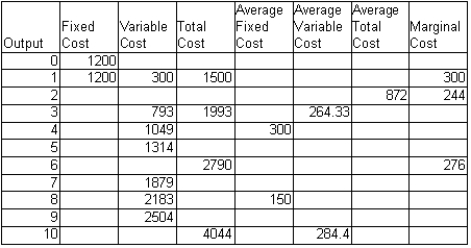 -Refer to Table 13-3.At what level of output will average variable cost equal average total cost?
 (Multiple Choice)
4.8/5 (82)
(82) Graph 13-5 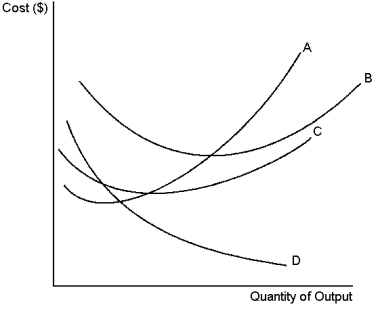 The set of curves above reflect information about the cost structure of a firm.Use this graph to answer the following question(s).
-Refer to Graph 13-5.Which of the curves is most likely to represent average total cost?
The set of curves above reflect information about the cost structure of a firm.Use this graph to answer the following question(s).
-Refer to Graph 13-5.Which of the curves is most likely to represent average total cost? (Multiple Choice)
4.9/5 (87)
(87) Graph 13-1  This graph depicts a production function for a firm that produces cookies.Use the
graph to answer the following question(s).
-Refer to Graph 13-1.As the number of workers increases:
This graph depicts a production function for a firm that produces cookies.Use the
graph to answer the following question(s).
-Refer to Graph 13-1.As the number of workers increases: (Multiple Choice)
4.8/5 (72)
(72) Variable costs usually change as the firm alters the quantity of output produced.
(True/False)
4.9/5 (68)
(68) When average total cost rises if a producer either increases or decreases production, then the firm is said to be operating at efficient scale.
(True/False)
4.8/5 (84)
(84) The average total cost curve will be downward sloping whenever:
(Multiple Choice)
4.9/5 (69)
(69) Graph 13-2 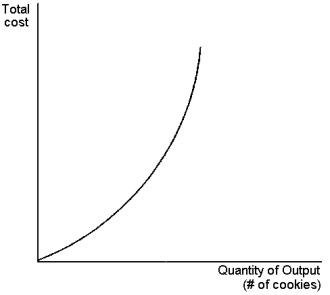 This graph depicts a total cost function for a firm that produces cookies.Use the graph to answer the following question(s).
-Refer to Graph 13-2.Which of the statements below best captures information about the underlying production function?
This graph depicts a total cost function for a firm that produces cookies.Use the graph to answer the following question(s).
-Refer to Graph 13-2.Which of the statements below best captures information about the underlying production function? (Multiple Choice)
4.9/5 (77)
(77) Graph 13-5 The set of curves above reflect information about the cost structure of a firm.Use this graph to answer the following question(s).
-Refer to Graph 13-5.This particular firm is necessarily experiencing diminishing marginal product when which of the following is occurring?
(i) line A is rising
(ii) line B is rising
(iii) line C is rising
The set of curves above reflect information about the cost structure of a firm.Use this graph to answer the following question(s).
-Refer to Graph 13-5.This particular firm is necessarily experiencing diminishing marginal product when which of the following is occurring?
(i) line A is rising
(ii) line B is rising
(iii) line C is rising (Multiple Choice)
4.9/5 (82)
(82) Economists normally assume that the goal of a firm is to maximise revenue.
(True/False)
4.9/5 (86)
(86) Graph 13-6 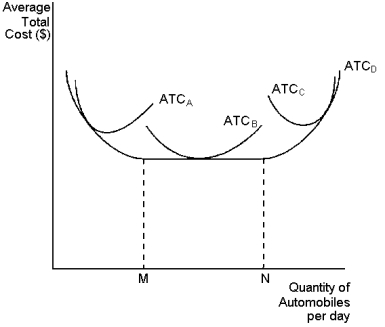 This graph depicts average total cost functions for a firm that produces automobiles.Use the graph to answer the following question(s).
-Refer to Graph 13-6.This firm experiences constant returns to scale at which output levels?
This graph depicts average total cost functions for a firm that produces automobiles.Use the graph to answer the following question(s).
-Refer to Graph 13-6.This firm experiences constant returns to scale at which output levels? (Multiple Choice)
5.0/5 (78)
(78) The amount of money that an orchardist could have earned if he had planted orange trees rather than apple trees is termed:
(Multiple Choice)
4.9/5 (82)
(82) 
Filters
- Essay(0)
- Multiple Choice(0)
- Short Answer(0)
- True False(0)
- Matching(0)