



 Chat with AI
Exam 13: The Costs of Production

Exam 1: Ten Lessons From Economics146 Questions
Exam 2: Thinking Like an Economist133 Questions
Exam 3: Interdependence and the Gains From Trade139 Questions
Exam 4: The Market Forces of Supply and Demand215 Questions
Exam 5: Elasticity and Its Application178 Questions
Exam 6: Supply, Demand and Government Policies145 Questions
Exam 7: Consumers, Producers and the Efficiency of Markets171 Questions
Exam 8: Application: the Costs of Taxation135 Questions
Exam 9: Application: International Trade151 Questions
Exam 10: Externalities199 Questions
Exam 11: Public Goods and Common Resources178 Questions
Exam 12: The Design of the Tax System154 Questions
Exam 13: The Costs of Production191 Questions
Exam 14: Firms in Competitive Markets198 Questions
Exam 15: Monopoly212 Questions
Exam 16: Monopolistic Competition212 Questions
Exam 17: Business Strategy and Oligopoly179 Questions
Exam 18: Competition Policy103 Questions
Exam 19: The Markets for the Factors of Production214 Questions
Exam 20: Earnings, Unions and Discrimination201 Questions
Exam 21: Income Inequity and Poverty111 Questions
Exam 22: The Theory of Consumer Choice158 Questions
Exam 23: Frontiers of Microeconomics111 Questions
Exam 24: Measuring a Nations Income51 Questions
Exam 25: Measuring the Cost of Living55 Questions
Exam 26: Production and Growth62 Questions
Exam 27: Saving, Investment and the Financial System62 Questions
Exam 28: The Natural Rate of Unemployment58 Questions
Exam 29: The Monetary System66 Questions
Exam 30: Inflation: Its Causes and Costs74 Questions
Exam 31: Open-Economy Macroeconomics: Basic Concepts68 Questions
Exam 32: A Macroeconomic Theory of the Open Economy61 Questions
Exam 33: Aggregate Demand and Aggregate Supply81 Questions
Exam 34: The Influence of Monetary and Fiscal Policy on Aggregate Demand73 Questions
Exam 35: The Short-Run Trade-Off Between Inflation and Unemployment57 Questions
Exam 36: Global Financial Crisis of 2008 and Beyond37 Questions
Exam 37: Five Debates Over Macroeconomic Policy38 Questions
Select questions type


Table 13-3
Consider the following firm which makes high-performance racing bicycles.All costs are given in dollars.Output is shown on a monthly basis.The firm's fixed costs include a rent of $800 and a lease cost of $400 per month. 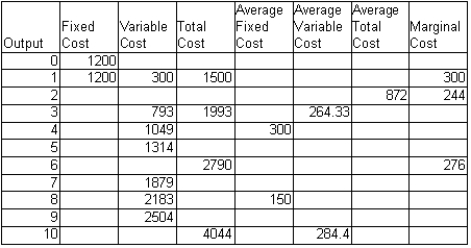 -Refer to Table 13-3.What is the average variable cost for the month if six bicycles are produced?
 (Multiple Choice)
4.8/5  (69)
(69) Table 13-2
Adrienne's Premium Boxing Service subcontracts with a chocolate manufacturer to box premium chocolates for their mail order catalogue business.Adrienne rents a small room for $150 a week in the downtown business district that serves as her factory.She can hire workers for $275 a week.Costs are in dollars per week. 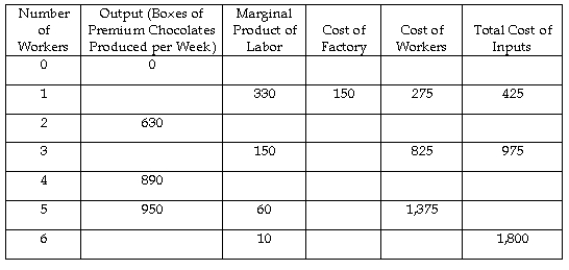 -Refer to Table 13-2.One week, Adrienne exactly breaks even.If her revenue for the week is $1525, how many boxes of chocolate did she produce?
 (Multiple Choice)
4.8/5 (76)
(76) Which of the following statements are true? When marginal cost exceeds average total cost:
(i) average total cost must be rising
(ii) average variable cost must be rising
(iii) average fixed cost must be rising
(Multiple Choice)
5.0/5 (93)
(93) Average variable cost is equal to the quantity of output divided by the total variable cost.
(True/False)
4.8/5 (74)
(74) In reference to setting the production level, a firm's cost curves:
(Multiple Choice)
4.9/5 (66)
(66) 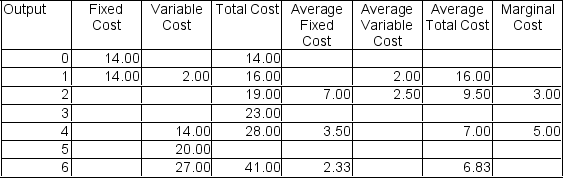
When trying to understand the decision making process of different firms, economists assume that people think at the margin.
(True/False)
4.9/5 (88)
(88) The production function depicts a relationship between which two variables? Draw a production function that exhibits diminishing marginal product.
(Essay)
4.9/5 (94)
(94) According to the information provided, Amy's economic profit is:
(Multiple Choice)
4.9/5 (84)
(84) Harry's Hotdogs is a small street vendor business owned by Harry Huggins.Harry is trying to get a better understanding of his costs by categorising them as fixed or variable.Which of the following costs are most likely to be considered fixed costs?
(Multiple Choice)
4.8/5 (83)
(83) Table 13-1
Measures of Cost for Splashy Cardboard Kayak Factory. 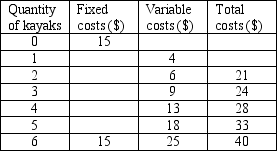 -Refer to Table 13-1.The average variable cost of producing two kayaks is:
 (Multiple Choice)
4.9/5 (80)
(80) According to the information provided, which of the following statements is(are) true?
(i) farmer Jack experiences decreasing marginal product
(ii) farmer Jack's total cost curve is linear
(iii) farmer Jack's production function is nonlinear
(Multiple Choice)
4.9/5 (88)
(88) Bob Edwards owns Bob's Bagels.He hires an economist who assesses the shape of the bagel shop's average total cost (ATC) curve as a function of the number of bagels produced.The results indicate a U-shaped average total cost curve.Bob's economist explains that the ATC curve is U-shaped for two reasons, the first being the existence of diminishing marginal product, which causes it to rise.What would the second reason be? Assume that the marginal cost curve is linear.(Hint: The second reason relates to average fixed cost.)
(Essay)
4.8/5 (73)
(73) The average total cost curve is unaffected by diminishing marginal product.
(True/False)
4.8/5 (72)
(72) If a business is profitable from an accountant's point of view, then:
(Multiple Choice)
4.9/5 (72)
(72) The marginal cost curve bisects the average total cost curve at the minimum point of the average total cost curve.
(True/False)
4.9/5 (80)
(80) Consider the following graph of a firm in the short-run. 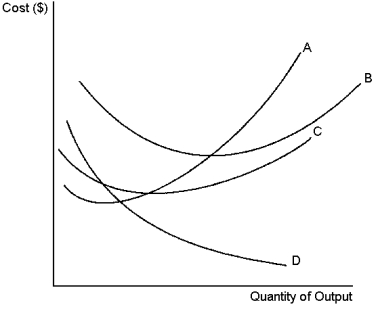 Identify the average fixed cost curve, the marginal cost curve, the average variable cost curve and the average total cost curve.
 (Essay)
4.8/5 (78)
(78) Average total cost reveals how much total cost will change as the firm alters its level of production.
(True/False)
4.9/5 (80)
(80) 
Filters
- Essay(0)
- Multiple Choice(0)
- Short Answer(0)
- True False(0)
- Matching(0)