



 Chat with AI
Exam 2: The Chemical Basis of Life

Exam 1: The Human Organism120 Questions
Exam 2: The Chemical Basis of Life168 Questions
Exam 3: Cell Biology227 Questions
Exam 4: Tissues174 Questions
Exam 5: Integumentary System152 Questions
Exam 6: Skeletal System: Bones and Bone Tissue176 Questions
Exam 7: Skeletal System: Gross Anatomy173 Questions
Exam 8: Joints and Movement126 Questions
Exam 9: Muscular System: Histology and Physiology200 Questions
Exam 10: Muscular System: Gross Anatomy140 Questions
Exam 11: Functional Organization of Nervous Tissue171 Questions
Exam 12: Spinal Cord and Spinal Nerves124 Questions
Exam 13: Brain and Cranial Nerves158 Questions
Exam 14: Integration of Nervous System Functions142 Questions
Exam 15: The Special Senses198 Questions
Exam 16: Autonomic Nervous System109 Questions
Exam 17: Functional Organization of the Endocrine System83 Questions
Exam 18: Endocrine Glands167 Questions
Exam 19: Cardiovascular System: Blood148 Questions
Exam 20: Cardiovascular System: the Heart139 Questions
Exam 21: Cardiovascular System: Blood Vessels and Circulation234 Questions
Exam 22: Lymphatic System and Immunity174 Questions
Exam 23: Respiratory System175 Questions
Exam 24: Digestive System253 Questions
Exam 25: Nutrition, Metabolism, and Temperature Regulation168 Questions
Exam 26: Urinary System159 Questions
Exam 27: Water, Electrolyte, and Acid-Based Balance108 Questions
Exam 28: Reproductive System160 Questions
Exam 29: Development, Growth, Aging, and Genetics187 Questions
Select questions type


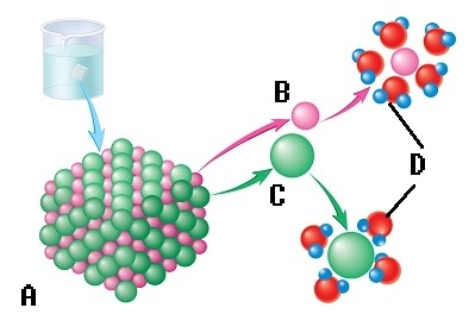 -The sodium chloride molecule breaks apart in water. What does "B" represent?
 (Multiple Choice)
4.9/5  (89)
(89) 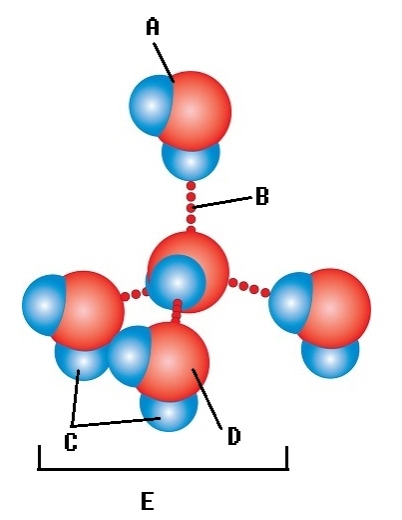 -Water accounts for 50% of the weight of a young adult female and 60% of a young adult male. What kind of molecule is found at "E"?
 (Multiple Choice)
4.8/5 (69)
(69) For most chemical reactions, an increase in temperature will cause the reaction rate to
(Multiple Choice)
4.9/5 (63)
(63) Which of the following organic groups does lactose belong to?
(Multiple Choice)
4.8/5 (70)
(70) The term mass describes the material that makes up all living and nonliving things.
(True/False)
4.9/5 (72)
(72) Arrange the following from largest to smallest: (1) nucleus
(2) DNA molecule
(3) skin cell
(4) chicken eggs
(Multiple Choice)
4.8/5 (70)
(70) Intermolecular forces are weak electrostatic attractions that exist between
(Multiple Choice)
4.9/5 (86)
(86) Normal pH for blood is 7.35 to 7.45. Maintenance of the pH in this range is
(Multiple Choice)
4.8/5 (85)
(85) An organic molecule consists of carbon, hydrogen, oxygen, nitrogen, and sulfur; the molecule is probably
(Multiple Choice)
4.7/5 (85)
(85) 
Filters
- Essay(0)
- Multiple Choice(0)
- Short Answer(0)
- True False(0)
- Matching(0)