



 Chat with AI
Exam 4: Projects

Exam 1: Introduction78 Questions
Exam 2: Strategy56 Questions
Exam 3: Design of Products and Services71 Questions
Exam 4: Projects108 Questions
Exam 5: Strategic Capacity Management69 Questions
Exam 6: Learning Curves57 Questions
Exam 7: Manufacturing Processes52 Questions
Exam 8: Facility Layout60 Questions
Exam 9: Service Processes71 Questions
Exam 10: Waiting Line Analysis and Simulation77 Questions
Exam 11: Process Design and Analysis67 Questions
Exam 12: Six Sigma Quality70 Questions
Exam 13: Statistical Quality Control64 Questions
Exam 14: Lean Supply Chains85 Questions
Exam 15: Logistics, Distribution, and Transportation61 Questions
Exam 16: Global Sourcing and Procurement73 Questions
Exam 17: The Internet of Things and Erp40 Questions
Exam 18: Forecasting102 Questions
Exam 19: Sales and Operations Planning61 Questions
Exam 20: Inventory Management104 Questions
Exam 21: Material Requirements Planning91 Questions
Exam 22: Workcenter Scheduling125 Questions
Select questions type


Which of the following is not a disadvantage of a matrix project?
(Multiple Choice)
4.8/5  (74)
(74) A series of projects that are organized in such a way that each project utilizes people from different functional areas is using which of the following organizational structures?
(Multiple Choice)
4.8/5 (75)
(75) When reducing the planned duration of a project using the time-cost CPM model, we select the activity to crash by determining the cost of each alternative and selecting the one whose cost is the greatest.
(True/False)
4.9/5 (81)
(81) A project has four activities: A, B, C, and D. The amount spent on each activity to date is $22K, $14K, $12K, and $28K respectively. The planned percentages complete for the current date are 90%, 80%, 70%, and 20% respectively. The actual percentages complete for the current date are 100%, 90%, 75%, and 10% respectively. The actual cost of the work performed to date is $40K. What is the BCWP for the project?
(Multiple Choice)
4.7/5 (81)
(81) A project has four activities: A, B, C, and D. The amount spent on each activity to date is $22K, $14K, $12K, and $28K respectively. The planned percentages complete for the current date are 90%, 80%, 70%, and 20% respectively. The actual percentages complete for the current date are 100%, 90%, 75%, and 10% respectively. The actual cost of the work performed to date is $40K. What is the BCWS for Activity B?
(Multiple Choice)
4.9/5 (88)
(88) A company must perform a maintenance project consisting of seven activities. The activities, their predecessors, and their respective time estimates are presented here: 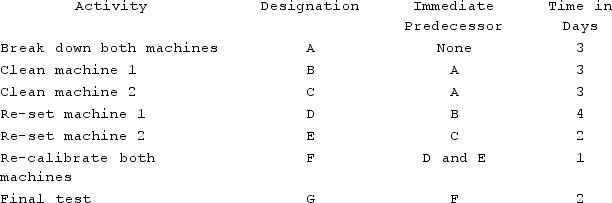 Using CPM, which activities make up the critical path?
 (Multiple Choice)
4.8/5 (79)
(79) You have just used the network planning model and found the critical path length is 60 days and there are two critical paths. The standard deviation of the first critical path is 10 days and the s.d. of the second critical path is 15 days. The probability that the project will be completed in 70 days or less is equal to (2 decimal accuracy).
(Multiple Choice)
4.9/5 (85)
(85) A company must perform a maintenance project consisting of seven activities. The activities, their predecessors, and their respective time estimates are presented here: 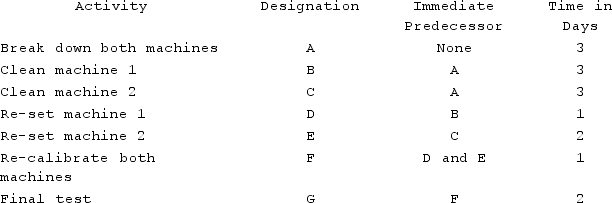 Using CPM, what is the latest finish time for the last activity in this project (i.e., the total time to complete the project)?
 (Multiple Choice)
4.8/5 (75)
(75) You have the following time and cost information for use in a time-cost CPM scheduling model.  What are the three costs per unit of time to expedite each activity?
 (Multiple Choice)
4.8/5 (72)
(72) You have collected the data for a time-cost CPM scheduling model analysis. The time is in days and the project "direct costs" are given here. 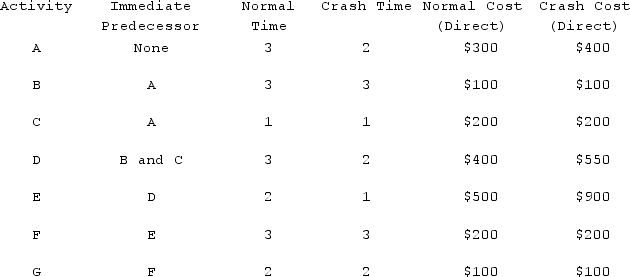 The indirect costs for the project are determined on a daily duration basis. If the project lasts 16 days, the total indirect costs are $400; 15 days, they will be $250; 14 days, they will be $200; and 13 days, they will be $100.
At what day do we achieve the lowest total project cost (i.e., direct plus indirect costs)?
The indirect costs for the project are determined on a daily duration basis. If the project lasts 16 days, the total indirect costs are $400; 15 days, they will be $250; 14 days, they will be $200; and 13 days, they will be $100.
At what day do we achieve the lowest total project cost (i.e., direct plus indirect costs)? (Multiple Choice)
4.9/5 (77)
(77) You know when you have arrived at the optimal solution in using the time-cost CPM scheduling model analysis when what happens?
(Multiple Choice)
4.9/5 (85)
(85) A matrix project attempts to blend properties of functional and pure project structures.
(True/False)
4.8/5 (93)
(93) Some of the advantages of a functional project where the project is housed in a functional division include which of the following?
(Multiple Choice)
4.8/5 (85)
(85) An activity has an optimistic time of 16, a most likely time of 25, and a pessimistic time of 40. What is the variance for the activity?
(Multiple Choice)
4.8/5 (77)
(77) Calculating the early start and early finish times for each activity in a CPM analysis does not provide any useful information.
(True/False)
4.8/5 (85)
(85) PERT is an abbreviation for which of the following methodologies?
(Multiple Choice)
4.7/5 (81)
(81) 
Filters
- Essay(0)
- Multiple Choice(0)
- Short Answer(0)
- True False(0)
- Matching(0)