



 Chat with AI
Exam 6: Bones and Skeletal Tissues

Exam 1: The Human Body: an Orientation100 Questions
Exam 2: Chemistry Comes Alive120 Questions
Exam 3: Cells: the Living Units119 Questions
Exam 4: Tissue: the Living Fabric97 Questions
Exam 5: The Integumentary System107 Questions
Exam 6: Bones and Skeletal Tissues94 Questions
Exam 7: The Skeleton102 Questions
Exam 8: Joints105 Questions
Exam 9: Muscles and Muscle Tissue109 Questions
Exam 10: The Muscular System109 Questions
Exam 11: Fundamentals of the Nervous System and Nervous Tissue95 Questions
Exam 12: The Central Nervous System132 Questions
Exam 13: The Peripheral Nervous System and Reflex Activity97 Questions
Exam 14: The Autonomic Nervous System96 Questions
Exam 15: The Special Senses127 Questions
Exam 16: The Endocrine System119 Questions
Exam 17: Blood99 Questions
Exam 18: The Cardiovascular System: the Heart94 Questions
Exam 19: The Cardiovascular System: Blood Vessels107 Questions
Exam 20: The Lymphatic System and Lymphoid Organs and Tissues95 Questions
Exam 21: The Immune System: Innate and Adaptive Body Defensives118 Questions
Exam 22: The Respiratory System120 Questions
Exam 23: The Digestive System145 Questions
Exam 24: Nutrition, Metabolism, and Body Temperature Regulation114 Questions
Exam 25: The Urinary System116 Questions
Exam 26: Fluid, Electrolyte, and Acid-Base Balance94 Questions
Exam 27: The Reproductive System126 Questions
Exam 28: Pregnancy and Human Development97 Questions
Exam 29: Heredity90 Questions
Select questions type


Bones are classified by whether they are weight bearing or protective in function.
(True/False)
4.9/5  (77)
(77) Cartilage has a flexible matrix that can accommodate mitosis of chondrocytes.
(True/False)
4.8/5 (62)
(62) An osteon contains osteocytes, lamellae, and a central canal, and is found in compact bone only.
(True/False)
4.7/5 (87)
(87) In newborn infants, the medullary cavity and all areas of spongy bone contain yellow bone marrow.
(True/False)
4.7/5 (73)
(73) How can a tooth be moved in a bony socket during orthodontic treatment?
(Essay)
4.9/5 (70)
(70) Lengthwise, long bone growth during infancy and youth is exclusively through .
(Multiple Choice)
4.8/5 (85)
(85) What is absolutely required for bone growth or healing from a fracture?
(Multiple Choice)
4.8/5 (83)
(83) 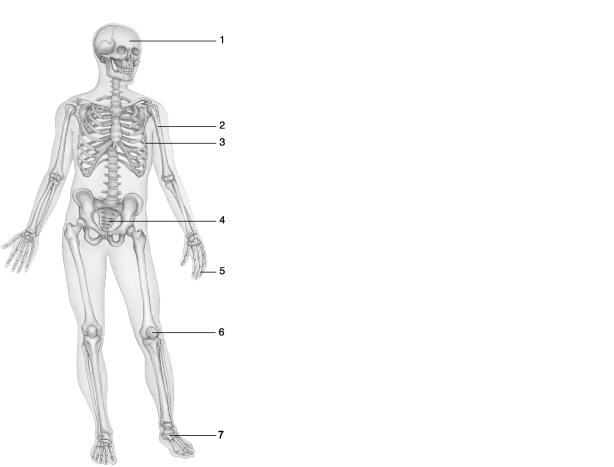 Figure 6.1Using Figure 6.1, match the following bone types with the numbered structure:
-What is found in a Haversian canal?
Figure 6.1Using Figure 6.1, match the following bone types with the numbered structure:
-What is found in a Haversian canal? (Short Answer)
4.9/5 (61)
(61)  Figure 6.1Using Figure 6.1, match the following bone types with the numbered structure:
-Bone 3.
Figure 6.1Using Figure 6.1, match the following bone types with the numbered structure:
-Bone 3. (Short Answer)
4.8/5 (65)
(65) What can a deficiency of growth hormone during bone formation cause?
(Multiple Choice)
4.8/5 (75)
(75) If your elderly patient's blood calcium level is normal, does that mean the patient does not have osteoporosis? Explain.
(Essay)
4.8/5 (82)
(82) What are the differences between the diaphysis and the epiphyses of long bones?
(Essay)
4.9/5 (83)
(83) A round or oval hole through a bone that contains blood vessels and/or nerves is called a(n) .
(Short Answer)
4.8/5 (100)
(100) The canal that runs through the core of each osteon (the Haversian canal) is the site of .
(Multiple Choice)
4.9/5 (90)
(90) The periosteum is secured to the underlying bone by dense connective tissue called .
(Multiple Choice)
4.8/5 (88)
(88) If your doctor notices a marked decrease in calcium ion levels in your blood, what gland might he suspect is not functioning properly and why?
(Essay)
5.0/5 (83)
(83) 
Filters
- Essay(0)
- Multiple Choice(0)
- Short Answer(0)
- True False(0)
- Matching(0)