



 Chat with AI
Exam 9: Muscles and Muscle Tissue

Exam 1: The Human Body: an Orientation100 Questions
Exam 2: Chemistry Comes Alive120 Questions
Exam 3: Cells: the Living Units119 Questions
Exam 4: Tissue: the Living Fabric97 Questions
Exam 5: The Integumentary System107 Questions
Exam 6: Bones and Skeletal Tissues94 Questions
Exam 7: The Skeleton102 Questions
Exam 8: Joints105 Questions
Exam 9: Muscles and Muscle Tissue109 Questions
Exam 10: The Muscular System109 Questions
Exam 11: Fundamentals of the Nervous System and Nervous Tissue95 Questions
Exam 12: The Central Nervous System132 Questions
Exam 13: The Peripheral Nervous System and Reflex Activity97 Questions
Exam 14: The Autonomic Nervous System96 Questions
Exam 15: The Special Senses127 Questions
Exam 16: The Endocrine System119 Questions
Exam 17: Blood99 Questions
Exam 18: The Cardiovascular System: the Heart94 Questions
Exam 19: The Cardiovascular System: Blood Vessels107 Questions
Exam 20: The Lymphatic System and Lymphoid Organs and Tissues95 Questions
Exam 21: The Immune System: Innate and Adaptive Body Defensives118 Questions
Exam 22: The Respiratory System120 Questions
Exam 23: The Digestive System145 Questions
Exam 24: Nutrition, Metabolism, and Body Temperature Regulation114 Questions
Exam 25: The Urinary System116 Questions
Exam 26: Fluid, Electrolyte, and Acid-Base Balance94 Questions
Exam 27: The Reproductive System126 Questions
Exam 28: Pregnancy and Human Development97 Questions
Exam 29: Heredity90 Questions
Select questions type


Excitation- contraction coupling requires which of the following substances?
(Multiple Choice)
5.0/5  (90)
(90) The giant protein titin maintains the organization of the assisting in muscle stretching.
(Multiple Choice)
4.8/5 (88)
(88) After nervous stimulation stops, what prevents ACh in the synaptic cleft from continuing to stimulate contraction?
(Multiple Choice)
4.9/5 (84)
(84) An anaerobic metabolic pathway that results in the production of two net ATPs per glucose plus two pyruvic acid molecules is .
(Multiple Choice)
4.8/5 (69)
(69) 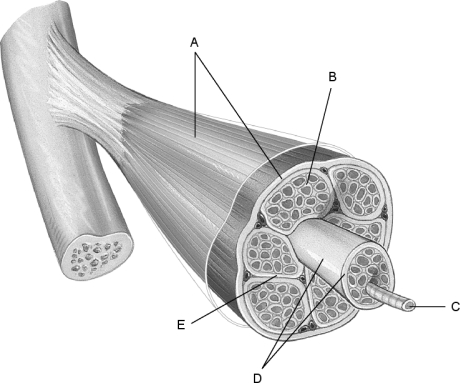 Figure 9.1
Using Figure 9.1, match the following:
-Individual muscle fiber.
Figure 9.1
Using Figure 9.1, match the following:
-Individual muscle fiber. (Short Answer)
4.7/5 (74)
(74) 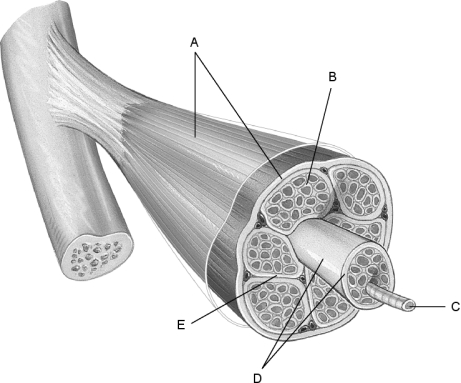 Figure 9.1
Using Figure 9.1, match the following:
-Connective tissue covering the exterior of a muscle organ.
Figure 9.1
Using Figure 9.1, match the following:
-Connective tissue covering the exterior of a muscle organ. (Short Answer)
4.9/5 (76)
(76) A contraction in which the muscle does not shorten but its tension increases is called isometric contraction.
(True/False)
4.8/5 (77)
(77) Which of the following would be recruited later in muscle stimulation when contractile strength increases?
(Multiple Choice)
4.8/5 (91)
(91) The end of the muscle that typically moves when a muscle contracts is called the .
(Short Answer)
4.7/5 (81)
(81) Muscle cells store more creatine phosphate than ATP resulting in the muscle having a reserve source of energy.
(True/False)
4.9/5 (90)
(90) Which of the following is not a connective tissue sheath that wraps individual muscle fibers?
(Multiple Choice)
4.8/5 (72)
(72) Smooth muscles relax when intracellular Ca2+ levels drop but may not cease contractions.
(True/False)
4.8/5 (68)
(68) Figure 9.1
Using Figure 9.1, match the following:
-What is a muscle spasm?
Figure 9.1
Using Figure 9.1, match the following:
-What is a muscle spasm? (Essay)
4.9/5 (53)
(53) Figure 9.1
Using Figure 9.1, match the following:
-Skeletal muscles have two special inclusions that help them perform their function of movement. What are the two special inclusions of skeletal muscle cells and how would they be useful to the cell?
Figure 9.1
Using Figure 9.1, match the following:
-Skeletal muscles have two special inclusions that help them perform their function of movement. What are the two special inclusions of skeletal muscle cells and how would they be useful to the cell? (Essay)
4.8/5 (94)
(94) 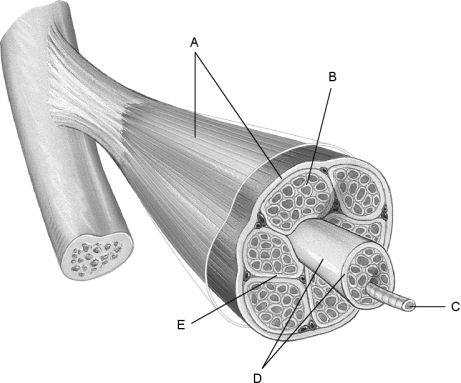 Figure 9.1
Using Figure 9.1, match the following:
-The time in which cross bridges are active is called the period of .
Figure 9.1
Using Figure 9.1, match the following:
-The time in which cross bridges are active is called the period of . (Short Answer)
4.8/5 (71)
(71) 
Filters
- Essay(0)
- Multiple Choice(0)
- Short Answer(0)
- True False(0)
- Matching(0)