



 Chat with AI
Exam 18: The History of Life

Exam 1: An Introduction to Life on Earth91 Questions
Exam 2: Atoms, Molecules, and Life90 Questions
Exam 3: Biological Molecules98 Questions
Exam 4: Cell Structure and Function90 Questions
Exam 5: Cell Membrane Structure and Function96 Questions
Exam 6: Energy Flow in the Life of a Cell90 Questions
Exam 7: Capturing Solar Energy: Photosynthesis102 Questions
Exam 8: Harvesting Energy: Glycolysis and Cellular Respiration97 Questions
Exam 9: Cellular Reproduction133 Questions
Exam 10: Meiosis: the Basis of Sexual Reproduction104 Questions
Exam 11: Patterns of Inheritance98 Questions
Exam 12: DNA: The Molecule of Heredity97 Questions
Exam 13: Gene Expression and Regulation93 Questions
Exam 14: Biotechnology91 Questions
Exam 15: Principles of Evolution97 Questions
Exam 16: How Populations Evolve109 Questions
Exam 17: The Origin of Species89 Questions
Exam 18: The History of Life125 Questions
Exam 19: Systematics: Seeking Order Amid Diversity90 Questions
Exam 20: The Diversity of Prokaryotes and Viruses97 Questions
Exam 21: The Diversity of Protists102 Questions
Exam 22: The Diversity of Plants115 Questions
Exam 23: The Diversity of Fungi107 Questions
Exam 24: Animal Diversity I: Invertebrates101 Questions
Exam 25: Animal Diversity Ii: Vertebrates118 Questions
Exam 26: Animal Behavior116 Questions
Exam 27: Population Growth and Regulation114 Questions
Exam 28: Community Interactions125 Questions
Exam 29: Energy Flow and Nutrient Cycling in Ecosystems122 Questions
Exam 30: Earths Diverse Ecosystems126 Questions
Exam 31: Conserving Earths Biodiversity109 Questions
Exam 32: Homeostasis and the Organization of the Animal Body95 Questions
Exam 33: Circulation89 Questions
Exam 34: Respiration92 Questions
Exam 35: Nutrition and Digestion91 Questions
Exam 36: The Urinary System99 Questions
Exam 37: Defenses Against Disease104 Questions
Exam 38: Chemical Control of the Animal Body: the Endocrine System133 Questions
Exam 39: The Nervous System118 Questions
Exam 40: The Senses94 Questions
Exam 41: Action and Support: the Muscles and Skeleton90 Questions
Exam 42: Animal Reproduction120 Questions
Exam 43: Animal Development122 Questions
Exam 44: Plant Anatomy and Nutrient Transport95 Questions
Exam 45: Plant Reproduction and Development90 Questions
Exam 46: Plant Responses to the Environment87 Questions
Select questions type


If you open a can of chicken noodle soup and immediately examine it microscopically, you will find no microorganisms. If you let the open can sit on the shelf for a few weeks and then examine it, you will find many microorganisms. The origin of these microorganisms is most likely
(Multiple Choice)
4.8/5  (83)
(83) If the Cretaceous mass extinction had not occurred, which group of animals would probably include the largest land animals today?
(Multiple Choice)
4.7/5 (90)
(90) Theories on the atmosphere of early Earth indicate that it lacked
(Multiple Choice)
4.8/5 (83)
(83) Who is credited with proposing that prebiotic chemical conditions could lead to the evolution of complex molecules and, eventually, to living organisms?
(Multiple Choice)
4.9/5 (75)
(75) Which of the following processes involves behaviors that are acquired by learning and can be modified and passed on from one generation to the next?
(Multiple Choice)
4.8/5 (70)
(70) 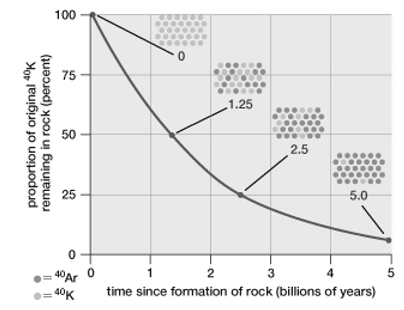 -Based on the graph, if 35% of the original 40K remains in a sample of basalt, what is the approximate age of the rock?
 (Multiple Choice)
4.8/5 (85)
(85) The oldest fossil organisms presently known have been dated at approximately how many years old?
(Multiple Choice)
4.8/5 (71)
(71) Based on current knowledge about the conditions of early Earth, the first organisms were most likely
(Multiple Choice)
4.7/5 (78)
(78) Modern invertebrates first appear in the fossil record during the
(Multiple Choice)
4.7/5 (77)
(77) According the pictured phylogenetic tree, the common ancestor for all Homo species is 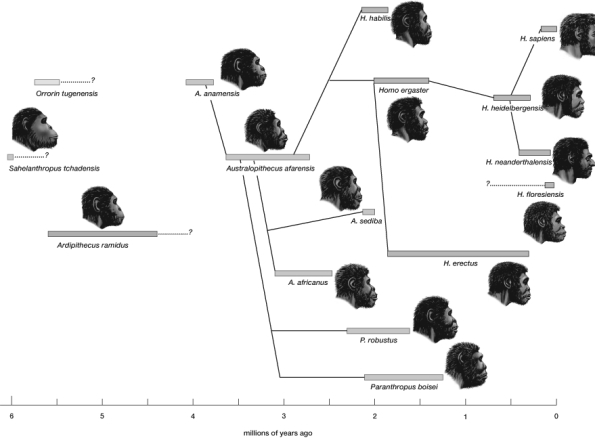
(Multiple Choice)
4.9/5 (77)
(77)
-Based on the graph, if 60% of the original 40K remains in a sample of basalt, what is the approximate age of the rock?
-Based on the graph, if 60% of the original 40K remains in a sample of basalt, what is the approximate age of the rock? (Multiple Choice)
4.9/5 (78)
(78) The fossil record indicates that about 600 million years ago, a wide variety of__________animals had evolved in the oceans.
(Short Answer)
4.8/5 (67)
(67) Which group of vertebrates was the first to evolve a waterproof egg, which allowed the group to move away from water, deeper onto dry land?
(Multiple Choice)
4.9/5 (78)
(78) Probably the greatest advantage for the original multicellular organisms was their ability to
(Multiple Choice)
4.9/5 (77)
(77) Miller and Ureyʹs experiments to simulate prebiotic evolution produced
(Multiple Choice)
4.7/5 (67)
(67) 
Filters
- Essay(0)
- Multiple Choice(0)
- Short Answer(0)
- True False(0)
- Matching(0)