



 Chat with AI
Exam 18: The History of Life

Exam 1: An Introduction to Life on Earth91 Questions
Exam 2: Atoms, Molecules, and Life90 Questions
Exam 3: Biological Molecules98 Questions
Exam 4: Cell Structure and Function90 Questions
Exam 5: Cell Membrane Structure and Function96 Questions
Exam 6: Energy Flow in the Life of a Cell90 Questions
Exam 7: Capturing Solar Energy: Photosynthesis102 Questions
Exam 8: Harvesting Energy: Glycolysis and Cellular Respiration97 Questions
Exam 9: Cellular Reproduction133 Questions
Exam 10: Meiosis: the Basis of Sexual Reproduction104 Questions
Exam 11: Patterns of Inheritance98 Questions
Exam 12: DNA: The Molecule of Heredity97 Questions
Exam 13: Gene Expression and Regulation93 Questions
Exam 14: Biotechnology91 Questions
Exam 15: Principles of Evolution97 Questions
Exam 16: How Populations Evolve109 Questions
Exam 17: The Origin of Species89 Questions
Exam 18: The History of Life125 Questions
Exam 19: Systematics: Seeking Order Amid Diversity90 Questions
Exam 20: The Diversity of Prokaryotes and Viruses97 Questions
Exam 21: The Diversity of Protists102 Questions
Exam 22: The Diversity of Plants115 Questions
Exam 23: The Diversity of Fungi107 Questions
Exam 24: Animal Diversity I: Invertebrates101 Questions
Exam 25: Animal Diversity Ii: Vertebrates118 Questions
Exam 26: Animal Behavior116 Questions
Exam 27: Population Growth and Regulation114 Questions
Exam 28: Community Interactions125 Questions
Exam 29: Energy Flow and Nutrient Cycling in Ecosystems122 Questions
Exam 30: Earths Diverse Ecosystems126 Questions
Exam 31: Conserving Earths Biodiversity109 Questions
Exam 32: Homeostasis and the Organization of the Animal Body95 Questions
Exam 33: Circulation89 Questions
Exam 34: Respiration92 Questions
Exam 35: Nutrition and Digestion91 Questions
Exam 36: The Urinary System99 Questions
Exam 37: Defenses Against Disease104 Questions
Exam 38: Chemical Control of the Animal Body: the Endocrine System133 Questions
Exam 39: The Nervous System118 Questions
Exam 40: The Senses94 Questions
Exam 41: Action and Support: the Muscles and Skeleton90 Questions
Exam 42: Animal Reproduction120 Questions
Exam 43: Animal Development122 Questions
Exam 44: Plant Anatomy and Nutrient Transport95 Questions
Exam 45: Plant Reproduction and Development90 Questions
Exam 46: Plant Responses to the Environment87 Questions
Select questions type


What adaptations did ancient algae have to make as they washed ashore and evolved into land plants?
(Essay)
4.9/5  (83)
(83) 
Pollen eliminated the need for__________ in plant reproduction.
(Short Answer)
4.8/5 (82)
(82) What species of hominin created the cave paintings at Lascaux, France?
(Multiple Choice)
4.9/5 (74)
(74) Water-based photosynthesis converts carbon dioxide and which of the following to energy-containing molecules?
(Multiple Choice)
4.8/5 (91)
(91) Most scientists attribute the mass extinction of the dinosaurs to
(Multiple Choice)
4.8/5 (62)
(62) A major human cultural innovation that happened about 10,000 years ago was the
(Multiple Choice)
4.8/5 (66)
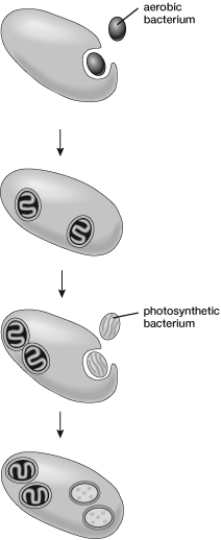
(66) The hypothesis that certain eukaryotic cell structures may have evolved from a prokaryotic cell being engulfed by a eukaryotic cell is called the
(Multiple Choice)
4.9/5 (73)
(73) Multicellularity enables organisms to overcome cellular limits and
(Multiple Choice)
4.8/5 (72)
(72) The hobbit-sized hominin whose fossilized remains were recently discovered on a remote oceanic island belonged to the species
(Multiple Choice)
4.8/5 (76)
(76) The earliest multicellular animals in the fossil record are
(Multiple Choice)
4.8/5 (87)
(87) The first land plants were restricted to moist, marshy environments because of
(Multiple Choice)
4.8/5 (70)
(70) Scientists find several sets of fossil remains in a cave. The skeletons appear have been buried with stone tools and carved jewelry of ivory and bone. The artifacts are dated to 90,000 years old. The skeletons are anatomically similar to modern humans. Based on this information, the skeletons most likely are all
(Multiple Choice)
4.8/5 (65)
(65) The earliest group of land plants whose reproduction did not require water for swimming sperm were the
(Multiple Choice)
4.9/5 (88)
(88) Which is the correct series of events in the evolution of life on Earth?
(Multiple Choice)
4.8/5 (74)
(74) 
Filters
- Essay(0)
- Multiple Choice(0)
- Short Answer(0)
- True False(0)
- Matching(0)