



 Chat with AI
Exam 20: The Milky Waya Normal Spiral Galaxy

Exam 1: Thinking Like an Astronomer 97 Questions
Exam 2: Patterns in the Skymotions of Earth and the Moon101 Questions
Exam 3: Motion of Astronomical Bodies99 Questions
Exam 4: Gravity and Orbits100 Questions
Exam 5: Light100 Questions
Exam 6: The Tools of the Astronomer100 Questions
Exam 7: The Formation of Planetary Systems100 Questions
Exam 8: The Terrestrial Planets and Earths Moon100 Questions
Exam 9: Atmospheres of the Terrestrial Planets100 Questions
Exam 10: Worlds of Gas and Liquidthe Giant Planets100 Questions
Exam 11: Planetary Moons and Rings100 Questions
Exam 12: Dwarf Planets and Small Solar System Bodies100 Questions
Exam 13: Taking the Measure of Stars101 Questions
Exam 14: Our Starthe Sun100 Questions
Exam 15: The Interstellar Medium and Star Formation100 Questions
Exam 16: Evolution of Low-Mass Stars100 Questions
Exam 17: Evolution of High-Mass Stars100 Questions
Exam 18: Relativity and Black Holes97 Questions
Exam 19: Galaxies100 Questions
Exam 20: The Milky Waya Normal Spiral Galaxy100 Questions
Exam 21: The Expanding Universe98 Questions
Exam 22: Cosmology100 Questions
Exam 23: Large-Scale Structure in the Universe103 Questions
Exam 24: Life100 Questions
Select questions type


Imagine you discovered a barred spiral galaxy that was a "Milky Way twin" because of the size of the bulge and disk, the arrangement of the spiral arms, and other characteristics just like those in our galaxy.Then you measured its rotation curve and plotted the data as shown in the figure below.What would you conclude about this galaxy? 
(Multiple Choice)
4.8/5  (69)
(69) What evidence is there for dark matter existing in our galaxy? How does it compare to the dark matter content of other galaxies?
(Essay)
4.9/5 (76)
(76) Describe, for each component of the Milky Way Galaxy labeled in the figure below, the typical heavy-element abundances found in that region, and what causes that region to have those abundances. 
(Essay)
5.0/5 (69)
(69) You find a star orbiting about the center of the galaxy at a distance of 15 kpc.Using the rotation curve in the figure shown below, estimate how much mass is enclosed within the orbit of that star.You can assume the star is on a circular orbit around the center of the Milky Way. 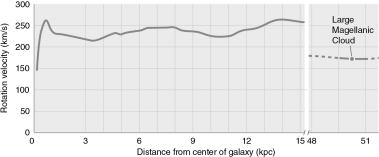
(Essay)
4.8/5 (73)
(73) Describe two pieces of evidence that show that Sagittarius A* is a supermassive black hole.
(Essay)
4.8/5 (84)
(84) If we found a star cluster at the edge of the disk of the Milky Way at a distance of 10 kpc from the center, and it orbited with a velocity of 250 km/s, what would be the total mass enclosed within this radius?
(Multiple Choice)
4.8/5 (79)
(79) Where are the stars with the highest fraction of heavy elements found in the Milky Way?
(Multiple Choice)
4.9/5 (77)
(77) Suppose that scientists in the future are able to observe a star orbiting the central region of the Andromeda Galaxy and find that it has an orbital period of 31 years and a semimajor axis of 4,500 AU.The mass of Andromeda's central black hole must then be around
(Multiple Choice)
4.9/5 (68)
(68) X-ray observations indicate that around the Milky Way there may be an extended halo of
(Multiple Choice)
4.8/5 (92)
(92) Which regions of the Milky Way are the most likely to support star systems with habitable planets? Back up your answer with evidence-based reasoning.
(Essay)
5.0/5 (80)
(80) Sagittarius A*, the radio source located at the center of our galaxy, is thought to be a
(Multiple Choice)
4.8/5 (75)
(75) The most distant globular clusters are found in which part of the galaxy?
(Multiple Choice)
4.9/5 (84)
(84) Open star clusters primarily inhabit which part of spiral galaxies?
(Multiple Choice)
4.9/5 (84)
(84) Given that astronomers cannot see our Milky Way Galaxy's from the outside, how do they measure its rotation curve?
(Essay)
4.9/5 (80)
(80) 
Filters
- Essay(0)
- Multiple Choice(0)
- Short Answer(0)
- True False(0)
- Matching(0)