



 Chat with AI
Exam 20: The Milky Waya Normal Spiral Galaxy

Exam 1: Thinking Like an Astronomer 97 Questions
Exam 2: Patterns in the Skymotions of Earth and the Moon101 Questions
Exam 3: Motion of Astronomical Bodies99 Questions
Exam 4: Gravity and Orbits100 Questions
Exam 5: Light100 Questions
Exam 6: The Tools of the Astronomer100 Questions
Exam 7: The Formation of Planetary Systems100 Questions
Exam 8: The Terrestrial Planets and Earths Moon100 Questions
Exam 9: Atmospheres of the Terrestrial Planets100 Questions
Exam 10: Worlds of Gas and Liquidthe Giant Planets100 Questions
Exam 11: Planetary Moons and Rings100 Questions
Exam 12: Dwarf Planets and Small Solar System Bodies100 Questions
Exam 13: Taking the Measure of Stars101 Questions
Exam 14: Our Starthe Sun100 Questions
Exam 15: The Interstellar Medium and Star Formation100 Questions
Exam 16: Evolution of Low-Mass Stars100 Questions
Exam 17: Evolution of High-Mass Stars100 Questions
Exam 18: Relativity and Black Holes97 Questions
Exam 19: Galaxies100 Questions
Exam 20: The Milky Waya Normal Spiral Galaxy100 Questions
Exam 21: The Expanding Universe98 Questions
Exam 22: Cosmology100 Questions
Exam 23: Large-Scale Structure in the Universe103 Questions
Exam 24: Life100 Questions
Select questions type


If you find a halo star that is 13 billion years old and has the same amount of heavy elements as the Sun, should you be surprised?
(Multiple Choice)
4.8/5  (91)
(91) Compared to the Sun's stellar neighborhood, globular clusters have
(Multiple Choice)
4.9/5 (88)
(88) The location, motion, and heavy-element enrichment of interstellar gas can be strongly affected by what?
(Multiple Choice)
4.8/5 (68)
(68) These three barred spirals are the largest members of the Local Group:
(Multiple Choice)
4.8/5 (83)
(83) Astronomers expect life to be rare (and maybe impossible) in the Milky Way's bulge because
(Multiple Choice)
4.8/5 (84)
(84) Somebody shows you the picture in the figure below and comments that it is the most recent photo of the Milky Way taken with an instrument aboard a spacecraft that has just recently left the boundaries of our home galaxy and is on its way to Andromeda. You would immediately react by saying: "This cannot be the Milky Way because 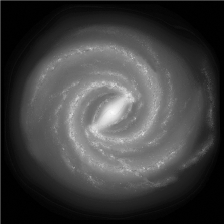
(Multiple Choice)
4.8/5 (91)
(91) Cosmic rays in the Milky Way are important to study because
(Multiple Choice)
4.7/5 (82)
(82) What would be the apparent angular size of a 100 light-year-diameter globular cluster in the Andromeda Galaxy (2.5 x10⁶ light-years away), as measured from Earth?
(Essay)
4.9/5 (81)
(81) Why is 21-cm radiation one of the best ways to map the spiral arms of the Milky Way?
(Multiple Choice)
5.0/5 (81)
(81) If you wanted to study the properties of nearby stars that were some of the first stars to form in the Milky Way, but were not members of a globular cluster, how would you go about finding them? Name and explain two properties that would allow you to distinguish these stars from others.
(Essay)
4.9/5 (92)
(92) If dust is present between Earth and a distant globular cluster, the cluster will appear to be ________ than it is in reality.
(Multiple Choice)
5.0/5 (86)
(86) Name at least two objects that are best studied at radio or infrared wavelengths, and explain why.
(Essay)
4.8/5 (76)
(76) We find that interstellar gas and the youngest disk stars are found in a very narrow distribution along the galactic plane, but the older disk stars can be found in a thicker disk.What might this mean?
(Multiple Choice)
4.8/5 (88)
(88) Why is the Milky Way Galaxy's magnetic field "trapped" in its disk? How does this affect cosmic rays?
(Essay)
4.9/5 (88)
(88) Outline the basic scenario of formation and evolution of the Milky Way, including a description of how the halo and disk formed.
(Essay)
4.7/5 (81)
(81) Globular clusters, when compared with open clusters, generally
(Multiple Choice)
5.0/5 (84)
(84) Our galaxy is ________ many other galaxies because the dark matter in the Milky Way ________.
(Multiple Choice)
4.8/5 (80)
(80) 
Filters
- Essay(0)
- Multiple Choice(0)
- Short Answer(0)
- True False(0)
- Matching(0)