



 Chat with AI
Exam 20: The Milky Waya Normal Spiral Galaxy

Exam 1: Thinking Like an Astronomer 97 Questions
Exam 2: Patterns in the Skymotions of Earth and the Moon101 Questions
Exam 3: Motion of Astronomical Bodies99 Questions
Exam 4: Gravity and Orbits100 Questions
Exam 5: Light100 Questions
Exam 6: The Tools of the Astronomer100 Questions
Exam 7: The Formation of Planetary Systems100 Questions
Exam 8: The Terrestrial Planets and Earths Moon100 Questions
Exam 9: Atmospheres of the Terrestrial Planets100 Questions
Exam 10: Worlds of Gas and Liquidthe Giant Planets100 Questions
Exam 11: Planetary Moons and Rings100 Questions
Exam 12: Dwarf Planets and Small Solar System Bodies100 Questions
Exam 13: Taking the Measure of Stars101 Questions
Exam 14: Our Starthe Sun100 Questions
Exam 15: The Interstellar Medium and Star Formation100 Questions
Exam 16: Evolution of Low-Mass Stars100 Questions
Exam 17: Evolution of High-Mass Stars100 Questions
Exam 18: Relativity and Black Holes97 Questions
Exam 19: Galaxies100 Questions
Exam 20: The Milky Waya Normal Spiral Galaxy100 Questions
Exam 21: The Expanding Universe98 Questions
Exam 22: Cosmology100 Questions
Exam 23: Large-Scale Structure in the Universe103 Questions
Exam 24: Life100 Questions
Select questions type


By comparing globular clusters, you find that Cluster A's RR Lyrae stars are 225 times fainter than Cluster B's RR Lyrae stars.You know that both clusters have approximately the same chemical composition and age, and thus their RR Lyrae stars should have the same luminosities.Which cluster has the larger distance, and what is the ratio of the clusters' distances?
(Essay)
4.9/5  (74)
(74) If you want to look for old stars with low amounts of heavy elements, the best place to look out of the following locations is
(Multiple Choice)
4.7/5 (86)
(86) How would we explain why are there are no known disk stars with exceptionally low abundances of massive elements?
(Essay)
4.9/5 (78)
(78) The "normal" mass of the Milky Way (stars and interstellar medium together) is estimated at 100 billion-200 billion solar masses.The total mass of the galaxy measured by its rotation curve, however, is estimated in the interval of 1 trillion-1.5 trillion solar masses.How do we explain this discrepancy? What fraction of the Milky Way's mass is "normal"?
(Essay)
4.8/5 (78)
(78) Explain why within the galactic disk we can find older stars that have higher abundances of massive elements than younger stars at larger radii from the center.
(Essay)
4.8/5 (84)
(84) Andromeda and the Milky Way are approaching at a measured relative speed of 110 km/s.If Andromeda is currently separated from the Milky Way by about 770 kpc, provide a simple estimate for how far in the cosmic future the two galaxies will collide.Why is this estimate "simple," and not correct?
(Essay)
4.9/5 (85)
(85) In which part of the Milky Way would you find little or no neutral hydrogen, no current star formation, and stars that are all older than 10 billion years?
(Multiple Choice)
4.7/5 (85)
(85) The Large Magellanic Cloud is about 50 kpc from the center of the Milky Way and moves around it at about 170 km/s, as shown in the figure below.What is the inferred mass of the galaxy enclosed within this radial extent? 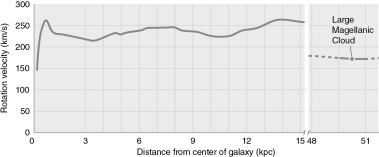
(Multiple Choice)
4.7/5 (77)
(77) Why is it that, when astronomers look in the direction of the Sun's motion around the galaxy, that we see many stars that are blueshifted?
(Essay)
4.9/5 (88)
(88) The motion and chemical composition of stars in the outer halo may suggest that
(Multiple Choice)
5.0/5 (78)
(78) What is expected to happen to our Solar System when the Andromeda and Milky Way galaxies collide?
(Multiple Choice)
4.9/5 (66)
(66) The gamma-ray bubbles at the poles of our galaxy are evidence that the nucleus of the Milky Way was once a(n)
(Multiple Choice)
4.9/5 (82)
(82) Magnetic fields in the Milky Way are concentrated in the disk because
(Multiple Choice)
4.8/5 (77)
(77) Any single star in the Milky Way Galaxy has the same elemental abundances as
(Multiple Choice)
4.7/5 (76)
(76) In the figure below, we expect the absorption lines in the indicated star's spectrum to be 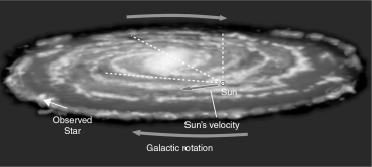
(Multiple Choice)
4.9/5 (77)
(77) What observed property of the Milky Way suggests that it must contain a large amount of matter not in the form of stars, gas, or dust?
(Multiple Choice)
4.8/5 (68)
(68) In a star that has heavy-element abundance similar to the Sun's, what percentage of the star's mass is made up of elements heavier than hydrogen and helium?
(Multiple Choice)
4.8/5 (67)
(67) What type of standard candles did Shapley use to determine distances to globular clusters?
(Multiple Choice)
4.9/5 (81)
(81) Halo stars near the Sun are distinguished from disk stars by what characteristics?
(Multiple Choice)
5.0/5 (91)
(91) 
Filters
- Essay(0)
- Multiple Choice(0)
- Short Answer(0)
- True False(0)
- Matching(0)